
South Korea Travel Guide: Cities, Food & Things to Do
South Korea: What Actually Happens When You Go Beyond the Instagram Frame
You're standing in Myeongdong at 11 PM on a Tuesday, and the street is still heaving. A woman in a face mask leans over a cosmetics counter, testing foundations under clinical lighting while her friend films her for TikTok. Nearby, teenagers in oversized hoodies orbit a boba tea shop, their shopping bags stacked like small monuments. The neon signs flicker in Korean and English. It's disorienting and electric and utterly authentic—not despite the commercialism, but because of it.
This is South Korea, and it's nothing like the carefully curated travel content suggests.
The Real Weight of a Destination
South Korea occupies this strange space in global travel consciousness where it's simultaneously hyper-visible and wildly misunderstood. K-pop, Korean dramas, skincare routines—these are the entry points. But they're just doorways. What actually anchors the country is something more durable: a culture that has managed to modernize at breakneck speed while maintaining distinct rituals, hierarchies, and ways of moving through the world that haven't entirely vanished into globalization's blender.
You notice this when you're waiting for a subway train and everyone stands in ordered lines. You see it when a restaurant owner refuses your offer to pay extra for an addition because the meal comes with what it comes with. You feel it when someone spends 20 minutes helping you navigate directions, even though they don't speak English beyond greetings.
South Korea works like a well-maintained machine, but it's operated by humans who still have grandmothers, traditions, and opinions about how things should be done.
What Actually Makes This Place Memorable
Seoul's spatial contradiction
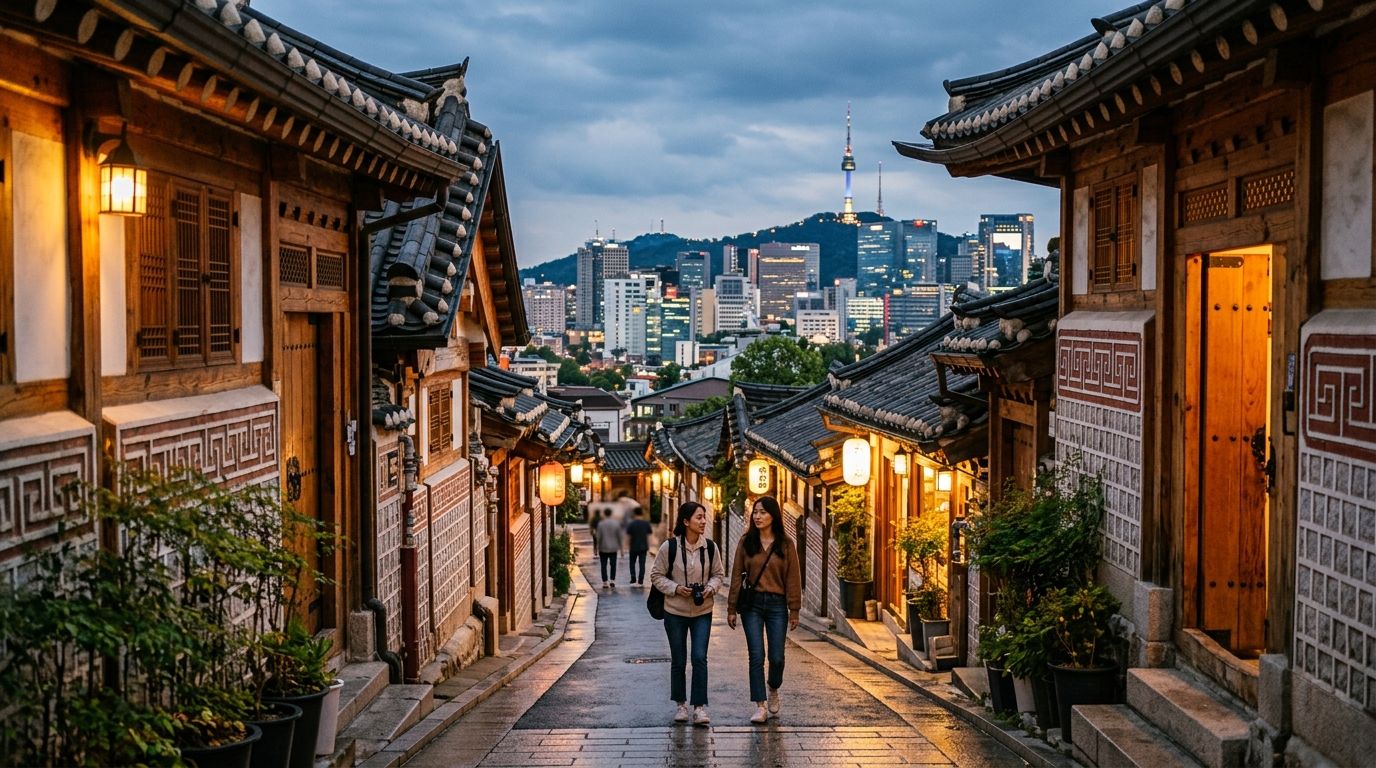
The capital city sits on itself like a palimpsest. Walk out of a subway station in Gangnam and you're in a hyper-contemporary landscape of glass towers and coffee shops designed by architects whose names you recognize. Walk ten minutes north and you're in a residential neighborhood where laundry dries on narrow balconies and neighborhood restaurants have been operating since before you were born. The city doesn't hide this contradiction—it expands across it without apology.
The temple experience (but not the postcard version)
If you visit Bulguksa Temple in Gyeongju, you'll encounter the monks' actual schedule, not a performance for tourists. You might see them sweeping the grounds at dawn before most visitors arrive. You might attend a chanting ceremony where you're the only foreigner and nobody's performing for a camera. There's something about seeing living religion in operation—rather than as a backdrop—that clarifies why people travel in the first place.
The food isn't exotic; it's just better
Every meal you eat will contain more fermented elements, more side dishes, more intentionality than you've experienced. Banchan (side dishes) appear beside everything, and they're not decoration—they're part of the meal's logic. Street food isn't a novelty; it's how people feed themselves between scheduled meals. Tteokbokki (spicy rice cakes), hotteok (stuffed pancakes), samgyeopsal (grilled meat)—these aren't Instagram moments, they're the rhythm of daily eating.
The night culture is genuinely different
South Korea's nightlife isn't about getting drunk in a Western sense; it's about the architectural possibility of the night. Noraebang (private karaoke), pojangmacha (street tent restaurants), 24-hour cafés, late-night bookstores—the city simply doesn't close the way Western cities do. You can eat at 2 AM. You can get your hair done at midnight. You can sit in a café at 3 in the morning and watch people work. This isn't hedonism; it's a different relationship with time.
What to Expect: The Ground-Level Experience
Seoul: The city proper
You'll spend 3-4 days here if you're visiting for a week. You'll take the subway more than you've taken any transit system, and it'll work perfectly. Neighborhood matters: Hongdae is art students and independent shops. Gangnam is where the money goes. Myeongdong is where tourists and teenagers concentrate. Jongno is older, with university students and quieter corners. Insadong mixes tourists and local galleries. Itaewon is the foreign district (which is useful and limiting simultaneously).
The logical error most visitors make is trying to see 15 things. Seoul rewards patience and repetition. Spend time in one neighborhood. Return to the same café. Eat at the same restaurant three times and they'll remember your order. The city opens up through familiarity, not coverage.
Outside Seoul: The cultural infrastructure
Gyeongju (2 hours south by train) contains the country's Buddhist heritage in concentrated form. You'll see Bulguksa Temple, the Seokguram Grotto, and multiple museum collections that explain how sophisticated Korean culture was when Europe was still working things out.
Busan (3-4 hours south) is the port city—grittier than Seoul, less polished, with genuine neighborhoods where locals actually live. The beaches are real (not Instagram-perfect, but real). The seafood is fresher than anywhere you'll eat it.
Jeju Island (flights from Seoul, 1 hour) is the volcanic island that functions as Korea's beach destination, though the beaches themselves are darker, rockier, and less Caribbean than the tourism board suggests. Go for the hiking (Hallasan mountain), the black sand, and the genuine strangeness of island life.
Practical motion
The Korea Train eXpress (KTX) connects major cities and runs on time with the predictability of a German watch. Buses are cheaper and slower. Flying domestically costs almost the same as the train and takes twice the time with all the security overhead. You'll move through the country efficiently but not adventurously.
Planning Your Visit: Timing and Logistics
Season matters more than people admit
Spring (April-May) is genuinely pleasant: cherry blossoms, moderate temperatures, not yet crowded. Fall (September-October) is nearly identical in quality but more stable weather-wise. Summer is humid and occasionally oppressive. Winter is cold and dry—beautiful for photography but requiring appropriate clothing.
Duration expectation
A proper South Korea visit requires 10 days minimum. Five days is a Seoul-only sprint. Seven days lets you see Seoul plus one region. Ten days allows Seoul, a southern excursion, and breathing room. Two weeks makes the trip feel less like a checklist.
Visa and entry
Most Western nationals get 90 days visa-free. The entry process is smooth. The Korean government has streamlined tourist infrastructure for efficiency, not warmth.
Transportation card
Buy a Railplus card (basically a transit card that works everywhere) within your first hour. It works on subways, buses, taxis, and some shops. No fumbling with cash or tickets.
Language reality
English exists in major cities but not reliably. Younger people often speak it; older people often don't. Translation apps help but aren't perfect. Pointing and a smile still work. Consider this a feature, not a bug—it makes the place less aggressively familiar.
Nearby Contexts Worth Considering
Nami Island (90 minutes from Seoul): A scenic island that's become somewhat tourist-dense, but the tree-lined paths are legitimately atmospheric. Good for a day trip if you have that time, forgettable if you don't.
Suwon Hwaseong Fortress (1 hour south): A reconstructed Joseon Dynasty fortress that's beautiful for walking and marginally less visited than Seoul's palaces. Less dramatic than Gyeongju but more accessible.
Seoul's Demilitarized Zone (DMZ): A valid side trip if you're interested in Korean history, though it's heavily controlled and somewhat sterile. You'll see the border and understand Korea's division on a visceral level, which matters.
Is It Worth Visiting? The Honest Assessment
Yes, but not because of the mythology. South Korea doesn't need the mythology.
It's worth visiting because you'll see a country that refused to stay poor or peripheral and instead became excellent at being itself. You'll eat better food than you expected. You'll ride trains that work perfectly. You'll see people living their actual lives at 2 AM. You'll encounter temples and palaces that remind you how long human culture has been complex and sophisticated.
It's also worth visiting because it won't transform your life. You'll come back and integrate it into your understanding of how diverse and functional human cities can be. You'll stop seeing Asia as a monolith. You'll understand why millions of people care deeply about Korean culture without needing to be converted into a fanatic.
The genuine value of travel is becoming slightly less ignorant than you were. South Korea is an efficient vehicle for that specific goal.
Quick Facts
- Official language: Korean
- Currency: South Korean Won (KRW); approximately 1,300 won per USD
- Best for: Urban exploration, food, temple culture, efficient transit, late-night energy
- Challenging for: Non-K-pop fans seeking "authenticity," people who need quiet
- Typical daily budget: $40-60 (hostels/cheap food) to $200+ (mid-range comfort)
- Major cities: Seoul (population 10M+), Busan, Incheon, Daegu
- Getting around: Subway (Seoul), KTX trains, buses, occasional flights
- Mobile data: Easily rented at airport; works everywhere
- Food allergies: Learn how to communicate them; some restaurants are cautious about foreign dietary needs
Final Note: Explore with Intelligence
South Korea deserves to be experienced as what it actually is: a densely complex modern nation with deep cultural roots, not as a backdrop for other people's aesthetic choices. Take time with the city. Eat the same meals twice. Skip the overhyped attractions if they don't interest you. Talk to people when you can. Read something about Korean history before you go—it'll make the palaces and temples and divisions make sense.
To discover routes that work for your interests, explore Touratu's interactive map, which shows how different neighborhoods and regions connect logistically. Watch travel videos of actual neighborhoods to understand what different areas feel like before you arrive. Book activities that align with what you actually want to do—not what everyone says you should do. That's the difference between travel and tourism.
South Korea is waiting. It'll function perfectly whether you fall in love with it or not.
Loading activities…
