
Singapore: 20 Places Travelers Return to Again
Singapore: Why Travelers Keep Coming Back to These 20 Places
Singapore arrives like an exhale—the kind of city that doesn't need to shout to be heard. You step out of Changi Airport and feel it immediately: the precision of its streets, the humidity wrapping around you like a familiar embrace, the sense that something matters deeply about order and beauty here. It's a place where skyscrapers cast shadows on centuries-old temples, where hawker stalls serve meals that taste like the neighborhood's entire history, and where you find yourself returning not because you've checked boxes, but because something in the city's rhythm has lodged itself in your memory.
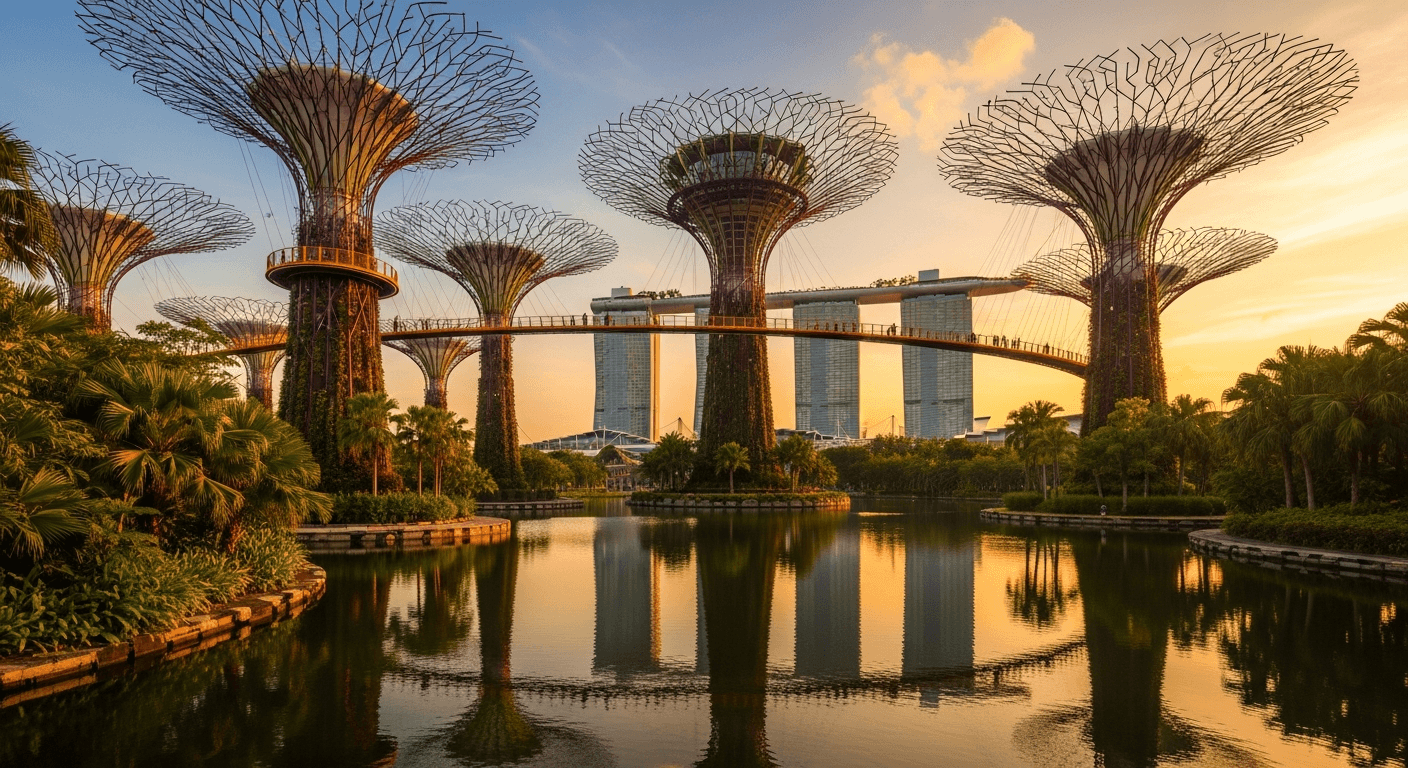
For decades, travelers have circled back to Singapore, often without being able to explain exactly why. It's not a city of singular stunning landmarks. Rather, it's a place of accumulation—small grace notes that build into something profound. An unexpected garden hanging from a building. A conversation with a shopkeeper in Chinatown who tells you their family has been there for ninety years. The way the light falls in a particular hawker center at 6 p.m. These are the moments that make people book return flights.
1. Marina Bay Sands: The Observation Deck at Golden Hour
Most visitors photograph this hotel from the outside. Arrive at the observation deck just before sunset—not at the peak of day—and you're standing in a completely different Singapore. The light turns the entire city bronze and amber. You can see the island's complexity from this height: the colonial district's preserved buildings, the container ships waiting offshore, the forest of residential towers that actually house real people with real lives.
The specificity of this view matters. There's no grand monument here, just the accumulated evidence of human ambition and planning. Stand facing east, toward the Straits, and watch how the light touches the water.
Best time: 5:15–5:45 p.m. during the dry season (June–August). Insider observation: The deck is least crowded on weekday late afternoons. Most tourists arrive mid-morning. Photography moment: Capture the reflection of the sun against the glass of distant buildings, rather than the sunset itself. Practical tip: Arrive with about thirty minutes before sunset to secure a position by the windows. Book online for a slight discount and guaranteed entry.
2. Thian Hock Keng: Morning Incense and Continuity
This temple has been holding the same space in Chinatown since 1839. When you visit early—around 7 a.m., when the morning prayers are happening—you're not a tourist observing architecture. You're witnessing something that has repeated itself thousands of times in this exact spot. The air hangs thick with incense. Devotees move through familiar rituals. A grandmother sorts offerings into small piles.
The temple itself is intricate without being ornate—a careful balance of symbolism and restraint. The central hall's proportions feel right, though you couldn't explain why without architectural training. What stays with you is the continuity. This temple, like Singapore itself, has negotiated countless transformations while remaining essentially itself.
Best time: Early morning, 7–8 a.m., any day except Lunar New Year (when it's overwhelmingly crowded). Insider observation: The temple's surrounding neighborhood is where you discover the real Chinatown—not the touristy main street, but the small grocers and family restaurants tucked into side streets. Photography moment: The interplay of natural light through the roof openings hitting the altar's golden surfaces. Practical tip: Remove shoes before entering the inner sanctum. Dress respectfully. The entrance is quiet; respect that silence.
3. Bukit Timah Nature Reserve: The Hike Nobody Expects to Find
Singapore feels like a city that has eliminated nature entirely, which makes Bukit Timah a shock—in the most profound way. This reserve covers only 164 hectares, but it contains primary rainforest that's existed here for centuries. You hike for 45 minutes through genuine jungle, surrounded by cicadas, unseen birds, moisture-laden air. At the summit (only 163 meters high, but don't let that fool you), you're above the city, looking down at its towers through the canopy.
The hike itself is unremarkable in terms of difficulty. What's remarkable is the psychological shift—leaving ordered streets and stepping into something wild, then leaving the wilderness and stepping back into precision. This duality is Singapore's essential tension.
Best time: Early morning, 7–8 a.m., any day except during heavy rain. Insider observation: Most visitors never discover this place. The main hiking circuit is quiet even on weekends. Photography moment: Shafts of light breaking through the dense canopy during early morning hours. Practical tip: Wear proper hiking shoes (roots are slippery when damp) and bring insect repellent. The trail is well-marked but can be muddy.
4. Joo Chiat Road: Where Nostalgia Still Pays Rent
This street in the Katong neighborhood preserves something Singapore is rapidly losing: the vernacular architecture and lifestyle of an older era. The shophouses here still have lived-in ground floors—real businesses, not curated heritage experiences. You'll find a tailor who's been on this street for forty years, a small grocer selling dried goods, a restaurant family has owned since 1967. The buildings have maintained their peranakan details—the intricate tile work, the covered walkways, the proportions that feel generous compared to modern construction.
Walk here slowly. It's not Instagram-optimal, which is precisely why it matters. This is a street where the texture of time shows.
Best time: Late afternoon, 4–6 p.m., when the light softens and neighborhood residents are out. Insider observation: The side streets branching off Joo Chiat contain even quieter examples of this architecture, less touristed. Photography moment: The colored tiles and ornamental details of the shophouse facades, especially with diffuse afternoon light. Practical tip: Support the small businesses here—get a coffee at one of the local cafés rather than assuming you need a chain. The relationships between shop owners and neighbors matter; tourism that respects that feels different.
5. Singapore Botanic Gardens: Botanical Precision as Philosophy
This garden operates on two levels simultaneously. Functionally, it's a masterpiece of horticultural planning: every plant positioned, labeled, maintained with the kind of attention Singapore brings to everything. Aesthetically, it's one of Asia's most intelligent gardens—it doesn't try to be "natural," but rather to honor the relationship between humans and plants through careful curation.
The Japanese Garden feels like a philosophical statement rather than decoration. The National Orchid Garden contains 1,000 species of orchids without ever becoming overwhelming. There's a kind of wisdom in this restraint.
Best time: 8–10 a.m. on weekday mornings for quietness; mid-afternoon for the best light on the Japanese Garden. Insider observation: Most visitors stick to the main attractions. The back sections of the gardens toward Tyersall Park are nearly empty. Photography moment: Reflections in the water features, especially the Swan Lake during golden hour. Practical tip: Pick up the garden map and wander thematically (by region, by plant family) rather than trying to see everything. It changes your relationship to the space.
6. Orchard Road: The Paradox of Modern Consumption
Orchard Road demands a different kind of attention. It's aggressively commercial, towering with shopping malls, crowded with people pursuing transactions. But if you can see past the surface commerce, you'll notice something interesting: the careful thinking about public space, the quality of the architecture in many of the newer buildings, the way different generations of mall design stack visibly against one another. It's a document of three decades of urban retail development.
Walk it not as a shopper but as an observer of human behavior and commercial design. The cafés and restaurants scattered throughout reveal how different communities in Singapore spend their leisure time.
Best time: Weekday late afternoon, 4–6 p.m., to avoid crowds and see the light on the buildings. Insider observation: The side streets off Orchard (like Emerald Hill) contain charming older structures and quieter spaces. Photography moment: The architectural interplay of the different malls' facades, especially during dusk when the neon begins activating. Practical tip: Don't set out to shop here with a list. Wander instead. The smaller boutiques and local designers tucked into various malls tell stories that the flagship stores don't.
7. Kampong Glam: The Texture of a Historic Neighborhood
This quarter—centered around the Sultan Mosque with its distinctive golden dome—operates as a village within the city. The narrow streets are lined with galleries, vintage shops, small eateries, and homes that still function as homes (though increasingly precarious). The architecture is specifically Malay-Muslim: shophouses with particular proportions, the mosque as genuine community center rather than tourist site, the integration of lived space and commerce.
The neighborhood feels less gentrified than Chinatown, which means it retains genuine texture. You can still smell actual cooking from people's homes mixing with the smell from shops. You can hear conversations in Malay, Arabic, English, Mandarin.
Best time: Late afternoon into early evening, when the neighborhood is most alive with people going about their day. Insider observation: The small shophouses selling Arabic poetry, Islamic textbooks, and Middle Eastern ingredients are where you get a sense of the neighborhood's actual community. Photography moment: The Sultan Mosque's golden dome against blue sky during late afternoon, or the street-level details of tile work and wooden architecture. Practical tip: The main street (Arab Street) is the most touristy. Venture into the side lanes (like Bussorah Street and the alleys beyond) for genuine neighborhood feeling. Respect prayer times at the mosque.
8. Hawker Centers: The Institutional Memory of Singapore
Pick any hawker center—Maxwell, Lau Pa Sat, Tiong Bahru Market—and you're at the intersection of Singapore's actual life. These aren't quaint markets designed for tourism. They're where office workers, construction crews, retirees, and families eat breakfast, lunch, and dinner. Every stall represents someone's specialized knowledge accumulated over decades. The uncle making laksa at 6 a.m. has been making the same dish for forty years. The auntie selling popiah learned the recipe from her mother.
The real instruction is to sit, watch, and eat. Watch how people order (often without words—gestures, familiar names, nods). Notice the efficiency of the system. Understand that what looks like casual eating is actually a highly organized ecosystem.
Best time: Any meal time, but breakfast (6–8 a.m.) or lunch (11:30 a.m.–1 p.m.) shows the center at its most authentic. Insider observation: Ask locals which center they prefer and why. The answer tells you something about the neighborhood and about Singapore's tribal geographies. Photography moment: The early morning light on wet market floors, the organized chaos of a lunch rush, the reflections in worn aluminum trays. Practical tip: Carry cash and coins. Learn the system: you order and sit, the food comes to your table. You pay when you leave. Don't photograph people without asking first.
9. National Museum of Singapore: Architecture as Argument
The building itself matters—that generous colonnade, the rational proportions, the way the spaces feel generous without being wasteful. The museum's recent expansion and redesign have made it a place that argues for the importance of thoughtfulness in public space.
The collections move beyond artifacts into the question of how a multicultural society remembers itself. The Timestamp galleries, in particular, present history not as a single narrative but as overlapping stories. It's not definitive; it's honest about the complexity of shared memory.
Best time: Weekday mid-morning, 10–11 a.m., for relative quiet and good light. Insider observation: The external courtyards and reading rooms are often more interesting than the exhibitions—they're designed to invite contemplation. Photography moment: The colonnaded entrance at angle-light, the interior spatial sequences. Practical tip: Allow at least two hours. Read rather than skim. Take notes if something resonates—it helps memory.
10. Sri Mariamman Temple: Devotion Without Distance
This temple, the oldest Hindu temple in Singapore (established 1827), uses color with a kind of exuberance that announces something about faith and community. The gopuram entrance is ornate without being excessive, intricate without becoming incomprehensible. Inside, there's a living quality—people light lamps, make offerings, pray in small groups. This is functioning religion, not cultural heritage presentation.
The surrounding area (South Bridge Road, the surrounding shops and streets) contains the layers of one of Singapore's oldest communities. The temple remains its center.
Best time: Early morning or late afternoon, outside of worship peak times. Weekday evenings are quieter than weekends. Insider observation: The small shrine spaces and personal altars throughout tell you more than the main hall about how the community practices faith. Photography moment: The color gradations of the gopuram at angle light, the play of light through open temple spaces. Practical tip: Remove shoes before entering. If there's a ceremony or celebration happening, ask permission before photographing. The temple's schedule varies by Hindu festival calendar.
11. East Coast Park: The Ordinary Made Beautiful
This isn't a nature park in any pristine sense. It's a heavily engineered recreational space—a 15-kilometer stretch of beach, volleyball courts, lagoons, bicycle paths, eateries. Yet precisely because it's completely planned, you notice the design intelligence at work. The vegetation is chosen carefully. The pathways flow logically. The relationship between human activity spaces and quieter vegetated areas follows principles of good design.
Come here to see how Singapore thinks about public leisure. Watch how different communities use the same space, at different times, for different purposes, with remarkable efficiency.
Best time: Early morning for cycling or walking (6–8 a.m.), late afternoon for the social energy (4–6 p.m.). Insider observation: The smaller beaches and quieter sections toward the eastern end are less crowded than the main areas near the city. Photography moment: The curves of the cycling paths seen from above (Google Earth perspective), or the play of light on water in early morning. Practical tip: Rent a bicycle and move slowly along the entire length rather than parking in one spot. Bring water—the sun reflects intensely off the water.
12. Kallang River: The Infrastructure of Memory
This river marks Singapore's transformation more clearly than any single monument. Follow it from the city through various neighborhoods and you're seeing layers: heritage areas, industrialized zones, residential developments, redeveloped waterfront. The river itself has been engineered, channeled, cleaned, and reimagined multiple times.
Walking along its banks tells you something about how cities evolve while remaining themselves. The infrastructure is visible and honest—no attempts to hide what keeps the city functioning.
Best time: Late afternoon, when light angles across the water and neighborhoods are quieter. Insider observation: The small temples, shrines, and community spaces tucked along the river's edges reveal what communities value. Photography moment: The patterns of water, light, and urban geometry—especially where old and new development interface. Practical tip: Follow the riverside walks and cycling paths. Stop wherever something catches your attention rather than maintaining an itinerary.
Local Knowledge Worth Keeping
Transportation and Neighborhood Logic: Singapore's MRT system is so efficient that it almost becomes invisible—you stop thinking about how to move and just move. But understanding neighborhoods through their MRT stations helps. Each station area contains distinct character: Holland Village around Holland Station has a different feeling from Tiong Bahru Station's neighborhood, which differs entirely from Serangoon Station's Tamil community center. Travel between neighborhoods rather than staying within one, and use the MRT as your primary navigation.
Timing and Rhythm: The city operates in distinct phases. Early mornings (6–8 a.m.) show you working Singapore—hawker centers packed with people, quiet temples with devotees, streets being cleaned and prepared. Mid-day (11 a.m.–2 p.m.) is often when you should be indoors or under shelter—the sun is fierce. Late afternoon (4–6 p.m.) brings a social activation—people leave work, neighborhoods fill with the day's second shift of activity. Evenings (after 8 p.m.) the city reorganizes again into dinner crowds, night markets, and late-night workers.
Etiquette and Presence: Singapore values courtesy expressed through restraint. This means: don't photograph people without permission (ask genuinely, not rhetorically). Keep your voice moderate in public spaces. Don't eat or drink on the MRT. Respect temple and mosque spaces by dressing modestly and moving slowly. When you visit temples, contribute modestly to the donation boxes—you're a guest in someone's sacred space, not an attraction customer.
Discovering Your Own Path
The real practice in Singapore comes from using Touratu's interactive map to trace the routes other travelers have taken, then deliberately deviating from them. See where others have photographed, then visit those locations at different times. Discover the reels and visual histories people have left behind—not to replicate them, but to understand what drew their attention and why. Then walk the same streets and find what you notice instead.
Why People Keep Coming Back
Singapore doesn't ask you to believe in romance or grandeur. It doesn't trade in monuments or legends. Instead, it presents something quieter: the possibility of precision and care creating spaces where human life can unfold with a certain grace. A hawker uncle making the same dish exactly right for forty years. A temple maintaining its rituals through decades of radical change. A park designed so thoughtfully that you feel considered. A street that preserves its history not as museum but as living practice.
These details accumulate. They reshape how you think about cities and about what matters. That's why travelers keep returning—not to check off final destinations, but because each return reveals something new about what was always there.
Loading activities…
