
Philippines Travel Guide: Islands, Routes & Activities
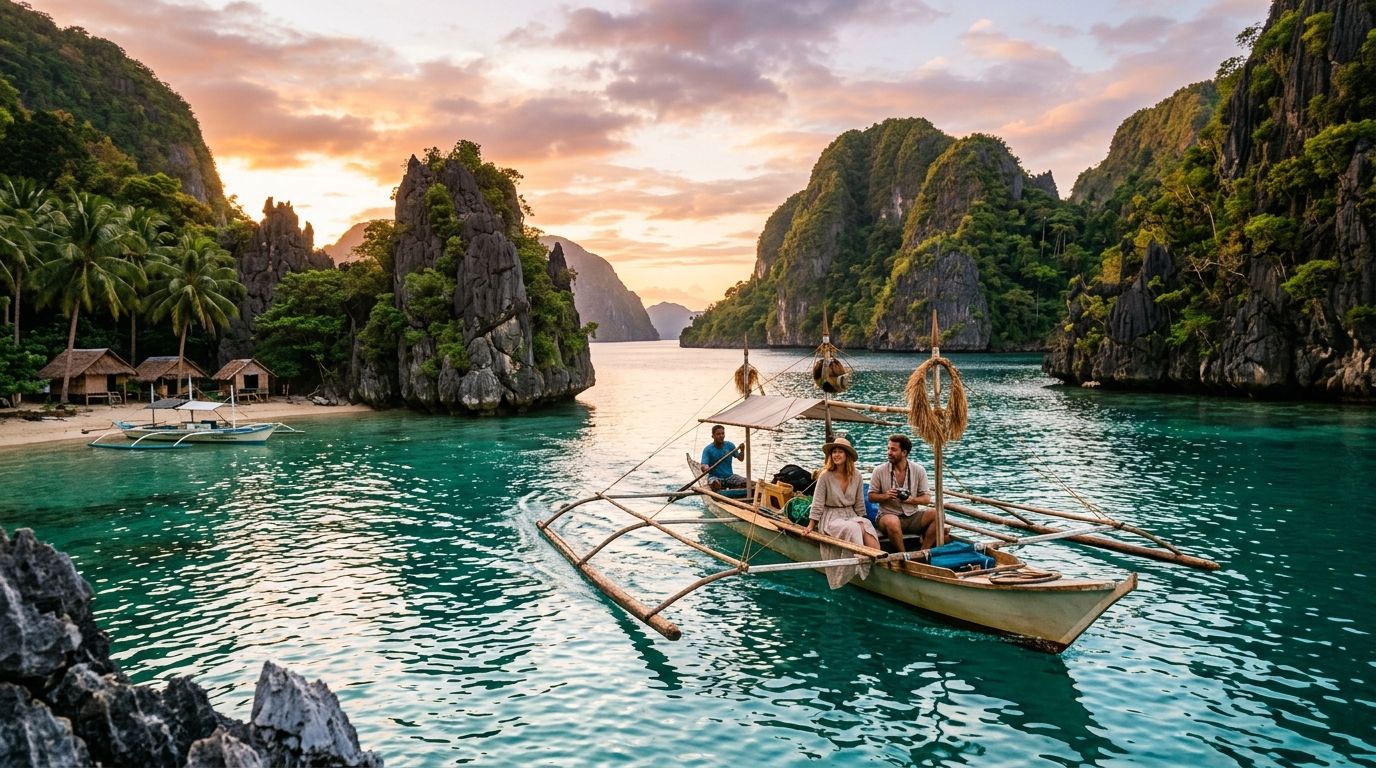
The Philippines: A Country That Doesn't Perform For You
There's a moment that happens on most people's first day in the Philippines where they stop taking photos and just sit with a beer, watching the light change across whatever body of water they've found themselves near. It's not dramatic. The revelation isn't wrapped in superlatives. It's quieter than that—a realization that the place works because it doesn't try so hard to impress you.
The Philippines is easy to misjudge. You see the postcards: those limestone cliffs rising vertically from turquoise water, the white sand beaches that have become the visual shorthand for "tropical escape." And yes, those things exist. But if that's all you expect, you'll miss why people actually stay longer than planned. Why they come back. Why the travellers who know the country best never seem to run out of stories.
This is a country that rewards curiosity more than it rewards a checklist.
What Actually Makes This Place Different
The Philippines occupies a strange middle ground in Asian travel. It's tropical enough to feel genuinely far from home, but English-speaking enough that you won't struggle to navigate basic logistics. It's touristy enough to have decent infrastructure, but distributed enough across 7,641 islands that you can still find genuine emptiness. That combination is rarer than you'd think.
What sets it apart isn't one thing. It's the texture of daily life running alongside the tourist experience without being consumed by it. You'll sit in a jeepney—those converted American military vehicles that serve as public transit—pressed against locals heading to market, reggaeton playing from tinny speakers, the smell of fried fish and diesel fuel. Twenty minutes later, you're at a resort pool. The disconnect is jarring. That's the point.
The country also moves at its own pace. Things take longer than you expect. Boats leave when they're full, not on schedule. Restaurants run out of dishes even at 6 PM. WiFi disappears without explanation. Most travellers see this as friction. The ones who return see it as permission to stop pretending the pace you keep at home matters here.
What to Expect: The Actual Experience
The Water
Let's start with the obvious because it genuinely warrants discussion. The Philippines has water in every configuration: coral reefs within 50 metres of shore, limestone caves you can kayak into, underground rivers, waterfalls that drop directly onto rock beaches, hot springs. The water is warm year-round (26-28°C), which sounds pleasant until you realize it means 12+ hours of straight sunshine feels hotter, and pruning happens faster than you'd think.
Diving and snorkeling here aren't Instagram moments pretending to be experiences. There's actual marine life: schools of barracuda moving like liquid silver, turtles that genuinely don't care about your presence, coral formations that haven't been beaten to death by thousands of daily boat tours. Even mediocre snorkeling days are solid.
The Islands
The obvious anchors are Palawan (the limestone drama everyone knows) and Boracay (which is what happens when you let a beach become an island of bars). Both are worth visiting. Both are also crowded in ways that don't feel accidental.
What actually moves people is the secondary circuit: Siargao for the emptier beaches and decent waves, Camiguin for the volcanic topography and genuine quiet, Mindanao's islands for the moment when tourist infrastructure disappears entirely and you're navigating purely by word-of-mouth and local generosity. Visiting these places means accepting slower boats, fewer dining options, and the low-level tension of not knowing exactly what you're walking into.
The Culture
The Philippines has a chaotic religious identity—Spanish Catholic influences mixed with indigenous animism, Chinese heritage, Islamic traditions, American pragmatism. This creates something genuinely unusual: a country that's remarkably tolerant, genuinely warm, and occasionally contradictory. You'll see Christmas decorations in September, Catholic churches adjacent to Muslim areas, family units that operate by logic you won't immediately understand.
Filipinos have a directness that catches a lot of travellers off-guard. They'll tell you the restaurant across the street is better. They'll ask how much money you make. They'll invite you to a birthday party and assume you're coming. It's not rude—it's just the social operating system. Most travellers adjust within days.
The Food
Filipino food has a bad reputation, mostly because it arrived in Western consciousness through second-generation immigrant cooking. The actual food is straightforward and good: grilled fish with salted lime, rice cooked in coconut milk, slow-cooked meat in vinegar, fresh fruit you've never seen before. You won't mistake it for fine dining, but you also won't find yourself craving different fuel. There's excellent seafood in coastal areas, the coffee is genuinely drinkable, and fresh juice costs roughly $1.
The Noise
One warning: the Philippines is loud. Karaoke is a national pastime, not a tourist trap. Jeepneys honk constantly. Construction happens at random hours. If you're someone who requires silence, this will test you.
Planning Your Visit
Best Time
Dry season runs November to May. This means less rain, calmer seas, better visibility for diving, and consequently more tourists. It's the obvious choice, and the islands feel proportionally crowded.
Wet season (June to October) brings afternoon rain, choppier water, and reduced visibility. But it also brings fewer people, lower prices, and an occasional romance to sudden storms. The rain doesn't last all day—usually just a couple of hours. It's genuinely worth considering if you value emptiness and can adapt to uncertainty.
How Long
Minimum sensible time is 10 days. That lets you explore one regional circuit without it being pure transit. Two weeks is more comfortable—you can shift between two island groups, absorb the pace, and actually feel like you're visiting rather than speedrunning. Most people come for 12-16 days.
Getting Around
Flights connect the major hubs: Manila (the capital, unavoidable unless you're flying in from outside Southeast Asia), Cebu, Davao, Iloilo. Within the islands, ferries are slow but often the only option. Bangka boats (traditional wooden vessels) handle shorter island-to-island trips. Some people fly between islands if they're budget-conscious and time-poor—it's genuinely affordable.
Finding Activities
This is where the Touratu interactive map becomes genuinely useful. Rather than generic tour recommendations, you can actually see where things are located, understand the geography, and identify routes that make logistical sense. That kind of spatial planning eliminates dead time and helps you notice the secondary sites worth diverting for.
Crowds
Boracay and Palawan are slammed during dry season. You'll find yourself in queues for boats, breathing closely with other tourists, paying inflated prices. If that bothers you, shift your dates, go during shoulder season (May or October), or adjust your island selection entirely. The country is large enough that crowds are an optional experience.
Nearby Places Worth Knowing About
Taiwan (2-3 hours by flight) is actually more logically paired with the Philippines than Japan or Thailand. Similar island geography, similar tropical climate, better coffee, superior organization. If you're doing a longer Asia loop, this makes sense.
Vietnam (3+ hours) is culturally further than distance suggests but worth considering as a second leg. Different atmosphere, different food, different energy.
Eastern Mindanao's diving sites (local transport) are genuinely world-class if you've already spent time on the more-visited northern islands. Very few international tourists venture this far, which is partly infrastructure and partly incomplete safety reputation. Worth investigating current conditions before committing.
Is It Actually Worth Visiting?
Yes. Not because it's perfect, but because it's genuinely interesting. You'll encounter natural beauty without it feeling artificial. You'll have good food and probably some mediocre meals. You'll meet people who are genuinely kind without performing hospitality. You'll spend money and won't feel robbed.
The experience is real because it's not trying to be an experience. It's a country that happens to be in a tropical location with good water and interesting people. That's enough.
The downsides are legitimate: poor infrastructure in remote areas, political complexity you're not equipped to solve, occasional safety concerns depending on region (local knowledge helps), and the reality that something genuinely weird will probably go wrong at some point—lost luggage, food that didn't agree with you, an overbooked accommodation.
But those things are true everywhere. The difference is that in the Philippines, people will help you solve them without making you feel stupid.
Quick Facts
- Entry: Visa-free for most Western passport holders (30 days)
- Money: Philippine Peso (₱). Roughly 55-60 = $1 USD. ATMs everywhere
- Language: English widely spoken. Tagalog is official
- Flights: Most people route through Manila. Regional hubs are Cebu, Davao
- Vaccinations: Routine shots plus Typhoid/Hepatitis A recommended
- Cost: $40-80 per day budget travel, $100-200 for comfortable accommodation and food
The Reality Check
The Philippines doesn't need your validation. It doesn't perform for you. That's what makes it worth visiting. You're not participating in an optimized experience—you're navigating a real place where people live actual lives alongside tourism.
Come for the islands and water. Stay because you'll find something you weren't looking for. Maybe it's a conversation that ran three hours longer than planned. Maybe it's discovering a beach where you're literally the only person for several kilometers. Maybe it's just the peculiar quiet of sitting on a boat as it cuts through predawn darkness heading toward better snorkeling.
When you're ready to build your itinerary—actually understanding how the islands connect geographically and which regional circuits make sense without pointless backtracking—explore Touratu's interactive map to visualize routes, see travel videos of what you're committing to, and book activities that don't feel generic. It changes how you plan because you can actually see the country before you arrive.
Loading activities…
