
Maldives Travel Guide: Reefs, Islands & Dive Sites
The Maldives: What Actually Happens When You Go
You're floating on water so clear you can see your own shadow twelve metres below. There's no platform under you, no boat, just liquid turquoise suspending you mid-ocean. A reef nurse shark glides past—unhurried, unbothered by your existence. A parrotfish crunches coral somewhere deeper. This isn't a moment constructed for Instagram. It's just what Tuesday feels like here.
The Maldives doesn't feel real on arrival. Not because it matches the postcards, but because it doesn't match anything your brain has filed away as "ocean." The water is too warm, too transparent, too hospitable. It challenges your assumptions about what seasickness feels like and whether sunscreen actually works. It forces you to reconsider why you spend eleven months indoors.
I've walked the limestone-paved streets of Venice and swum in the cenotes of Mexico, but the Maldives sits in a different category entirely. It's not about architecture or history or the particular flavour of local cuisine. It's about realigning yourself with water—remembering that you're a temporary guest in someone else's actual home.
What Makes The Maldives Actually Worth Your Time
There's a structural honesty to the Maldives that other beach destinations lack. It doesn't pretend to be anything except water, fish, and the peculiar arrangement of tiny islands. No ruins to excavate, no temples to photograph, no cultural performances retrofitted for tourists. Just an atoll nation that makes an unambiguous offer: come here to be in the ocean.
The reef system is functional and alive. You aren't visiting a natural museum—you're swimming through an operating ecosystem. The coral hasn't been bleached into oblivion everywhere (though climate change is aggressively working on that), and the fish populations have enough density that you'll see something unusual at least hourly. Trevally schools moving with unnerving coordination. Giant groupers that look like underwater boulders. Occasional mantas in channels, moving through water like living blankets.
The islands themselves carry a quiet specificity. Whether you're staying in a resort, a guesthouse, or one of the local islands, there's something about the spatial logic that changes how you move through time. Everything is walkable in under ten minutes. The horizon is constant and inescapable. You can't accidentally wander into a neighbourhood and get lost; you'll hit ocean. This simplicity is either meditative or claustrophobic depending on your temperament.
What actually distinguishes the Maldives from other tropical destinations is the diving and snorkelling infrastructure. Not because it's especially exotic—it's competent and accessible, which is rarer than you'd think. Even casual snorkelling yields encounters that would require effort elsewhere. You don't need certification or special expeditions. Walk off a jetty and you'll see reef life that occupies the imagination for weeks afterward.
The resorts themselves are an exercise in controlled remoteness. You're not roughing it—you have running water, air conditioning, and restaurants. But you're also genuinely separated from the outside world. There's no driving to dinner. No wandering into town looking for something to do. No escape hatch except by boat or seaplane. This forced presence changes what happens. Conversations with travel companions develop texture. Reading becomes actual reading, not a thing you do between activities. The pace of your attention shifts.
What To Actually Expect
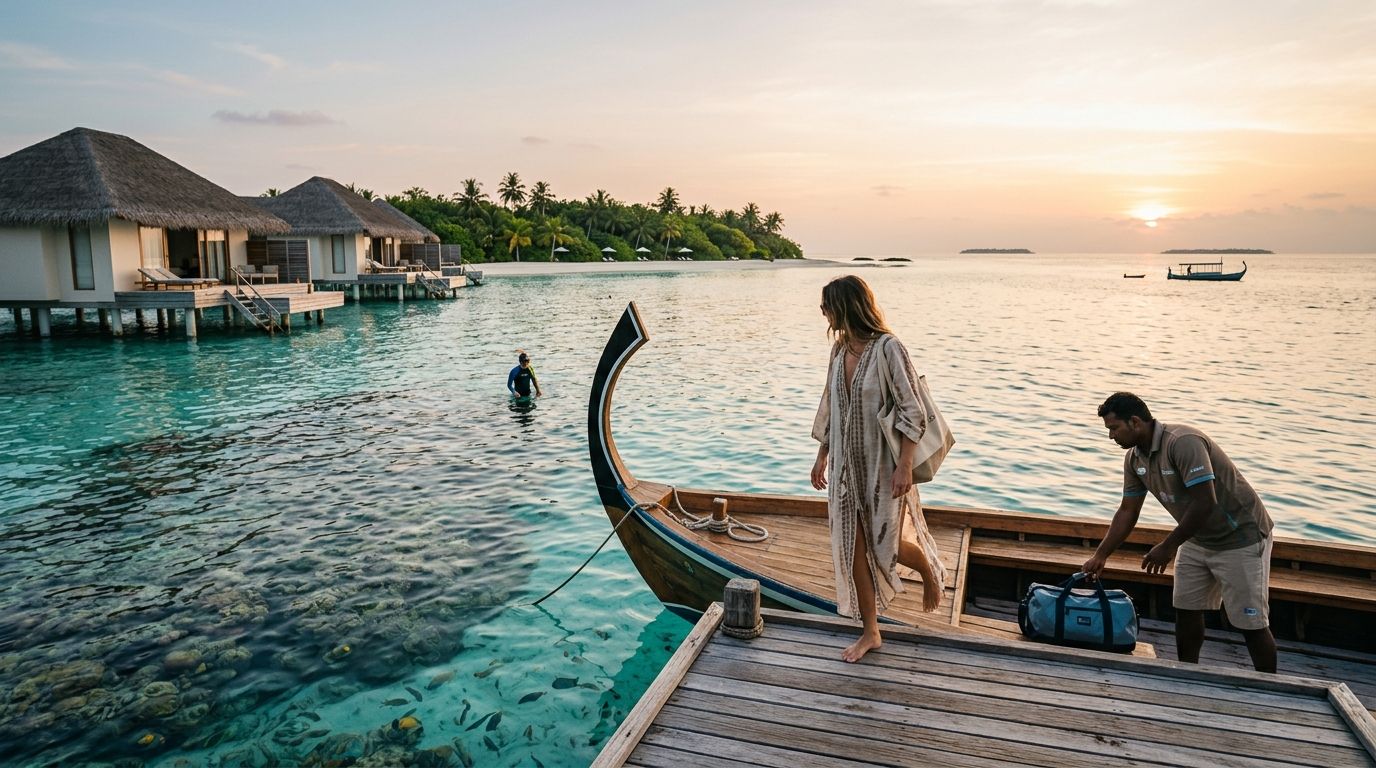
The transition arrives the moment your seaplane banks over the atoll rim. From altitude, the system makes sense—circles of life, channels of current, the particular geometry of how people survive in the middle of an ocean. Then you're down, and your eyes adjust to water so coloured it looks doctored.
The humidity is significant. You'll shower twice daily and still feel crystallized by afternoon. The sun works differently here—it's not just hot, it's geometrically efficient at finding exposed skin. Resort staff will slide SPF across your shoulders like they've rehearsed it a thousand times, because they have.
Snorkelling is the primary activity, and it works exactly as advertised. You'll put on fins in your room, walk twenty steps to a jetty, and drop into water already occupied by fish. The reef drop-offs are steep enough that you can move from five metres to forty metres in a few kicks. The coral formations look designed rather than grown. The fish have no fear because they're rarely hunted and often fed by tourists, which creates a morally complex situation that most people don't dwell on while underwater.
Night diving is available but surprisingly less rewarding than you'd anticipate—the nocturnal reef is less densely populated than day-time reefs, and visibility drops. Day diving is reliable. Channel dives around slack tide are the most interesting, with trevally and rays and the occasional nurse shark. Deep dives to forty-plus metres are available but feel excessive given the abundance at shallower depths.
Meals are paced differently. Most resorts operate on meal plans where breakfast, lunch, and dinner are at fixed times. This creates a rhythm that's either pleasant or suffocating depending on your baseline relationship with structure. The food is competent—seafood, tropical fruits, international buffets designed not to offend. It's not a gastronomic destination. Drink water obsessively; the heat and salt exposure dehydrate faster than feels possible.
Weather patterns matter. Rain arrives in sharp bursts rather than prolonged downpours. Wind varies seasonally. Swell direction changes the workability of certain islands and dive sites. This isn't a destination where you go at random times and get identical experiences.
Planning Your Visit: The Practical Framework
When to Go
November through March is the dry season and universally recommended. Water temperature sits around 27-28°C, winds are favourable, and humidity is at its most tolerable. December and January are peak season—prices peak, islands are fuller, but conditions are optimal.
May through September is the wet season. Rain is frequent, humidity becomes oppressive, and swell picks up. Some resorts close entirely during this period. Water temperature climbs to 30°C, which sounds nice until you realize you're immersed in bathwater for eight hours daily. The advantage: fewer tourists and significantly cheaper rates.
Duration
Three to four days is the minimum to justify the cost and travel time. This gives you two full days underwater and doesn't feel rushed. A week is generous and allows for bad-weather days, varied activities, and actual relaxation. Beyond a week and you've hit diminishing returns unless you're diving seriously and collecting new sites.
Getting There
Most visitors fly into Malé, the capital, via Middle Eastern hubs (Emirates, Qatar) or Asian gateways (Singapore, Bangkok). The international airport is modern and efficient. From Malé, you either take a speedboat (45 minutes to two hours depending on atoll distance) or a seaplane (15-30 minutes, visually spectacular, expensive—$400-600 return). Seaplanes are worth the cost for the perspective alone; you'll understand the atoll system in a way water-level travel doesn't permit.
Crowds and Expectations
North and South Malé atolls receive 60% of tourism. Resorts in these zones are fuller and more developed. Remote southern atolls are quieter but require longer boat transfers. "Local islands" (where Maldivians actually live) are increasingly accommodating tourists in guesthouses, which is cheaper and provides cultural contact that resorts don't. This is also where you'll encounter actual Dhivehi cuisine rather than international buffets.
Resort Selection
Resorts range from budget-adjacent ($300-500/night, which is still significant) to absurdly expensive ($2000+/night in the branded luxury category). Mid-range resorts ($500-1200/night) offer the best value—good reefs, decent food, reasonable service without the theatrical excess of ultra-luxury properties. Guesthouses on local islands run $100-300/night and offer different experiences entirely.
Nearby Places Worth Knowing About
Malé, the Capital
A densely packed, functionally chaotic city of 100,000+ people on an island smaller than Central Park. Most visitors miss it entirely, flying through the airport and straight to resorts. If you have a layover or arrive early, a few hours exploring Malé's fish market, mosques, and street food establishes context for why the resorts exist. It's not photogenic in conventional ways, but it's instructive about what happens when Caribbean-scale tourism infrastructure meets a tiny island nation.
Artificial Beach (Hulhumalé)
An engineered island near the airport with imported sand, created as a tourism buffer and local housing. It has a beach, restaurants, and shops. Useful for a few hours if you're early for a departure or delayed, though it has the specific sadness of artificial landscapes.
A four-hour ferry from the southernmost atolls, but realistically requiring a flight via Malé. If you've already spent five figures getting to the Maldives and want additional geography, Sri Lanka's highlands, tea plantations, and architectural sites offer something radically different. Most people don't combine them, but the logistics are possible.
Is The Maldives Actually Worth Visiting?
Yes, with caveats.
Worth visiting if you prioritize underwater experience over cultural immersion. The reefs are genuinely worth seeing—not once, but repeatedly, because depth changes everything.
Worth visiting if you have the budget. It's expensive relative to other destinations. If you're travelling on a tight budget, Southeast Asia offers better value and more texture.
Worth visiting if you can accept environmental complexity. You're consuming significant resources to be in a destination threatened by climate change. Many resorts are attempting sustainability measures, but you're still part of carbon-intensive tourism. Travel here consciously, not guiltlessly.
Not worth visiting if you need activity, stimulation, and variety. It's meditative or boring depending on your temperament, and there's no switching between cities or neighbourhoods if you get restless.
Not worth visiting if you have limited time and limited budget. The travel distances and costs are too high for a three-day trip, and the experience isn't culturally dense enough to justify trip-of-a-lifetime allocation if you could be elsewhere.
The honest answer: go if water calls to you more than land does. Go if you can afford it and accept the environmental implications. Go if you want to understand what happens underwater and have the time to sit still.
Quick Facts
- Population: ~540,000 spread across 1,190 coral islands
- Capital: Malé
- Language: Dhivehi (English widely spoken in resorts)
- Currency: Maldivian Rufiyaa (MVR); USD accepted everywhere
- Time Zone: UTC+5
- Best Visibility: November to May
- Average Water Temperature: 26-30°C year-round
- Altitude: Highest point is 2.4 metres above sea level
- Visa: Most nationalities receive 30-day visitor permits on arrival
The Maldives asks a specific question: what happens when you remove everything except water and time? The answer is different for everyone. Some people discover it's exactly what they needed. Others realize halfway through that boredom and meditation exist on a spectrum they haven't considered. Most find it somewhere in between—a necessary pause that reorganizes how they think about work, complexity, and what constitutes a worthwhile experience.
To explore routes through the atolls, dive sites, and resort locations, check out Touratu's interactive map. You'll also find travel videos showing what different islands and experiences actually look like—the pre-arrival research that gives context before you commit to the seaplane ride out.
Loading activities…
