
Malaysia Travel Guide: Things to Do & Local Insights
Malaysia: Where Southeast Asia Hits You All At Once
The moment your plane descends toward Kuala Lumpur, you see it—the Petronas Twin Towers slicing through a humid haze like something designed specifically to prove ambition can be vertical. But that visual punch is deceptive. Malaysia doesn't announce itself. It creeps up on you. You'll be eating laksa at a hawker stall in Penang and realize you've forgotten what day it is. You'll be hiking through rainforest so thick it feels prehistoric, stepping over roots that look like they've been there since before humans invented time, and understand why people stay for months when they meant to visit for days.
Malaysia works because it refuses to be one thing. It's simultaneously ultramodern and ancient, cosmopolitan and deeply traditional, chaotic and quietly organized in ways you only understand after you've spent a week there. It's the kind of destination that makes sense only after you've experienced it.
What Makes Malaysia Actually Worth Your Time
Most travel writing about Malaysia hits the same beats: shopping, food, beaches, temples. True enough. But here's what doesn't make it into the guidebooks: Malaysia is where you can genuinely do several different trips in one journey without feeling rushed.
In the peninsula's west, you're in a functioning megacity where old Chinese temples sit next to venture capital offices, where Petronas—the national oil company—sponsors world-class opera performances and street food is legitimately better than most Michelin-starred restaurants. In the east, on the peninsula, you're in laid-back university towns where backpackers and local families share the same food courts. Head east to Borneo—either Sabah or Sarawak—and you're suddenly in territory where indigenous communities still maintain longhouse traditions, and orangutans exist in places you can actually visit without a film crew.
This variety is why Malaysia draws people who've been everywhere. You can't bore yourself here, even if you try.
The food alone justifies the trip. Not because it's "exotic"—that word is lazy—but because Malaysian cuisine represents actual cultural negotiation made delicious. Malay, Chinese, Indian, and increasingly, global influences have created a food culture that's both deeply rooted and constantly evolving. You'll eat char kway teow (stir-fried noodles) that tastes different depending on which stall makes it, laksa varieties that could occupy a lifetime of study, and nasi lemak that functions as both breakfast and philosophy.
What to Expect: The Walking Tour Through Real Malaysia
Kuala Lumpur and the Klang Valley
The city itself isn't what makes people stay—though Petronas is worth seeing, even though it's busier than anyone tells you. What makes KL memorable is the neighborhoods. Chinatown (Petaling Jaya) is authentic chaos: narrow streets, produce vendors yelling prices, tiny restaurants with plastic stools serving food that's been refined over generations. The Petronas area is slick and modern, but walk fifteen minutes and you're in residential zones with coffee shops where old men play chess and read newspapers in four languages.
Bukit Bintang is where tourists congregate, but it's also where you'll find actual Malaysian shopping (not the sanitized mall version). The Central Market and surrounding areas feel like what cities felt like before Instagram decided to design them.
The mosques, temples, and churches punctuate the city constantly. The Islamic Arts Museum is thoughtfully curated, and unlike many museum experiences, you'll leave having actually learned something instead of just accumulated images.
Penang
This is where Malaysia reveals itself more slowly. Georgetown, the capital, is a UNESCO site—but it's lived-in, not preserved like an exhibit. Walk the streets in the early morning before the heat intensifies, and you see the actual rhythm: monks collecting alms, coffee shops opening, the day beginning.
The hawker food is genuinely among Southeast Asia's best, and the Penang locals will argue this point with the intensity of people protecting something sacred. They're not wrong. Eat char kway teow, assam laksa, and cendol, then try to remember how you survived without them.
Kek Lok Si Temple on Air Itam is the major tourist stop, and yes, it's worth the trip, but go early. The stairs (there are many) are easier before 10 AM, and the crowds haven't arrived.
The colonial architecture around the harbor area and in Georgetown proper tells stories of the Straits Settlements period. It's not subtle history; it's written into the buildings.
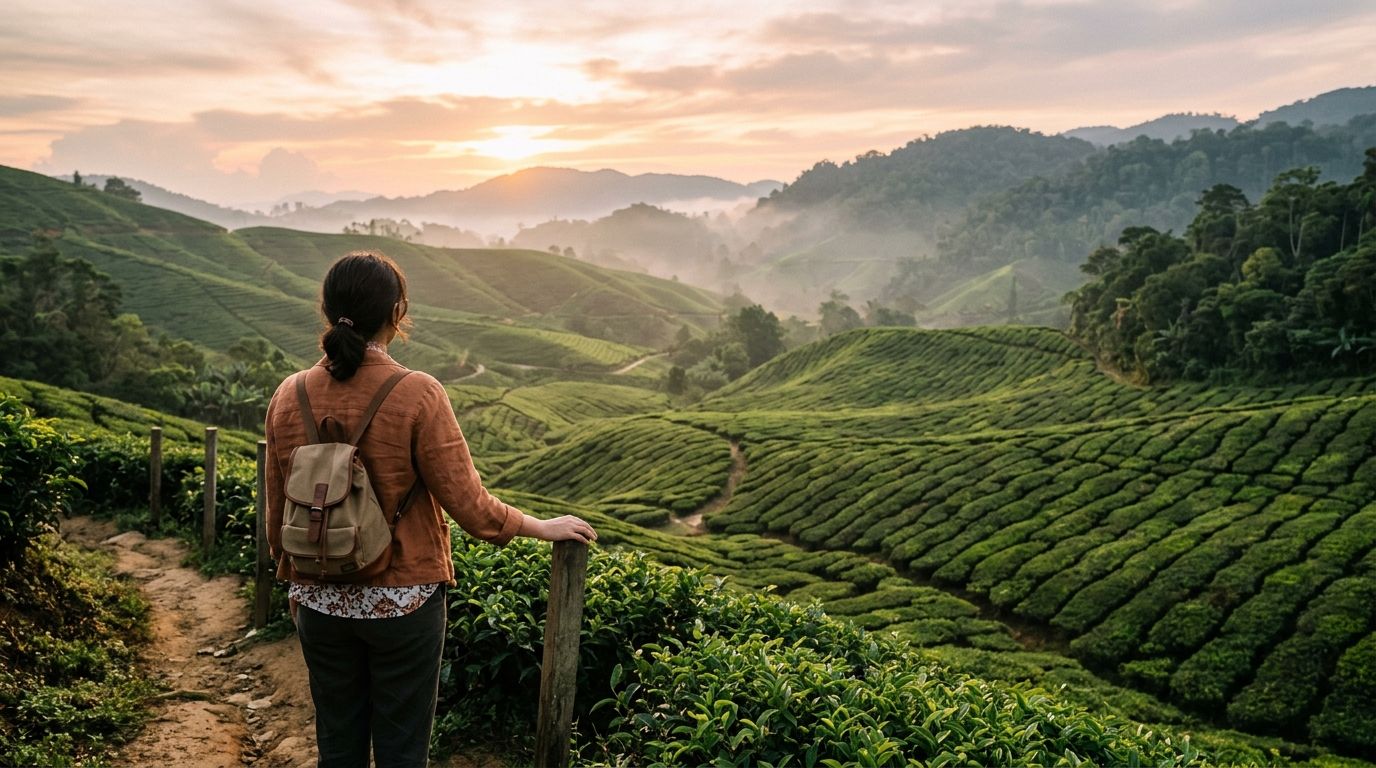
At 1,500 meters elevation, this hill station represents something specific to colonial Southeast Asia—a place where British officers could escape the heat and recreate something resembling England. Now it's tea plantations, cooler air, and a very different pace than the lowland cities.
The drive up takes three hours from KL and winds constantly. It's genuinely scenic without being show-offy about it. You'll pass through actual small towns, not tourist constructs. Stay in Tanah Rata or Ringlet, eat strawberry jam that tastes like actual strawberries, and hike through tea estates. This is where Malaysia slows down.
Taman Negara
Malaysia's largest national park is old-growth rainforest. Real rainforest—the kind where the canopy is so dense that midday feels like dusk, where humidity wraps around you like a weight, where the noise of insects and birds creates a constant audio environment you've never experienced before.
You can stay in riverside lodges, do canopy walks, and hike trails of varying difficulty. It's accessible but not easy. Bring good shoes, expect to sweat continuously, and understand that you're in an environment that's genuinely wild.
Borneo: Sabah and Sarawak
Kota Kinabalu and Kuching are the entry points, but they're launching pads, not destinations themselves. From here, you can visit orangutan rehabilitation centers (the Sepilok Orangutan Centre in Sabah is well-run and genuinely educational), trek to Mount Kinabalu, or visit indigenous communities.
The Kinabalu climb takes two days and is more physically demanding than people expect. Sunrise from the summit is real, not the post-processed Instagram version. You see it from 4,000 meters after hiking through the night, and it's quiet and genuinely moving.
Longhouse visits are negotiable ethically—avoid exploitative operations, seek community-run experiences where your money actually goes to the families living there.
Planning Your Visit: The Practical Stuff
Best time to visit: November to March for the peninsula and Sabah (dry season). April to October is monsoon season in the peninsula, though it means fewer tourists and better prices. Rain usually comes in intense afternoon bursts, not all-day affairs.
Duration: Two weeks minimum if you want to feel like you've actually been there. One week means choosing either the peninsula or Borneo. Ten days splits uncomfortably between regions.
Getting around: Flights within Malaysia are cheap and reliable (AirAsia, Malaysia Airlines, Firefly). Buses are affordable and generally comfortable. Trains exist but are slower than you'd expect. In cities, grab taxis or use Grab (Southeast Asia's Uber). Driving is possible but requires navigation skills and patience with traffic.
Money: Ringgit is stable. Everything from food to accommodation is affordable compared to Western countries. Street food costs $1-2 per meal. Mid-range hotels run $30-60. Budget $30-40 daily for food if you're eating locally.
Crowds: KL and Penang see consistent tourism. The Cameron Highlands and Taman Negara are quieter. Borneo has fewer visitors overall, which is part of its appeal.
Visas: Most Western passport holders get 90 days on arrival.
Nearby Worth Considering
Singapore (four hours by bus or one hour by flight from KL): If you want ultra-modern, ultra-clean contrast, Singapore is thirty minutes away. It's expensive and sanitized compared to Malaysia, but it's a different experience worth understanding.
Thailand's East Coast (ferry from various Malaysian points): Langkawi has ferries to Thailand. Southern Thai islands are accessible but require additional travel.
Brunei (from Sarawak): Small, wealthy, extraordinarily quiet. Worth two days if you're in Borneo anyway.
Is It Worth Visiting? The Honest Answer
Yes, but with conditions. Malaysia works best for travelers who want complexity—people who don't need everything explained in tourism-board language, who enjoy navigating different neighborhoods and finding their own restaurants, who appreciate that a country can contain extreme wealth and poverty, modernity and tradition, simultaneously.
If you want a simple vacation with clear narratives, Thailand or Bali might suit you better.
If you want to understand how a nation actually functions—how cultures negotiate shared space, how food works as currency and comfort, how history sits in buildings and streets—Malaysia will give you that. You'll leave with more questions than answers, which is the mark of actual travel.
The heat is genuine. The humidity will affect how you move and think. The traffic in cities is real. The food is so good you'll daydream about it years later. The people are unfailingly kind without being servile. The diversity is actual, not performative.
Malaysia doesn't perform its identity for tourists. It simply exists, and you either understand that or you don't.
Quick Facts
- Population: ~34 million
- Capital: Kuala Lumpur (federal territory, separate from Selangor state)
- Official language: Malay (but English is widely spoken, especially among younger people)
- Currency: Malaysian Ringgit (RM)
- Religion: Islam is the official religion; Buddhism, Hinduism, Christianity also widely practiced
- Best street food: Penang, Kuala Lumpur, Melaka
- Best for nature: Taman Negara, Cameron Highlands, Borneo
- Best for culture: Penang, Georgetown, Melaka
Malaysia reveals itself slowly—you don't understand why you came until you've been there several days. That's not a weakness of the destination; it's exactly the point. Use Touratu's interactive map to plot your specific route through these regions, compare different pathways through the peninsula and Borneo, and watch travel videos that show you what mornings actually look like in Georgetown or what the humidity feels like on a Taman Negara trail. Planning becomes easier when you see the geography in context.
Loading activities…
