
Luxembourg Travel Guide: What to Do & How to Explore
Luxembourg: Why Europe's Smallest Country Deserves More Than a Stopover
You arrive at Luxembourg City's airport and notice something immediately: the landscape doesn't perform. There are no dramatic peaks or crashing coastlines waiting to be photographed. Instead, there's a quiet competence to the place—manicured farmland, efficient signage, the understated confidence of a country that doesn't need to try hard. Within thirty minutes, you're in the capital, watching a castle emerge from dense forest above a river gorge, and you realize this is precisely why Luxembourg works. It's thorough. It's unhurried. And it refuses the tired glamour of places designed for tourists.
Luxembourg rewards the kind of traveler who moves slowly and pays attention.
The Real Luxembourg: Beyond the Stopover Narrative
Most people know Luxembourg as the place you pass through on the way to Belgium or Germany. A pit stop. A tax haven mentioned in financial documentaries. This reputation, while not entirely unfair, obscures something more interesting: Luxembourg is one of Europe's most livable destinations, and that matters for how you experience it.
The country is small enough to explore without logistics becoming theater. You can stand in three different nations before lunch. The infrastructure is obsessive—trains run with German punctuality, bus systems make Dutch planning look casual, and the cycling network suggests someone spent considerable thought on how people actually move through space. This matters because it means you're not negotiating chaos; you're inhabiting a place built around human rhythm.
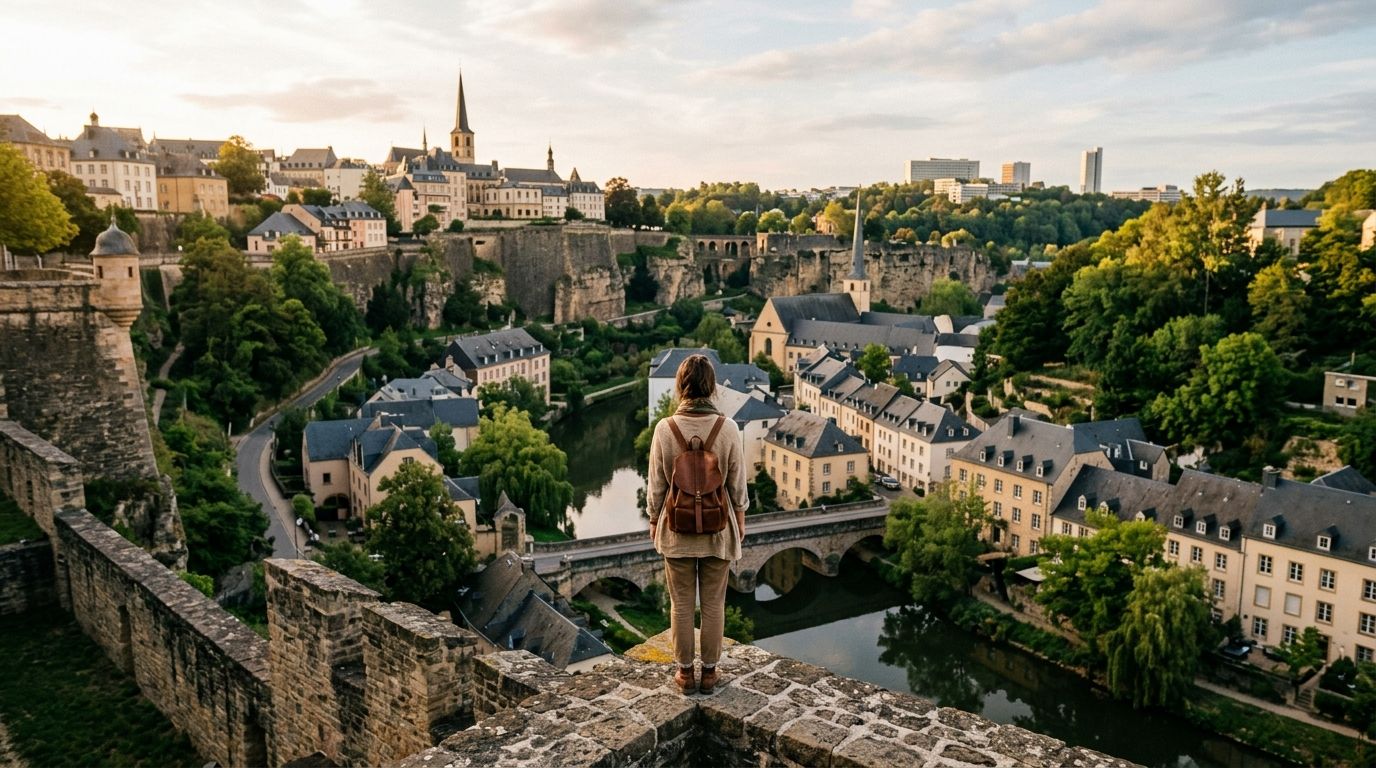
But what makes Luxembourg genuinely memorable is subtler. The medieval core of Luxembourg City—the Grund district, specifically—sits in a geography that seems almost intentionally dramatic. The fortress sits above, the river gorge cuts through like something from a fever dream, and narrow streets twist downward through layers of history. Walk it at dusk, when tour groups have evaporated, and you'll understand why people have defended this place for centuries.
The Ardennes region in the north isn't trying to be Switzerland. It won't change your life with a single vista. Instead, it offers something less fashionable: quiet woodland, small towns that feel lived-in rather than preserved, hiking routes where you actually see locals rather than tourists, and a sense of scale that feels right. Echternach, a small town on the German border, has an abbey and river setting that draws visitors, but the real draw is the walking culture—people here hike because the land invites it, not because an Instagram account demands evidence.
What to Expect: How Luxembourg Actually Unfolds
When you first arrive in Luxembourg City, the castle catches your eye, but the real experience begins below it. The Grund district is accessible via ancient stone staircases or a small elevator carved into the fortress wall—a choice that summarizes Luxembourg's approach to problem-solving. Once down, the perspective reverses; you're looking up at ramparts and medieval stonework while cafés operate at street level, unbothered by grandeur above.
The Musée de l'Histoire de la Ville de Luxembourg (Museum of the History of Luxembourg City) occupies three historic mansions and tells the story without excessive production value. You learn that Luxembourg has been fought over more times than anywhere else in Europe—a fact that explains the fortress architecture and the visible layers of different periods. The exhibits don't sensationalize this; they present it as simple history.
The Palais Grand-Ducal sits in the old town, still a working palace, and the Cathédrale Notre-Dame is exactly what a Grand Duke's cathedral should be—not ostentatious, but clearly belonging to someone with resources. The point isn't that these are jaw-dropping architectural statements. They're not. The point is that they're genuinely old, genuinely functional, and genuinely part of how people move through the city.
Budget two full days in the capital, minimum. The first covers the old town thoroughly and gives you an evening to sit by the river or at a café in Place d'Armes. The second lets you visit a museum, explore Kirchberg (the administrative district that showcases Luxembourg's modern face), and take the short train ride to Vianden, where a restored castle offers views that actually are worth your time.
In the Ardennes region, the experience shifts. Echternach becomes your base, a town where the abbey is significant but secondary to the walking network. The Müllerthal Trail is the hiking backbone—a marked route that loops through woodland, past cliffs, along the Sûre River, and through the kind of landscape that restores the soul without exhausting it. The walks aren't extreme; they're approximately eight kilometers and manageable for anyone with reasonable fitness.
Diekirch, further north, offers brewery culture (the local brewery is worth visiting), and Clervaux delivers castle ruins and a town photography museum that's unexpectedly rewarding. None of these are destinations that make headlines, but that's the appeal. You're moving through a region where tourism serves locals, not the reverse.
Planning Your Visit: The Practical Realities
Best time: Late April through October. May is particularly good—warm enough to enjoy outdoor time, and the hotel situation hasn't yet been colonized by tour groups. September offers similar weather with smaller crowds. July and August are warm but busy, particularly around Luxembourg City and the major towns.
Duration: Three to five days gives you a proper sense of the country. Two days minimum if you're optimizing for the capital only. A week allows you to experience both the city and the Ardennes without rushing and still have time for the Moselle wine region (Germany-adjacent but worth the detour).
Getting there: Brussels and Frankfurt have major airports with good connections. The Luxembourg airport is small but efficient. If you're already in Belgium or France, train connections are excellent. The train system between here and Germany is particularly good.
Transport within Luxembourg: Trains connect most major towns. Buses fill gaps and are reliable. The country is bike-friendly, and rental is straightforward. Renting a car is logical if you want flexibility in the Ardennes, but it's not essential.
Crowds: Summer weekends in Luxembourg City can feel busy, particularly around the castle and Grund. Weekday mornings offer relief. The northern towns are far quieter year-round. Tourist season doesn't have the crushing weight it does in Spain or Italy, but it exists.
Language: Luxembourgish is the official language, but it's not widely used in tourism. French and German are both spoken, and English is increasingly common, particularly among younger people and in the service industry. Come with basic courtesy phrases in whichever language matches your comfort, and you'll be fine.
Nearby Places: Context and Connection
Trier, Germany (30 minutes by train): The oldest city in Germany, with Roman remains that make ancient Rome tangible. The cathedral is extraordinary, and the city feels less crowded than Luxembourg City for comparative value. Stay here if you want more medieval substance, but it's also a perfect day trip.
Moselle Wine Region (Germany/Luxembourg border): If you're interested in wine, the Luxembourg side of the Moselle produces crisp whites that outperform their international reputation. The German side is busier and more famous. The Luxembourg villages—Remich, Schengen—are small and worth a few hours if wine interests you.
Vianden Castle (Luxembourg): About 45 minutes north of the capital by train. A properly restored medieval castle with usable interiors, positioned above a small riverside town. It's the kind of castle that children engage with, and adults find genuinely interesting.
Is It Worth Visiting? The Honest Assessment
Yes, but with caveats. Luxembourg works best if you move slowly and aren't chasing superlatives. It won't provide you with the overwhelming Gothic drama of Cologne, the romantic absurdity of Paris, or the raw energy of Berlin. What it offers instead is competence, livability, and a genuine sense of place—the impression that you're visiting a country where people live well rather than somewhere designed primarily for your consumption.
The Ardennes hiking is genuinely good, the food is hearty and honest, the beer and wine are excellent without pretense, and Luxembourg City is beautiful in a way that reveals itself gradually. There's also the practical advantage that everything works—trains are on time, information is clear, toilets are clean, and hospitality is professional without being performative.
The main reason travelers skip Luxembourg is simple: it doesn't have the cultural prestige of its neighbors. You won't return home with stories of monuments that changed your philosophy. You will, however, return with the memory of good walking, decent coffee, and the satisfaction of knowing a place most people overlook.
Quick Facts
- Capital: Luxembourg City
- Population: ~650,000 (one of Europe's smallest countries)
- Language: Luxembourgish (official); French and German widely spoken
- Currency: Euro
- Best for: Walkers, those interested in medieval history, people seeking low-stress travel
- Average visit duration: 3-4 days
- Visa: Schengen area (EU/EEA nationals and many others don't need a visa)
The Closing Thought
Luxembourg doesn't announce itself. It waits. The best travel happens when you're willing to wait alongside it—to sit at a café longer than planned, to take the walking trail without knowing what's around the corner, to let a small country reveal itself on its own timeline rather than yours.
Ready to explore Luxembourg's routes, hidden walks, and local spots? Check out Touratu's interactive map to plan your journey, discover bookable activities, and watch travel videos that show what the country actually feels like. You'll find practical guidance on everything from the best cafés in the Grund to lesser-known Ardennes trails—all built by people who've been there and know what matters.
Loading activities…
