
Jordan Travel Guide: History, Deserts & Ancient Sites
Jordan: A Land Where Ancient Stone Speaks Louder Than Words
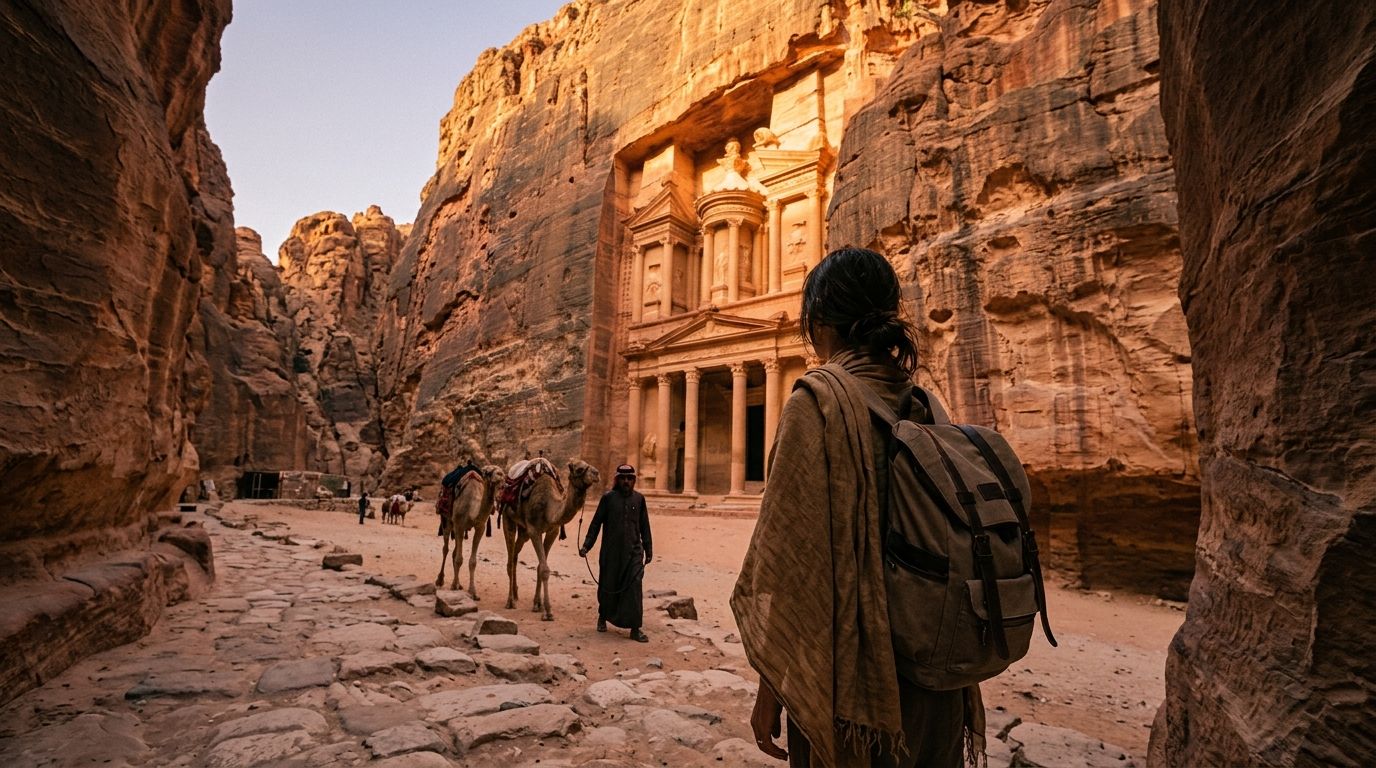
The first time you see Petra), you don't see it coming. You walk through a narrow canyon—the Siq—for twenty minutes, and the walls gradually narrow around you. The light shifts from gold to rust to shadow. Your eyes adjust to the darkness. And then the canyon opens.
There's a moment of pure disorientation. A vast facade emerges from the stone in front of you, impossibly proportioned, carved directly from the cliff face. It's not a painting or a photograph. It's real stone, sculpted by hand over two thousand years ago. The moment hits differently than you expect. Not quite shock. More like the world has suddenly clarified.
That's Jordan.
This isn't a country you visit to collect passport stamps or photograph landmarks for social media. Jordan is a place where geography, history, and human ambition converge in ways that force you to reconsider what you thought was possible. It's a country where ancient trade routes still pulse beneath the surface, where deserts contain underwater worlds, and where every direction offers something genuinely difficult to explain without experiencing it.
What Actually Makes Jordan Worth Your Attention
Most travel guides will list Petra first and call it a day. That's incomplete. Petra is remarkable—genuinely, unquestionably one of the most significant archaeological sites on the planet. But treating it as the sole reason to visit Jordan misses the entire point of being there.
Jordan works because of contrast. The Dead Sea, the lowest point on Earth, sits a few hours from some of the most dramatic highland terrain in the Middle East. Desert landscapes shift from rust-colored sandstone to black volcanic plains within a single drive. Amman, the capital, functions as a genuine working city—not a museum or a theme park—where Levantine culture is lived rather than performed.
The real magic emerges when you move between these spaces and notice how they connect. Bedouin communities have inhabited these deserts for centuries using knowledge systems that predate roads and maps. Roman cities like Jerash still stand largely intact, revealing infrastructure built for permanence. Nabataean traders engineered water systems in arid landscapes that sustained commerce across continents. You're not just seeing historical artifacts; you're reading a geological and cultural palimpsest where multiple civilizations have left distinct impressions.
This layering is what separates Jordan from destinations that rely on a single highlight. You're constantly aware of deep time—not as an abstract concept, but as something physical you can touch.
What to Expect: Moving Through the Landscape
Petra and the Three Days Around It
Most visitors give Petra a single day. That's workable, but it undersells the experience. The main canyon walk and Treasury visit takes 3-4 hours. The Monastery requires hiking further, with spectacular views from higher elevation. Real exploration—the kind where you notice how water flows, where you consider what daily life looked like—requires time.
Stay in the town of Wadi Musa, adjacent to Petra. The town exists entirely because of the site, which creates a weird energy. Tourist infrastructure is dense but not entirely polished. You'll find good coffee, mediocre hotels, and conversations with people whose families have worked as guides for generations. Spend an afternoon talking to someone who knows Petra's geology and history. The experience deepens considerably when you understand that Nabataean engineers didn't just carve facades—they engineered an entire city with hydraulic systems, cisterns, and water management that allowed thousands of people to live in the desert.
The Dead Sea
The Dead Sea is a sensory experience that reads differently in person than in description. You don't sink dramatically or float dramatically—you sit in water so dense that it requires minimal effort to stay buoyant. The experience is meditative rather than thrilling. The mineral content creates a particular sensation against your skin. Salt crusts form on your body as you dry.
More interesting than the floating itself is the landscape. The Dead Sea occupies a geological fault line. The cliffs surrounding it rise steeply. The air has a particular quality—heavier somehow, denser. Historically, this was one of the only places where salt and minerals could be harvested at scale. You're standing in a place that shaped economic life across millennia.
The Desert: Wadi Rum
Wadi Rum is harder to define. It's not exactly a desert in the traditional sense—it's a high desert plateau with dramatic sandstone formations rising like monuments. It's been used as a filming location for sci-fi movies because the landscape reads as alien. But it's inhabited. Bedouin communities still live here, organizing their lives around water sources and seasonal movements.
Most visitors take a jeep tour (4-6 hours) with a Bedouin driver. This is one of the few cases where a guided tour actually adds value rather than creating distance from the experience. The driver knows water sources, stories about the landscape, and practical knowledge about how to move through terrain that appears featureless but actually contains sophisticated navigational systems.
Amman
Amman serves as the logistical hub and the place where you'll spend partial days between major sites. It's not a destination in itself, but it's worth understanding. The city sprawls across hills in a way that reveals its organic growth. It's a capital city where daily life happens—coffee shops filled with people conducting business, neighborhoods with their own rhythms, a downtown where bargaining still occurs. Spend an afternoon wandering rather than checking boxes. Jerash, a Greco-Roman city about an hour north, is remarkable if you're interested in how cities were actually structured and used. Walking through intact colonnades gives you physical sense of scale and movement that photographs don't convey.
Planning Your Visit: Practical Reality
When to Go
Avoid mid-summer (July, August). Temperatures exceed 40°C (104°F) regularly. September is still hot. October through April is genuinely pleasant—15-25°C (60-77°F) during the day. December and January include occasional rain, which affects desert driving and hiking. March and April are ideal. November through February work well if you can tolerate occasional wind and cooler evenings.
The Dead Sea is swimmable year-round due to its mineral content and warm subsurface water.
Duration
You need a minimum of 5 days to see Petra, the Dead Sea, and Wadi Rum without feeling rushed. 7 days allows for Amman, Jerash, and more time to sit with individual experiences. Two weeks transforms the trip into something else—you start noticing small details, having conversations that go beyond logistics, understanding how places connect.
Getting Around
Flying into Amman (Queen Alia International Airport) is the standard entry. International flights are available from most major European, Middle Eastern, and Asian hubs.
Most people rent a car or hire a driver. Driving yourself is feasible—roads are generally well-maintained, signage is adequate—but hiring a driver (through your hotel or a service) costs roughly 40-60 JOD per day and removes navigation stress. Buses connect major cities, but schedules are loose and routes can be indirect.
Distances: Amman to Jerash (45 minutes), Amman to Dead Sea (50 minutes), Amman to Petra (3 hours), Petra to Wadi Rum (2.5 hours).
Crowds and Seasons
Petra attracts significant tourist traffic, particularly March-May and September-October. You'll share the space with tour groups. Early morning entry (before 7 AM) means fewer people in the initial sections. Mid-afternoon tends to have fewer visitors. If solitude is essential, accept that you won't find it at Petra, but you can find it easily in other parts of the country.
Wadi Rum is more diffuse. The landscape is large enough that you feel alone during jeep tours, even when other tours are happening elsewhere.
Nearby Places Worth Your Time
Wadi Mujib (Dead Sea Gorge)
About 40 minutes from the Dead Sea resort area, this canyon hike moves through dramatic geology and actually involves swimming through narrow sections. It's more physically demanding than Petra but offers a different relationship to the landscape—you're moving through it actively rather than observing it. Guide services are required. Half-day or full-day options available.
Aqaba
The southern coastal city on the Red Sea. Snorkeling and diving are accessible immediately from shore. You're looking at coral reefs and fish species. It's less developed than major Mediterranean resort areas, which means it's either refreshingly low-key or disappointingly sparse depending on what you want. Two days is sufficient.
An early Islamic castle in the eastern desert. Remote, less touristed than major sites, geologically interesting. Worth a half-day detour if you're interested in how military architecture responded to desert environments.
Is Jordan Worth the Effort?
Yes, with caveats.
If you're looking for pristine, uncrowded experiences, you'll find parts of that. Petra attracts crowds because it actually deserves them—the site is genuinely remarkable. But away from major sites, you'll find substantial stretches where you're moving through landscapes that are rarely photographed or discussed.
If you're hoping to feel transformed by your travels—to return home with fundamental perspectives altered—Jordan is capable of that. The layers of human history here are real. The geological story is visible. Conversations with people whose families have lived in this region for centuries reveal knowledge systems that predate modern nation-states.
The country isn't perfect. Infrastructure has gaps. Bureaucracy can be slow. It's not as developed as European tourism destinations, which is actually part of its value.
Go if you want to understand why these places matter historically, geologically, and culturally. Go if you're interested in actually exploring rather than consuming. Go if you can move at a slower pace than you're accustomed to.
Go if you want to walk through a canyon in the dark and emerge into something that genuinely stops you in your tracks.
Quick Facts
- Capital: Amman
- Currency: Jordanian Dinar (JOD); approximately 1 JOD = 1.40 USD
- Language: Arabic; English widely spoken in tourist areas
- Visa: Most nationalities receive 30-day tourist visas on arrival
- Best Time: October-April
- Jordan Pass: A tourist pass covering entry to multiple sites (Petra, Jerash, Dead Sea, others); costs roughly 70-90 JOD; worth considering if you're hitting multiple major attractions
Final Thoughts
Jordan doesn't announce itself. There's no single Instagram moment that defines the experience—though Petra comes close. Instead, it accumulates. You walk through ancient canyons, float in a sea below sea level, drive through desert landscapes that haven't fundamentally changed in centuries, and sit with people whose relationship to this land extends back further than most nations have existed.
Plan your journey, research your routes, and prepare for what you'll actually encounter—not what you think you'll encounter. Touratu's interactive map helps you explore different routes through Jordan and watch how various experiences connect. Their travel videos offer real perspective on what these sites actually feel and sound like, beyond the photograph.
Jordan is worth your time precisely because it doesn't try to be anything other than what it is: a place where deep time is visible, where human ambition confronted impossible geology and prevailed, and where standing still and observing tells you more than rushing ever could.
Loading activities…
