
Egypt Travel Guide: History, Sites & Planning
Egypt: What Happens When History Refuses to Stay in Museums
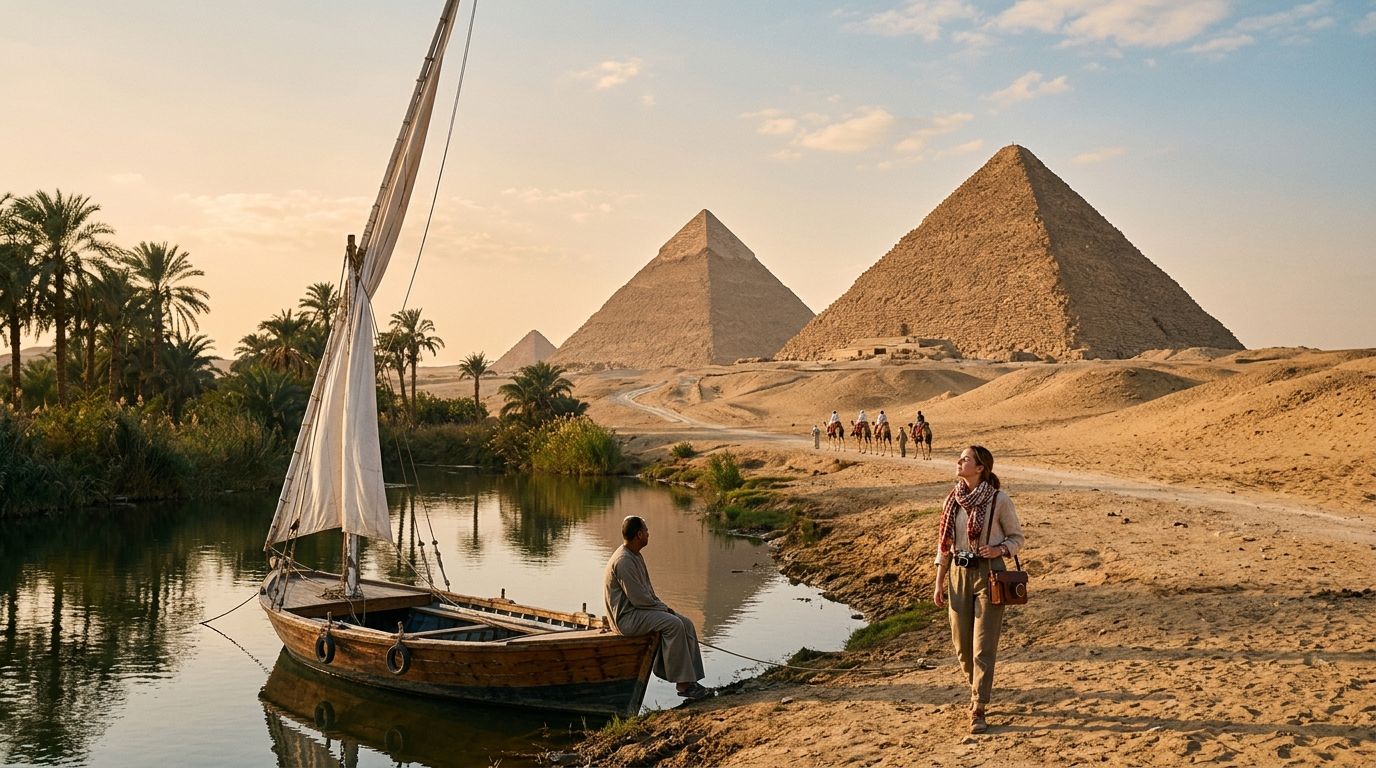
You're standing at dawn near the Giza Plateau, and the light is doing something impossible. It's not turning the pyramids golden—that's what postcards promise. Instead, it's revealing them. Four-and-a-half thousand years of accumulated dust, heat, and human breath seems to lift for a moment, and you understand why people spent decades arguing about how these things were built. Not because they're pretty. Because they're there, stubbornly, impossibly there, and your brain struggles to reconcile that fact with the casual way a camel herder walks past them.
This is what Egypt offers: not confirmation of what you already know about it, but something more unsettling. A place where the sheer continuity of human presence across millennia isn't abstract. It's embedded in streets, temples, tombs, and the daily rhythms of people who live alongside monuments with the same ease you might pass a church in your hometown.
What Actually Makes Egypt Worth the Journey
Egypt works on a different timescale than most places. You can visit Rome and feel the weight of centuries. You can visit Athens and see the skeleton of Western philosophy. But Egypt shows you something older and stranger: a civilization that didn't just rise and fall but transformed repeatedly while occupying the same geography. The Pharaohs are just one chapter. Then come Greeks, Romans, Arabs, Ottomans, and finally modern Egyptians who inherited all of it.
This layering is what makes exploration here genuinely complex. You're not ticking off a monument list. You're moving through different epochs, watching how each one left its mark. The Coptic Cairo district—narrow medieval streets, hanging churches, the Ben Ezra Synagogue—exists a few kilometers from Giza. The Islamic Cairo with its soaring minarets and medieval bazaars sits alongside the Greek-influenced downtown built by colonial powers. It's not organized neatly. It's overlapped, contradicted, lived in.
The Nile itself is the third major player in any Egypt trip. It's not scenery. It's infrastructure. Ninety-seven percent of Egypt is uninhabitable desert. Nearly the entire human and historical story happens within a few kilometers of this river. Taking a felucca—a traditional sailing boat—down it at dusk isn't romantic tourism. It's understanding geography as destiny.
What to Expect: The Actual Experience
Cairo
Cairo arrives in your senses before you fully enter it. The traffic is constant, loud, and somehow functional. Horns are a language. Motorbikes move through gaps that don't seem to exist. Pedestrians negotiate this chaos with casual expertise.
Once you're in it—and yes, you'll be overwhelmed initially—the city reveals itself through walking. The Egyptian Museum holds one of the world's most important collections of artifacts, though navigation is confusing and labeling is sparse. If you can, hire a guide. The Tutankhamun collection alone justifies the visit, but seeing it properly requires context.
Khan el-Khalili bazaar is genuinely cluttered with souvenirs, but push deeper into the side streets and you'll find craftspeople actually working—metalworkers, textile makers, spice merchants who've been in the same spot for generations. Haggling is expected but not aggressive if you engage respectfully. Budget time, bring water, and don't wander alone after dark.
Giza and the Pyramids
The Great Pyramid of Khufu is 139 meters tall. Those are just numbers until you stand in front of it. The scale disrupts perspective. You're used to objects having a horizon behind them. This thing is the horizon.
You can enter the Great Pyramid, though it involves crawling through corridors that haven't changed in 4,500 years. The King's Chamber—the final room—is deliberately austere. No treasure, no inscriptions, just red granite and emptiness. Many people find this disappointing. I found it honest.
The Sphinx is smaller and more eroded than photographs suggest. Its nose is definitively missing (medieval sources blame cannon fire, not treasure hunters). The body is animal, the head human, the purpose debated. Stand there long enough and you stop trying to decode it and just accept the oddness.
Visiting early (5 AM start) beats the crowds and heat. Hire guides through established operators. The plateau attracts hustlers, and distinguishing legitimate guides from touts requires local knowledge.
Luxor and Karnak
Luxor is where Egypt's depth becomes undeniable. The Karnak Temple complex isn't one building but 30 structures built over 1,300 years. Walking through the hypostyle hall—a forest of 134 columns—you're physically moving through time. Each ruler added to it, tried to outdo predecessors, left inscriptions boasting about conquests.
The Valley of the Kings, across the Nile, contains 62 royal tombs carved into rock. Tutankhamun's tomb (KV62) is small and crowded but intact. Others—like Seti I's tomb—are vast, decorated, architecturally sophisticated underground palaces. The preservation varies wildly. Some colors remain vivid; others are faded almost to invisibility.
Luxor requires 2-3 days minimum. You can rush it in one, but you'll resent the pace.
Aswan and Abu Simbel
Aswan marks the southern boundary of classical tourism infrastructure. It's warmer, slower, and the Nile is wider and more beautiful here. The felucca sailing experience is most pleasant here.
Abu Simbel—two colossal temples built by Ramesses II—requires a day trip (280km south). The four statues of the pharaoh are 20 meters high. They were relocated in the 1960s when the Aswan Dam threatened to flood them. Seeing them now involves some cognitive dissonance: engineering marvel in service of saved engineering marvel. But the temples themselves, carved into mountainside, are extraordinary.
Planning a Proper Visit
When to Go
November through February is ideal. Temperatures range from 15-25°C (59-77°F). Summer is brutal—Cairo hits 40°C (104°F) regularly, and Aswan approaches 50°C (122°F). Ramadan affects restaurant hours and business rhythms. It's not impossible to visit then, but it requires adjustment.
Duration
A rushed trip: 5-7 days (Cairo 2 days, Giza 1 day, Luxor 2 days, Aswan 1 day).
Proper exploration: 10-12 days. This lets you actually sit in museums, take felucca rides, explore side streets, and recover from the sensory overload Cairo induces.
Getting Around
Domestic flights between Cairo, Luxor, and Aswan are essential for time. EgyptAir and budget carriers run frequent routes. Trains exist but are slow (14+ hours Cairo to Aswan).
Within cities: taxis are cheap but negotiation matters. Uber works in Cairo. Walking is often faster than vehicles in traffic-congested areas.
Crowds and Practicalities
Tourism in Egypt requires realistic expectations. Expect persistent offers from unofficial guides, restaurant staff aggressive about seating, and constant requests for photos. This isn't malicious—it's commerce in a place where tourism is genuinely important economically. Firm but polite refusals work. Learning basic Arabic phrases ("shukran" for thanks, "aywa" for yes, "la" for no) changes interactions noticeably.
Hire guides through established hotels or tour operators. The knowledge gap is real—local guides explain context, navigate crowds, and access areas tourists often miss.
Nearby: Beyond the Standard Circuit
Alexandria (240km north of Cairo)
Alexandria is Egypt's Mediterranean gateway, founded by Alexander the Great. The Citadel of Qaitbay occupies the site of the ancient Lighthouse of Alexandria. The Catacombs of Kom el Shoqafa blend Egyptian and Greco-Roman burial traditions. It's visually different from inland Egypt and worth 2 days if you're not rushing.
The Western Desert and Siwa Oasis (from Cairo/Alexandria)
Siwa is genuinely remote—a saltwater oasis 500km southwest of Cairo, in the desert. The journey takes 8+ hours. You arrive somewhere that looks untouched, where Berber culture remains distinct, where the Oracle Temple of Amun sits quietly off tourist routes. It requires dedicated time and realistic expectations about isolation, but it's Egypt without the crowds.
Sinai: St. Catherine's Monastery (Bedouin region, religious site)
Near the traditional Moses mountain, this 6th-century monastery is architecturally significant and sits in genuine wilderness. Access requires Sinai travel permits (obtained through hotels). It's less famous than other sites, partly because logistics are complex, but it offers a different texture of Egypt—isolated, spiritual, geographically extreme.
Is It Actually Worth It?
Yes, but not because of romance or spiritual awakening or any of the language tour companies use.
Egypt is worth it because complexity deepens travel. It refuses to be simple. The monuments are magnificent, but they're also uncomfortable—reminders of pharaonic power built on slave labor, now existing in a country navigating poverty, politics, and tourism economics.
It's worth it because the Nile and desert create geography that shaped human civilization fundamentally. Seeing that geography—understanding how a river becomes destiny—teaches something abstract about history.
It's worth it because Cairo isn't Instagram-aesthetic. It's loud, chaotic, often frustrating, but genuinely human in a way sanitized travel destinations aren't.
It's worth it because Luxor's temples show architectural ambition at scales most people never encounter. Standing in front of them isn't passive. It requires reckoning with human capability across time.
And it's worth it because most travel involves relaxation. Egypt involves active engagement with difference—navigating language, customs, historical depth, and sensory intensity. That's tiring. It's also why it stays with you afterward.
Quick Facts
- Best time: November–February
- Language: Arabic (English spoken in tourist areas)
- Currency: Egyptian Pound (EGP; 1 USD ≈ 30 EGP as of 2024)
- Visa: Most nationalities receive tourist visas on arrival
- Duration: 10-12 days for meaningful exploration
- Main airport: Cairo International
- Getting between sites: Domestic flights or overnight trains
- Accommodation range: Budget ($15-30/night) to luxury (as expensive as anywhere)
Final Thoughts
Egypt doesn't present itself as convenient. It's hot, crowded, logistically complex, and historically layered in ways that require effort to understand. Guidebooks promise transcendence. The reality is messier: discomfort alongside genuine awe, exhaustion alongside fascination, and the constant negotiation of being a tourist in a place where tourism is economically necessary but culturally complicated.
That friction—between visitor and place, between expectation and reality, between ancient monumentality and modern life—is exactly why Egypt matters. It refuses the polished package most travel offers.
Plan properly, book through established operators, move slowly enough to absorb what you're seeing, and engage respectfully with the people and culture you encounter. The monuments will astound you. But what lingers afterward is usually something less obvious: a moment on the Nile at dusk, a conversation with a guide who spent decades studying temple inscriptions, or simply standing somewhere that humans have been standing for 4,500 years and feeling genuinely small.
Ready to explore Egypt's routes and uncover these experiences? Use Touratu's interactive map to navigate between sites, watch travel videos from real visitors, and discover bookable activities that connect you with local guides and authentic experiences. Start planning your Egypt journey today.
Loading activities…
