
Cambodia Travel Guide: Things to Do & Plan Your Trip
Cambodia: Beyond the Postcard Version
The boat cuts through water the color of weak tea, and you're watching a kid paddle past you with his feet—literally steering a boat while standing with his toes splayed on the gunwale. He's probably twelve. You wonder if you've ever felt that comfortable anywhere. The morning mist hasn't burned off yet, so the temples ahead look almost provisional, like they might dissolve if you blink. This is Tonlé Sap Lake, and nothing you've read about Cambodia quite prepares you for how ordinary it all feels until you're actually here.
Cambodia doesn't announce itself with drama. It whispers. And if you're paying attention—really paying attention—those whispers tell stories that rewire how you think about resilience, beauty, and what it actually means when a place chooses to move forward.
Why Cambodia Actually Matters
There's a particular kind of travel experience where you arrive as a consumer and leave as a witness to something larger than yourself. Cambodia does that, but not through the channels tourism usually advertises. Yes, Angkor Wat exists, and yes, it's architecturally significant in ways that don't require exaggeration. But what lingers isn't the geometry of the temples—it's how the country contains such contradictory energies in the same space.
You'll stand in front of a thousand-year-old carving of a celestial dancer and wonder about her hands. Then, thirty seconds later, you'll overhear a teenager on a motorbike negotiating a phone deal in flawless English. That simultaneity—ancient and furiously contemporary—is what makes Cambodia different from the meditation-app version of Southeast Asia that tourism markets globally.
The country has spent the last forty years rebuilding itself after nearly unimaginable trauma. That's not a marketing angle; it's the actual context. And what's remarkable isn't that Cambodia recovered. It's that it recovered with a specific kind of humor, generosity, and creative energy that you can feel in conversations with people who lived through it and refused to become their tragedy.
What Actually Happens When You Go
Let's start with what you'll probably do first: Siem Reap. The town itself is genuinely chaotic in the way that Southeast Asian cities are—scooters following their own traffic logic, the smell of grilled meat and charcoal, restaurants that open and close without explanation. There's a main drag called Pub Street that's exactly what it sounds like: a sequence of establishments designed for people who've decided to stop thinking about time zones.
But Siem Reap is mostly a staging ground. What matters is Angkor Archaeological Park, a site so sprawling that your first visit won't answer any questions—it'll just generate new ones. You'll rent a tuk-tuk and a driver (non-negotiable; the roads aren't built for rentals and the sun is genuinely hostile), and you'll move through a landscape that's temple, jungle, and water in constant negotiation.
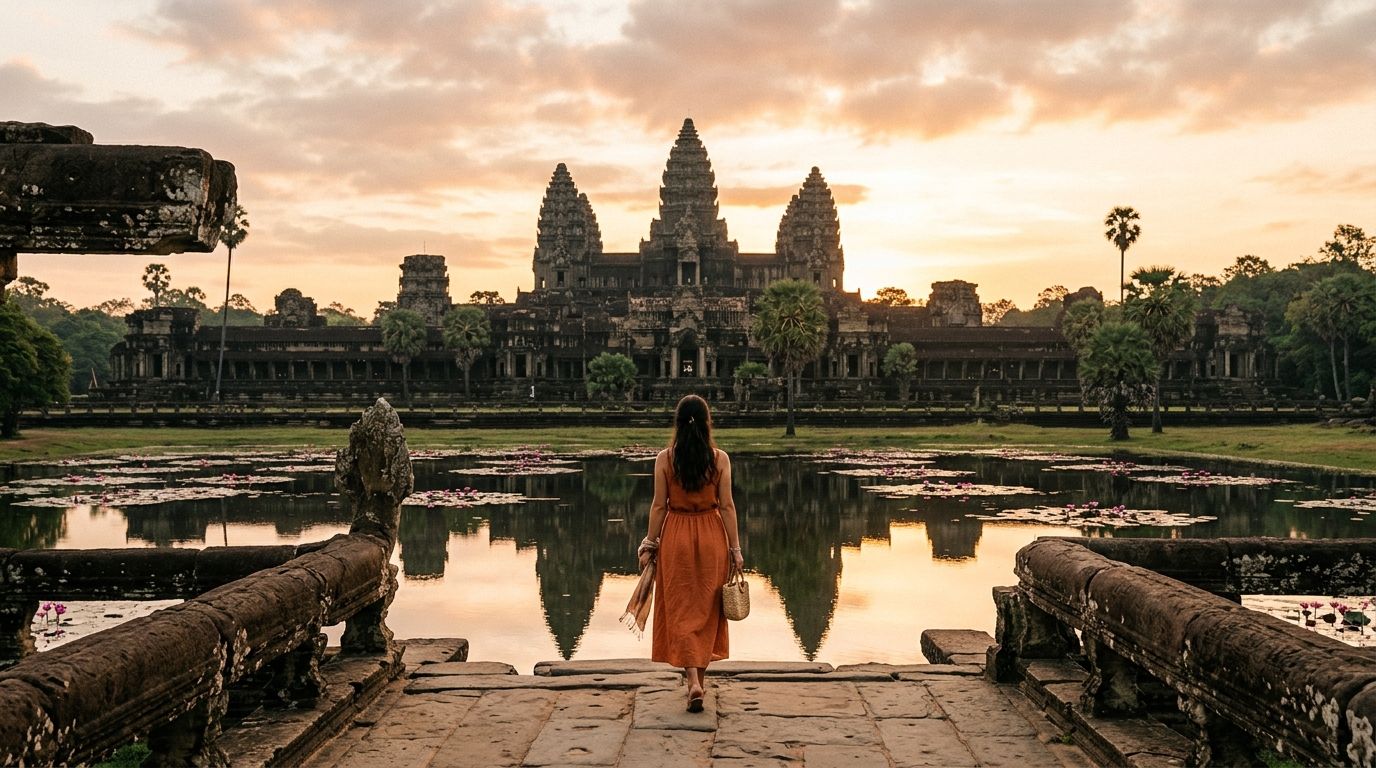
Angkor Wat itself is the architectural centerpiece—the one that appears on the flag. It's massive, precisely carved, and built on a scale that makes clear its builders understood something about permanence. You can walk the perimeter and watch the light change on the sandstone. You can climb to the upper level and feel genuinely small. Or you can arrive at 5 AM to photograph the sunrise, which is when you'll understand why this place became the dominant visual in every Cambodia tourism board's arsenal. The light is almost unfair.
But Angkor isn't just Angkor Wat. It's Ta Prohm—the temple that the jungle is actively reclaiming, with tree roots thicker than your torso cracking the stone. It's Bayon, where 216 carved faces stare outward with expressions that read differently every time you look. It's the smaller, quieter temples where you might be genuinely alone except for a monk or two, and the absence of crowds makes the age of these structures feel suddenly present instead of historical.
From Siem Reap, many people travel to Phnom Penh, the capital, though there's a particular kind of tourist who'll tell you it's less romantic than Siem Reap. This usually means less Instagram-friendly, which isn't the same thing. Phnom Penh is visceral—the Royal Palace is stunning in that formal way, the National Museum holds sculptures that'll change your reference points, and the night markets operate on a logic of chaos that rewards wandering. The Killing Fields and the Tuol Sleng Genocide Museum are necessary and difficult. They're also sites where your discomfort in front of recent history is the point.
The third essential destination is Tonlé Sap Lake itself. You can base yourself in Siem Reap and take day trips to floating villages, or you can do what fewer people do: spend actual time on and around the water. The lake operates on tidal principles—it expands and contracts with seasonal rains in ways that seem almost sentient. In wet season (June to November), it's immense. In dry season, it contracts, and the villages that float become temporary, anchored to shallow water. The people who live there—largely ethnic Vietnamese and Cham Muslim communities—operate in an economy of fishing and, increasingly, tourism. It's economically complicated and undeniably beautiful. You can hire a boat and a guide for a day and essentially become a temporary member of the water community, watching children commute to school by rowboat and fishermen deploy nets with movements honed across decades.
Getting There and Figuring Out When
Timing matters. November to March is the dry season—cooler, clearer, the light better. But it's also high season, which means Angkor Wat at sunrise will include hundreds of other people all trying to capture the same moment. If you can, travel in shoulder seasons: late April, early May, or October. The heat is phenomenal (we're talking 35-40°C, humid), but the crowds are thinner and the landscape is greener.
Getting there: Most international flights land in Siem Reap or Phnom Penh. Siem Reap makes logical sense if temples are your priority; Phnom Penh if you want the fuller Cambodian experience. Both airports have reasonable facilities and taxi arrangements. Visas are straightforward—on-arrival is the norm. You'll fill out a form, provide a photo, and pay approximately $30. Expect a small bribe request at immigration, depending on your passport and luck. It's annoying and routine.
Transport between destinations: Buses run regularly between Siem Reap and Phnom Penh (about 6 hours). Don't cheap out on the bus company; a mid-range operator is worth the extra $5. Driving yourself is theoretically possible and practically inadvisable unless you've spent time in Southeast Asia and feel comfortable with traffic that doesn't recognize lane markings. Tuk-tuks are your daily transport and cost $8-15 for a day hire. Motorbike taxis exist and are cheap if you're comfortable with risk.
Duration: You need a minimum of five days (two for temples, two for Phnom Penh, one for floating villages or other exploration). A week lets you breathe. Two weeks lets you actually absorb the country instead of just accumulating experiences.
A Few Places Nearby
Sihanoukville (4 hours from Siem Reap): A coastal town that's become increasingly built-up and, frankly, increasingly compromised by Chinese investment in casinos. It's not offensively touristed in the Western sense, but it's no longer a quiet beach escape. Go for the islands rather than the town—Koh Rong and Koh Rong Sanloem are swimmable and less developed.
Battambang (3 hours from Siem Reap): The second city, genuinely undervisited, with French colonial architecture, a more authentic atmosphere, and access to smaller temples and rural experiences. If you want Cambodia without the international tourism infrastructure, Battambang is your option.
Kep and Kampot (combined 3 hours from Phnom Penh): Coastal towns in the south where you can escape the heat and crowds. Kep is genuinely tiny and increasingly touristed; Kampot maintains more local character. Neither is essential, but both are pleasant if you have extra time.
Is It Actually Worth the Trip?
Yes, but not for the reasons tourism boards emphasize. Cambodia is worth visiting because it offers something genuine: the experience of a country that's actively rebuilding its cultural identity and doesn't pretend the past didn't happen. The temples are genuinely significant. The food is remarkably good and distinctly different from Thai food, despite proximity. The people are patient with tourists while maintaining a certain ironic distance from them.
Where Cambodia falls short: the tourism infrastructure is functional but not luxurious, especially outside Siem Reap. Expect occasional electrical brownouts, internet that lags, and plumbing that's character-building. The weather in dry season is blisteringly hot. Some of the "authentic village experiences" have become performed versions of authenticity. And if you're looking for a relaxing beach vacation, better options exist throughout Southeast Asia.
But if you want to see a place that's genuinely historic, actively contemporary, and full of people who've survived things that would break most of us—and you're willing to be mildly uncomfortable for that—Cambodia delivers.
Quick Facts
- Best season: November–February
- Visa: On-arrival ($30), valid for 30 days
- Currency: Cambodian Riel (KHR), though USD widely accepted
- Language: Khmer; English increasingly common in tourist areas
- Flight time from Singapore: 1.5 hours
- From Bangkok: 1 hour to Siem Reap, 2 hours to Phnom Penh
- Cost: Mid-range: $50–100 daily (accommodation, food, transport)
The Last Word
Cambodia doesn't seduce you with the immediate appeal of Thailand or the architectural drama of Vietnam. Instead, it grows on you—through conversations, unexpected moments, the sight of a kid fishing from a floating school, a sunset over the Tonlé Sap that you didn't plan but somehow found. The country asks you to move slower and pay attention, which isn't what most travelers want until they realize it's exactly what they needed.
When you're ready to plan your route through Cambodia's temples, villages, and coastal edges, explore our interactive map on Touratu—it'll show you the distances between destinations, the best transport options, and recommended routes based on how much time you have. We've also documented the key experiences in travel videos that give you a sense of what daily life actually feels like on the ground. These aren't highlight reels; they're the conversations, the food, the ordinary moments that made us want to return.
Loading activities…
