
USA Travel Guide: Map, Routes & Things to Do
The United States: A Country Built on Motion and Reinvention
You're standing at a crossroads somewhere between the industrial decay of a Rust Belt city and the gleaming glass towers of its revitalized downtown. A stranger nods as they pass. You realize you don't know which state you're in, or maybe you do, but it doesn't feel like it matters as much as you thought it would. This is what traveling through the United States does: it dissolves borders in your mind while simultaneously proving they're everywhere.
The United States is not a destination in the conventional sense. It's a series of contradictions—a country that invented the road trip while simultaneously building airports to skip the roads entirely. It's a place where you can eat the best meal of your life in a strip mall, or spend $300 on an experience that costs $8 elsewhere. It's where you'll find strangers more generous with their time than their city's taxi drivers, and where the person ahead of you on the hiking trail could live 2,000 miles away but feel like a neighbor.
Most travel guides treat America like it's one place. That's where they're wrong.
What Actually Draws People Here
If you're from elsewhere, you come to America expecting a certain version of itself. You've seen the movies. You know about Times Square and the Grand Canyon and Route 66. But what actually stays with you are the margins—the things that don't appear in guidebooks because they're too ordinary to photograph, or too specific to generalize.
It's the particular way light hits the Hudson River on a November afternoon. The smell of a specific deli in Queens that's been there since 1987 and hasn't changed the menu. The moment you realize that the small town nobody's heard of in rural Montana has better coffee than the Capitol Hill café you paid $8 for. The unexpected kindness of a gas station attendant in rural Georgia who tells you the best route isn't on your GPS.
The United States is genuinely about movement and discovery. Not the Instagram kind, where you're collecting locations like stamps. The actual kind, where you get lost and find something better than what you were looking for.
What to Expect: A Reader's Guide to American Travel
The East Coast: If you arrive on the Eastern Seaboard, you're entering the oldest part of America—literally and spiritually. Boston feels like a city with an attitude problem and a Harvard degree. New York still operates under the assumption that you're trying to impress it, not the other way around. Philadelphia is what New York would be if it smiled occasionally. Washington, D.C. is haunted by its own importance. Charleston moves slower and speaks softer. Miami is whatever you need it to be at that moment.
The experience here is urban and dense. You're walking everywhere. You're eating at restaurants that have been families' projects for generations. You're in museums that shouldn't exist—weird ones, not the famous ones. You're realizing that "Northeast corridor traffic" isn't a joke, it's a lifestyle choice.
The South: Travel deeper into the country's belly, and you enter a different America entirely. The South moves at a different speed. People will talk to you. Strangers become acquaintances over sweet tea. The food tastes like history—some of it delicious, some of it complicated. New Orleans is an entire country unto itself. Nashville is country music, but also a genuine city where creative people actually live. Austin is what happened when Silicon Valley had a one-night stand with Texas. Savannah, Charleston, and Beaufort are where time moved slower and somehow the architecture remembers it.
The Midwest: This is America's secret. The Midwest doesn't want your attention. Places like Chicago have architecture that rivals anywhere on Earth. The Great Lakes are genuinely great. The tallgrass prairies around Kansas City feel like nowhere else you've been. Detroit is a city writing its own comeback story. The people here are practical. They'll feed you well. They won't perform hospitality; they'll just do it.
The West: The scale changes. You understand what "wide open spaces" means when you're driving through Nevada and you don't see another car for forty miles. Los Angeles is chaos masquerading as a city. San Francisco is a city masquerading as a tech campus. Denver is young and growing. The Rockies are exactly as big as you think they are. Utah's red rock country doesn't need you to understand it—it just wants you to look. The Pacific Northwest feels like a different country entirely. Seattle and Portland are cities where it rains but nobody seems to mind. Crater Lake in Oregon exists outside of normal time.
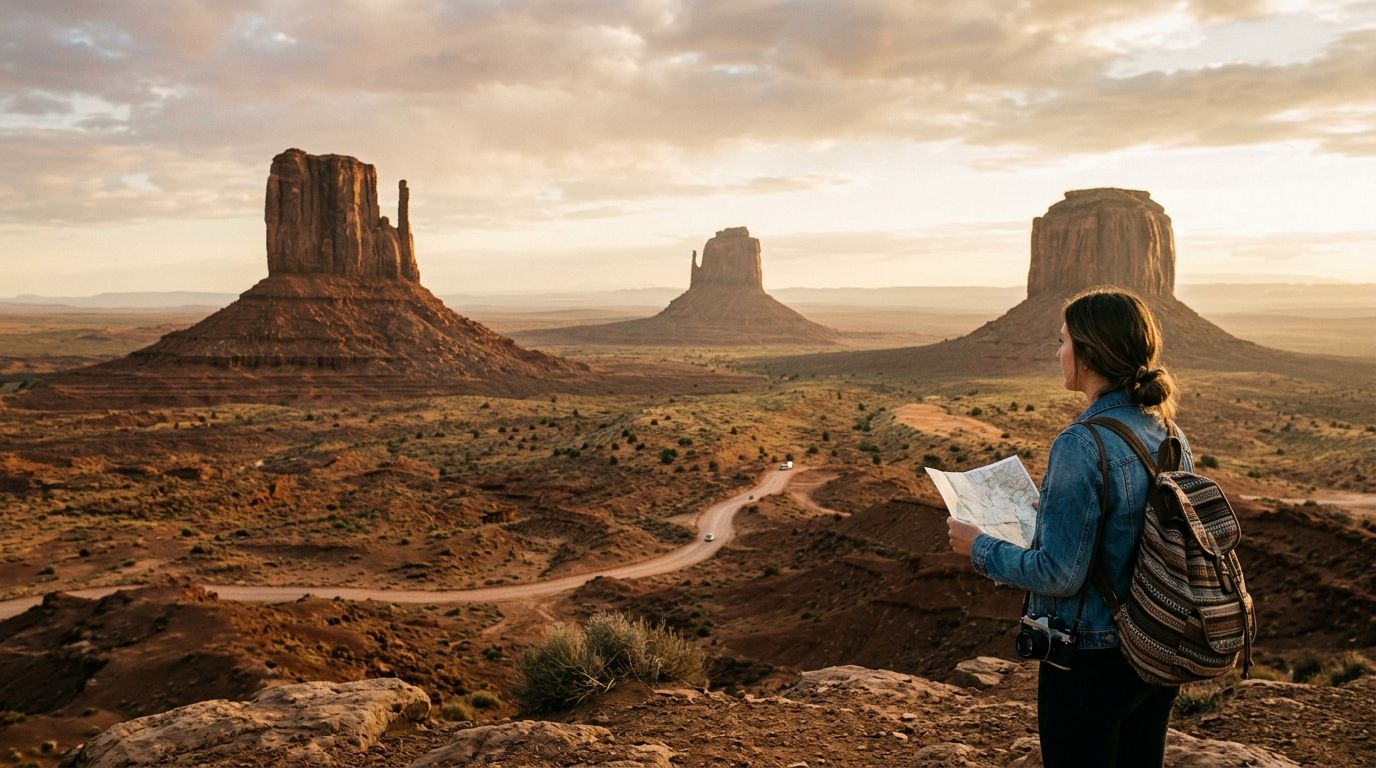
The Southwest: Arizona, New Mexico, and parts of Texas are where the light looks different. The Grand Canyon is famous, but the real revelation is everywhere else—Sedona, Monument Valley, Chaco Canyon. Santa Fe is a small city that somehow contains an outsize amount of human creativity. The desert teaches you about scale and insignificance and your place in it all.
The Experience Itself: American travel is about layered experiences. You're in a major city eating Vietnamese food made by someone whose family came here thirty years ago. You're driving through small towns where the main street is half-empty but the local diner makes pie that tastes like someone's grandmother learned the recipe by accident. You're hiking through national parks alongside retirees and families and solo travelers. You're taking trains, buses, and internal flights. You're staying in hotels from every era, and the $40 motel will sometimes be the most interesting.
Planning Your Visit: The Practical Reality
Best Time to Visit: This entirely depends on where you're going. The country is too large for a "best time." The East Coast's autumn (October-November) is undeniably beautiful. The South is gentler in spring and fall. The Southwest is ideal October through April (summers are brutal). The Pacific Northwest is slightly less rainy June through September. Winter travel exists—snow in the Northeast, mild weather in the South—but you should choose deliberately, not by accident.
How Long: Most people underestimate this. The United States is approximately the size of continental Europe. You cannot "do" the country in two weeks unless you're willing to spend that time mostly in transit. A realistic domestic trip involves a region (the Southwest, the East Coast, California and the Pacific Northwest) explored over 10-14 days, or a longer road trip lasting 2-4 weeks. Americans themselves take road trips that last months.
Getting Around: This is where the United States differs entirely from other destinations. Domestic flights are cheap and reliable (but the experience is decidedly unglamorous). Trains exist (Amtrak) but are slow and expensive for what you get. Buses (Greyhound, Megabus, regional carriers) are affordable but tedious. Renting a car is standard practice and often the best option for exploring beyond major cities. Public transit varies wildly by city—excellent in New York and San Francisco, functional in most major cities, nonexistent elsewhere.
The Costs: The United States is expensive in inconsistent ways. A meal in New York or San Francisco can cost $30-50. The same meal in Albuquerque costs $12. Hotels in major cities range from $150-300+. Accommodation in smaller towns ranges from $60-120. National park entrance fees are approximately $35 per vehicle and valid for a week. Gas (petrol) costs roughly $3-4 per gallon depending on location.
Crowds: This depends on season and location. National parks are genuinely crowded in summer, peaceful in shoulder seasons. Major cities are always busy but less suffocating outside peak summer and December holidays. Small towns and rural areas are never crowded.
Nearby Experiences (Geography Varies)
If You're in the East: The Appalachian region offers small-town authenticity, hiking, and food culture. The Hudson Valley (New York) combines wine country with genuine food culture. The Outer Banks (North Carolina) are beaches without the theme park atmosphere.
If You're in the Southwest: Sedona (Arizona) for red rocks and hiking. Valley of the Gods (Utah) for landscape that looks alien. Carlsbad Caverns (New Mexico) for underground geology.
If You're on the West Coast: The Redwood Forests (Northern California) for old-growth majesty. Mount Rainier National Park (Washington) for mountains that touch clouds. Big Sur (California) for coastline that refuses to be contained.
Is It Worth Visiting?
Yes, but not for the reasons the postcards suggest. The United States isn't worth visiting for the "experience of America" as a concept—that's too abstract. It's worth visiting because you want to understand how millions of people live across a vast, contradictory landscape. It's worth it because sometimes the best food you eat is in a place you weren't planning to go. It's worth it because Americans, despite everything, are generally helpful and curious about strangers. It's worth it because natural landscapes here are genuinely extraordinary. It's worth it because motion is the closest thing to a national sport, and you'll understand something about yourself on a long drive you wouldn't understand anywhere else.
Quick Facts
- Population: Approximately 330 million
- Capital: Washington, D.C.
- Language: English (primary), Spanish widely spoken, plus dozens of immigrant languages
- Currency: US Dollar (USD)
- Time Zones: Six continental zones (Pacific, Mountain, Central, Eastern, plus Alaska and Hawaii)
- Electrical Standard: 120V, Type A/B plugs
- Visa: Depends on your nationality; many countries eligible for ESTA (Electronic System for Travel Authorization)
- Best Transportation: Car for flexibility, flights to cover large distances, public transit in major cities
- When to Avoid: Peak summer (July-August) if you dislike crowds
The Road Ahead
Traveling through the United States isn't about accumulating moments for social media. It's about understanding a country that's still figuring itself out, and recognizing that the figuring-out happens in real time, in real places, with real people. You'll drive through towns that are struggling and towns that are thriving and towns that are somewhere in between. You'll eat food that changes how you think about food. You'll meet people who have nothing to gain by being kind to you and are kind anyway.
The United States doesn't need your validation as a destination. It exists whether you visit or not. But if you come with genuine curiosity instead of a checklist, you might understand why so many people fought so hard to get here—and why so many people who are already here, despite everything, choose to stay.
Explore the routes, detailed maps, and travel videos on Touratu's interactive map to plan your own American journey. Filter by region, duration, and interests to discover routes others have taken—and create your own.
Loading activities…
