
Turkey Travel Guide: Best Things to Do
Turkey: A Traveller's Guide to What Actually Matters
There's a moment when you're standing in Istanbul's Grand Bazaar—surrounded by the smell of cumin and saffron, the clatter of copper being worked, vendors calling out in languages you don't recognise—when you realise you've stumbled into something genuinely alive. Not a museum piece. Not a postcard. A place where commerce and culture are still tangled together in the most ordinary, extraordinary way.
That's Turkey. Not the Turkey of travel brochures, but the actual country—where ancient history isn't cordoned off behind velvet ropes, where locals still haggle over the price of pomegranates, and where you can spend an afternoon watching someone throw pottery on a wheel using techniques that haven't changed in centuries.
What Makes Turkey Worth Your Time
The honest truth is this: Turkey is massive. It's not a destination you "do" in a long weekend, and it shouldn't be. The country spreads across two continents, connecting Europe and Asia, and that geography has made it a crossroads for empires, religions, and ideas for thousands of years. You feel that layering everywhere.
What distinguishes Turkey from other historically rich destinations is the accessibility of its layers. You're not just reading about Byzantine architecture in a textbook—you're walking through the Hagia Sophia, actually standing beneath that impossible dome. You're not imagining Ottoman gardens—you're sitting in one, sipping tea while cypress trees frame the view. The history here isn't presented as a historical event. It's presented as a place where people lived, worked, and still do.
But there's more than the famous stuff. Turkey has a contemporary culture that exists completely independently of tourism. There are neighbourhoods in Istanbul where you won't see another foreign traveller. There are regional cuisines so distinct from one another that eating your way through Turkey becomes a proper education. There are mountain valleys, Aegean coastlines, and underground cities carved into rock that offer experiences that have nothing to do with following a guidebook.
What to Actually Expect
Istanbul
If you've never been, yes, it lives up to the hype. But understanding what you're actually walking into helps. Istanbul is a city of roughly 15 million people, straddling the Bosphorus, where European traffic jams blend with Asian island villages, and Byzantine churches stand next to Ottoman mosques next to art galleries next to fishermen.
The Sultan Ahmed district (where the Blue Mosque and Hagia Sophia sit) is crowded. There's no soft way to say this. During peak season, you'll be moving through these spaces with thousands of other people. Go early, genuinely early—before 7 a.m.—if you want to experience these buildings with any sense of calm. Or go in winter, when the crowds thin considerably and the light becomes strange and beautiful.
Beyond the major mosques, the real Istanbul exists in districts like Balat, where Ottoman houses in shades of pink and yellow line narrow streets, or Beyoğlu, where independent bookshops, galleries, and restaurants indicate where the city's creative energy actually lives. Spend a full day getting lost in the neighborhoods that exist beyond the tourist infrastructure.
Cappadocia
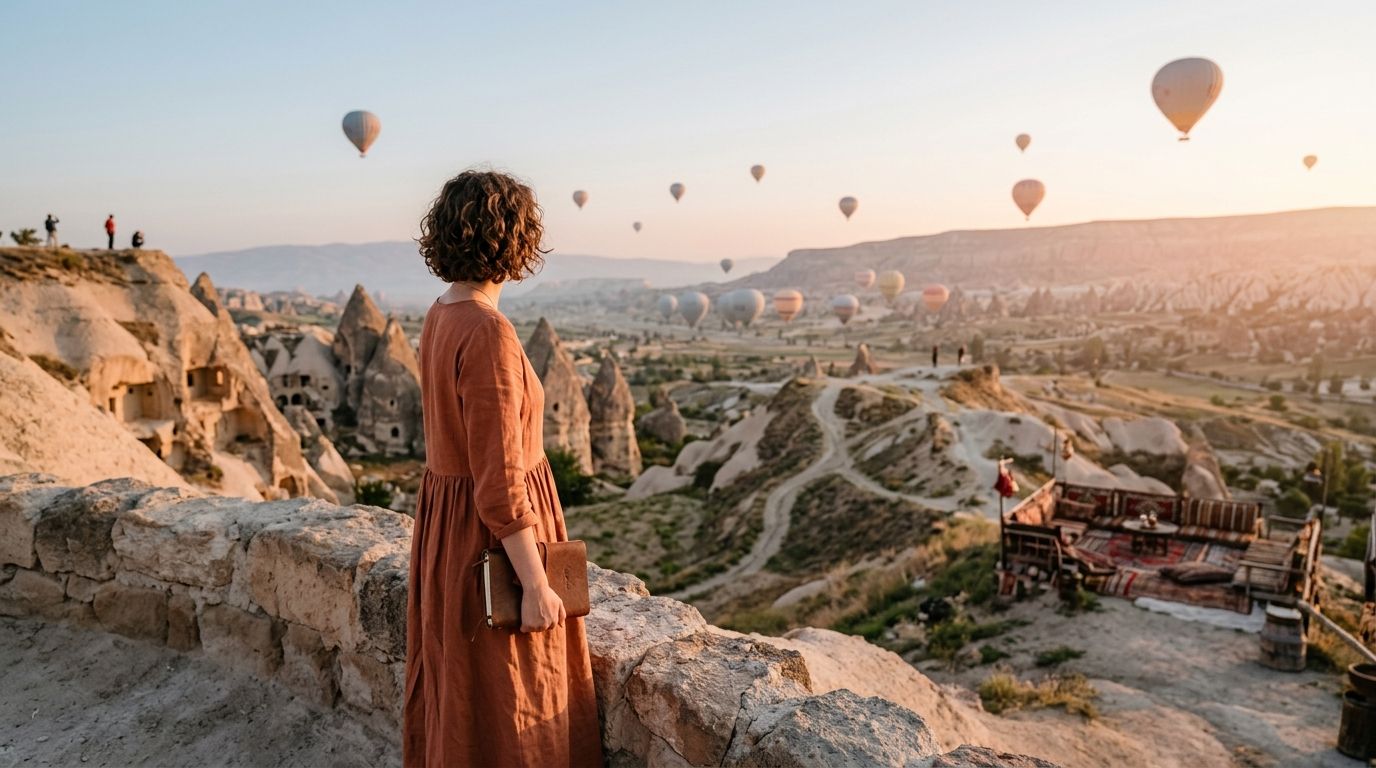
The fairy chimneys—those peculiar rock formations rising from the earth—look exactly like the photos. That's actually unusual. Usually, places look smaller or less dramatic in person. Not Cappadocia. If anything, the scale is disorienting. You're standing in a landscape that feels genuinely alien, where humans carved entire settlements into soft volcanic rock and then lived underground for centuries.
The hot air balloon rides at sunrise are worth doing, even though they're touristy. There's something about floating above this impossible landscape as the light changes that justifies the experience. Book them locally, not through online aggregators—you'll pay less and support the actual operators.
Expect a slower pace here. Cappadocia doesn't reward rushing. Spend time walking through the valleys, visiting the cave churches with their Byzantine frescoes, and sitting in small villages where life moves according to agricultural rhythms, not tourist schedules.
Aegean Coast
The turquoise water is real. Bodrum and Marmaris are the famous coastal towns, and they've been developed accordingly—meaning seafront restaurants, boat tours, and infrastructure. That's useful if you want comfort; it's limiting if you want authenticity.
The smaller towns—Datça, Kalkan, Ölüdeniz—offer what feels like a more genuine version of Mediterranean Turkey. The swimming is still excellent. The food is fresher. The evening light is the same, but you're experiencing it with fewer people around.
Ankara and Antalya
Most travellers skip Ankara, the capital, assuming there's nothing to see. There is: the Anatolian Civilizations Museum contains some of the world's most important archaeological artifacts, and the city itself has museums, parks, and neighborhoods worth exploring. It's refreshingly untouristy.
Antalya serves as the main beach resort destination, backed by the Taurus Mountains. It's pleasant without being particularly distinctive—a launching point for other experiences rather than a destination itself.
Planning Your Visit: The Practical Bits
Timing
April through May and September through October are genuinely the best months. Weather is warm, crowds are lighter than summer, and the landscape isn't dried out. July and August are hot, chaotic, and expensive. Winter (November to February) is quieter but unreliable—some regions can be rainy or snowy, and some smaller attractions close seasonally.
Duration
Two weeks is a reasonable minimum if you want to see Istanbul, Cappadocia, and the Aegean coast without feeling completely rushed. A week requires choosing your battles—perhaps Istanbul and one other region. Three weeks would let you actually breathe and include places like Konya (for Sufi history) or the Black Sea coast.
Getting Around
Domestic flights between major cities are cheap and frequent—flying Istanbul to Cappadocia to the Aegean coast makes logistical sense. Intercity buses (Flixbus, Pamukkale, Metro) are comfortable, inexpensive, and reliable; they're also slow if you're in a hurry. Renting a car is possible but driving in Turkish cities is its own learning curve—aggressive, unpredictable, and not for everyone.
Money and Practicalities
Turkey is affordable if you're not staying in Istanbul's luxury hotels. A good meal costs $5-8. A nice hotel room in a mid-sized city costs $30-50. The lira fluctuates against major currencies, but this makes Turkey increasingly good value for visitors from Europe and North America.
ATMs are ubiquitous. Most mid-range and upmarket places take cards. Tipping is expected (10-15% in restaurants) but less formalized than in some countries.
Language
English is spoken in tourist areas and by people in the tourism industry. In smaller towns and rural areas, English becomes much rarer. Learning a few key phrases in Turkish—"merhaba" (hello), "teşekkür ederim" (thank you), "ne kadar?" (how much?)—makes interactions warmer and locals noticeably more helpful.
Places Worth the Detour
Pamukkale
About 250km south of Cappadocia, these white mineral terraces descending a mountainside look like something designed by a fantasy architect. The thermal pools are warm year-round. It's touristy but genuinely distinctive—there's nothing quite like it anywhere else.
Troy and Gallipoli
Northwest Turkey, near the Dardanelles Strait. Troy is the archaeological site of the ancient city, genuinely important historically. Gallipoli is where you walk battlefields from World War I, a sobering experience. These are meaningful places, not just photo locations.
Konya
Interior Anatolia, known for the Sufi whirling dervish tradition and Islamic philosophy. If you're interested in understanding Turkish spirituality and culture beyond the surface, Konya offers that. It's less touristy than major destinations, which is part of its appeal.
Is It Worth Visiting?
Yes, with the understanding that Turkey isn't a single coherent experience. You're not going to stand on one hilltop and see the entire country. You need to move between regions, stay long enough in at least some places to let them reveal themselves, and accept that parts of it will confuse or frustrate you.
The bureaucratic side can be irritating. Some service industries aren't as efficient as Western expectations. Haggling is expected in bazaars and can feel exhausting if you're not used to it. The political complexity of modern Turkey exists—it's a secular state with an Islamic majority, a NATO member with complicated relationships with various powers, a country attempting to balance modernity and tradition.
But these complications are exactly what make Turkey interesting. It's not a polished destination. It's a genuine place with genuine complexity. And for travellers who can meet that complexity with curiosity rather than expectation, Turkey offers experiences that feel substantial and real.
Quick Facts
- Official language: Turkish
- Currency: Turkish Lira (TRY)
- Best time to visit: April-May, September-October
- Visa: Most Western citizens receive 90-day tourist visas on arrival or through ETIAS
- Electricity: 220V, European two-pin plugs
- Tipping: 10-15% in restaurants; not expected elsewhere
- Internet: Excellent in cities, reasonable in towns; local SIM cards are cheap
- Food to try: Manti (dumplings), lahmacun (Turkish pizza), fresh seafood, kebab (dozens of variations)
Turkey rewards curiosity and time. If you approach it as a checklist destination, you'll see the famous sights. If you approach it as a place to actually experience, you'll understand why it's been strategically important, artistically significant, and culturally layered for millennia.
Ready to plan your route? Explore Turkey's regions, highways, and hidden routes using Touratu's interactive map. Watch authentic travel videos from people who've actually spent time there, then book activities directly—from hot air balloon rides over Cappadocia to gulet sailing along the Mediterranean coast. The map is designed to help you discover not just what to see, but how to move through the country in a way that makes sense for your time and interests.
Loading activities…
