
Turkey's 20 Must-Return Destinations: Travel Guide
Turkey: Why Travelers Keep Coming Back to These 20 Places
There's a peculiar magnetism to Turkey that defies logic. You arrive expecting postcard moments—the blue mosques, the hot air balloons, the glittering straits. But what actually happens is more subtle. You watch morning light pour across ancient stones, and something shifts. The street vendor knows your name by day three. You find yourself returning to the same çay garden not because it's famous, but because the owner's grandson practices his English with you while his grandmother's laughter echoes from the kitchen. That's when you understand: Turkey isn't designed for a single visit. It's engineered for return.
The country doesn't reveal itself all at once. It unfolds across tea glasses, conversation, and the kind of wandering that makes maps seem optional. Whether you're drawn back by the call to prayer at dusk, the particular warmth of strangers-turned-friends, or simply the ache of unfinished exploration, Turkey has a way of becoming unmissable. Here are the places that make travelers book return flights before they've even left.
1. Istanbul: The Threshold Between Worlds
The real magic of Istanbul isn't in the monuments—though they're extraordinary. It's in the disorientation of standing where Europe and Asia trade places, where a fisherman casts into the Golden Horn while a city of 15 million pulses around him. Galata's narrow streets smell like cardamom and tobacco. The Grand Bazaar isn't a market; it's a living organism with its own rhythm and dialects.
The photography moment: Sunrise from Pierre Loti Café, when the mosques are still silhouettes and the ferries cut silver paths through mist.
Best time: April-May or September-October. Winter brings rain; summer brings chaos.
Insider observation: Skip Sultanahmet on weekends. Slip into neighborhoods like Balat or Ortaköy on weekday mornings—you'll see the city as residents actually live it.
Practical tip: The Istanbulkart transit card works on ferries, metros, and buses. Stay multiple times if you can; the city changes depending on which shore you sleep on.
2. Cappadocia: Landscape as Architecture
Cappadocia doesn't feel like Turkey at all. It feels like a fever dream rendered in tufa and time. The fairy chimneys weren't named for whimsy—they're geological poetry, weathered by two million years into formations that seem impossibly architectural. When you hike through valleys carved by ancient water, you're not just admiring scenery; you're walking through an underground city's ceiling.
Why it stands out: This is the only place on earth where you can actually stay inside a cave and watch the landscape glow apricot at sunset from your bedroom window.
Best time: April-May or September-October. The balloon rides are dreamy in any season, but spring light is unforgiving—bring sunscreen.
Photography moment: From inside a cave hotel at twilight, when the valley becomes amber and the stone walls frame the last light.
Practical tip: Book cave hotels months in advance if traveling in peak season. The experience matters more than the amenities.
3. Ephesus: When History Breathes
Most ancient ruins feel like skeletons. Ephesus feels inhabited. Walk the marble streets where philosophers and merchants once argued, and you're not imagining history—you're standing in someone's story. The Library of Celsus still commands attention despite its wounds, and the Temple of Artemis, reduced to a single column, somehow feels more sacred for its solitude.
Why it stands out: The scale is human. You're not looking up at something distant and marble-cold; you're walking where footsteps still echo.
Best time: Early morning in any season. Arrive before 8am and you'll have entire streets to yourself.
Insider observation: Visit the Houses of Mary and the Virgin Mary's supposed home up the mountain. Whether you believe the legend or not, the simplicity of the place—a woman's ordinary room—humanizes everything.
4. Pamukkale: The Illogical Beautiful
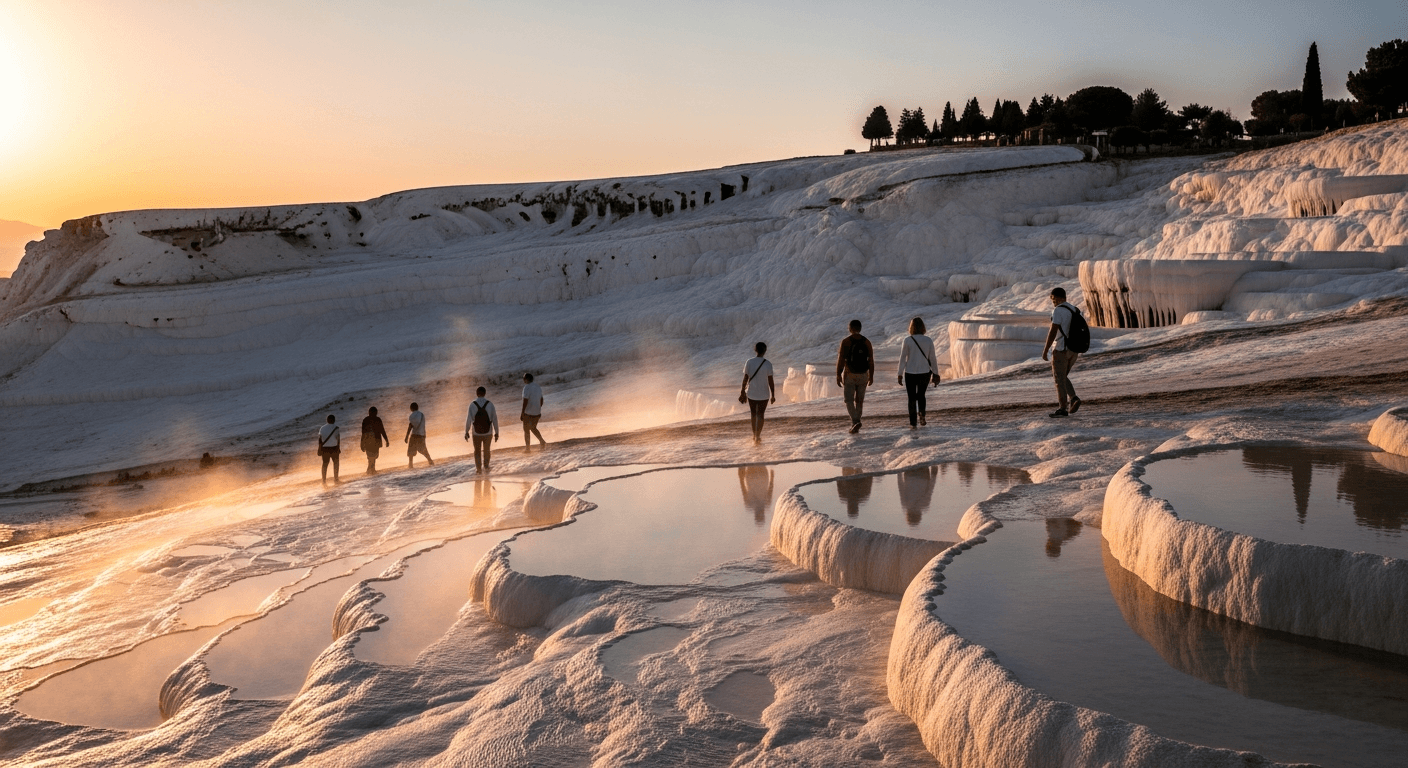
Cotton Castle. Water so saturated with minerals it builds castles. It sounds synthetic, like someone invented it for Instagram. But standing at the edge of those white travertine terraces, watching water cascade like liquid marble down the mountainside, you stop trying to explain it. Some places exist outside reason.
Best time: Early morning before crowds arrive. The light transforms the white into something almost ethereal.
Photography moment: From below, looking up as water catches the sun mid-fall.
Practical tip: Wear sandals. Bring a light wrap—the white amplifies heat, but the water pools are cool. Swimming in them is allowed but tourist-heavy.
5. Gallipoli: Where History Moves You
This isn't a destination for marvel-seeking. This is a pilgrimage for understanding. The beaches where thousands died are now quiet and ordinary. A handful of monuments mark impossible bravery. Whether you're Australian, Turkish, British, or simply human, standing here—really standing here—reminds you that tourism sometimes means witnessing sacrifice, not consuming views.
Why it stands out: The weight of story transforms landscape into something sacred.
Best time: April 25 (ANZAC Day) brings ceremonies that are moving without being performative.
Practical tip: Hire a guide. The history matters more than the views. Budget a full day.
6. Troy: Mythology Becomes Tangible
The wooden horse is long gone, and the actual archaeological layers seem anticlimactic until you climb them. Then something happens: you're literally ascending through wars, civilizations, destruction, and rebuilding. Troy isn't a single place—it's seventeen versions of human ambition stacked on top of each other.
Insider observation: Visit the small museum at the base. It transforms scattered stones into story.
Best time: May or October. Summer heat makes the exposed hill punishing.
7. Antalya: Modernism Beside Antiquity
The Turkish Riviera could be just another beach destination. Instead, it's a place where five-star resorts sit kilometers from Lycian tombs carved into cliffs. The old town, Kaleiçi, remains genuinely atmospheric despite tourism. Pebble beaches and pine forests create intimacy despite the summer crowds.
Why it stands out: You can dive into Hellenistic history in the morning and sunset-dine on contemporary Mediterranean food in the evening.
Best time: May or September. June-August is tourist season, but the sea is warmest August-September.
Photography moment: Kaş's turquoise harbor in late afternoon light, when shadows turn the water impossible shades of blue.
8. Konya: Sufi Devotion & Whirling Dervishes
Konya feels removed from coastal Turkey entirely. It's the heartland, the spiritual center where whirling dervishes perform their meditative dance at the Mevlana Museum. You don't watch this—you witness it. The spinning isn't performance; it's prayer.
Best time: December, during the Şeb-i Arus festival (the commemoration of Mevlana's death, paradoxically a celebration). Year-round performances happen Wednesday evenings.
Insider observation: The museum's tile work rivals anything in Istanbul. Arrive early for the sufi ceremony.
9. Bodrum: Summer's Truest Face
Unlike Antalya, Bodrum hasn't smoothed its edges for tourism. The castle dominates the harbor. The marina bustles with gulet sailing boats. Fishermen still sell their catch. It's busy in summer, yes, but it remains a working port town that happens to be beautiful.
Why it stands out: The water is clearer here, and the nightlife matters less than the everyday rhythm of a Mediterranean port.
Best time: June or September. August is relentless with tourists; May is unpredictable weather-wise.
Practical tip: Rent a gulet for a day sail to nearby Greek islands. The experience costs less than a four-star dinner and reveals the coast as it actually is.
10. Marmanis: Where Pines Meet Sea
The least famous of the Turquoise Coast towns, Marmaris compensates by being genuinely relaxed. Pine forests descend to turquoise water. The bazaar is functional rather than touristic. You can disappear here without feeling like you're escaping tourism—you're just living quietly in a very beautiful place.
Best time: June or September. The sea is ideal for swimming.
11. Dalyan: Turtle Country
This isn't about lounging. It's about river boat rides to Iztuzu Beach, where endangered loggerhead turtles nest. You float past limestone cliffs and Lycian tombs carved impossibly into rock faces. The turtles are the reason to come; everything else is just bonus.
Why it stands out: It's a place where tourism and conservation coexist respectfully.
Best time: June-July for turtle nesting season, though boats run year-round.
12. Rize: Tea Plantations & Misty Mountains
On Turkey's Black Sea coast, Rize grows what Turks drink obsessively: tea. The green hillsides are nothing like the Aegean or Mediterranean coasts. It's emerald, misty, almost Scottish. You visit not for monuments but for the rhythm of harvest season and for tea that tastes like it came from the hands that picked it.
Why it stands out: Tourism here hasn't petrified the place. You're genuinely welcome on tea estates; families still work the land as their grandparents did.
Best time: Any season. Summer is warmest; spring and fall have the most dramatic cloud formations.
Practical tip: Take the train from Istanbul to Rize. It's a journey in itself—you'll watch the landscape transform from urban to pastoral.
Getting There: The Practical Poetry
Domestic flights connect major cities efficiently; the bus system (Flixbus, Metro Turizm) is both cheap and surprisingly comfortable. Within towns, dolmuşes (shared minibuses) are the rhythm of local life—hop on, pay when you get off, learn the city's skeleton. Istanbul's metro and tram system works on the Istanbulkart; use it instead of taxis. The culture of hospitality isn't manufactured—if you're lost, someone will redirect you. Accept çay when offered; it's ritual, not obligation.
Etiquette matters: Remove shoes when entering homes and most mosques. Dress modestly in religious sites. Bargaining isn't aggressive here—it's conversation. The kindness toward travelers in Turkey is genuine, which means respect matters.
Neighborhoods to sleep in: In Istanbul, choose Balat or Cihangir over Sultanahmet. In smaller towns, stay in old quarters (Kaleiçi, Eski Şehir) rather than resort areas. The experience is dramatically different.
Discovering Your Own Return Routes
The beauty of returning to Turkey isn't just about visiting new places—it's about revisiting corners you thought you understood and finding new layers. On Touratu's interactive map, you can explore traveler routes through Turkey, discover personal reels and visual stories from people who've returned again and again, and trace the paths that made them come back.
The Reason for Return
Turkey doesn't demand to be understood. It simply invites you to stay longer, to drink more tea, to linger in a conversation that started as directions. The monuments will still be there on your next visit, but what actually brings you back is smaller: a café owner's memory of you, a trail you didn't have time to finish, a sunset you want to watch from a different angle. This is why travelers keep coming back. Not because Turkey is perfect, but because it's patient enough to let you discover what perfection means to you.
Loading activities…
