
Sri Lanka Travel Guide: Routes, Videos & Activities
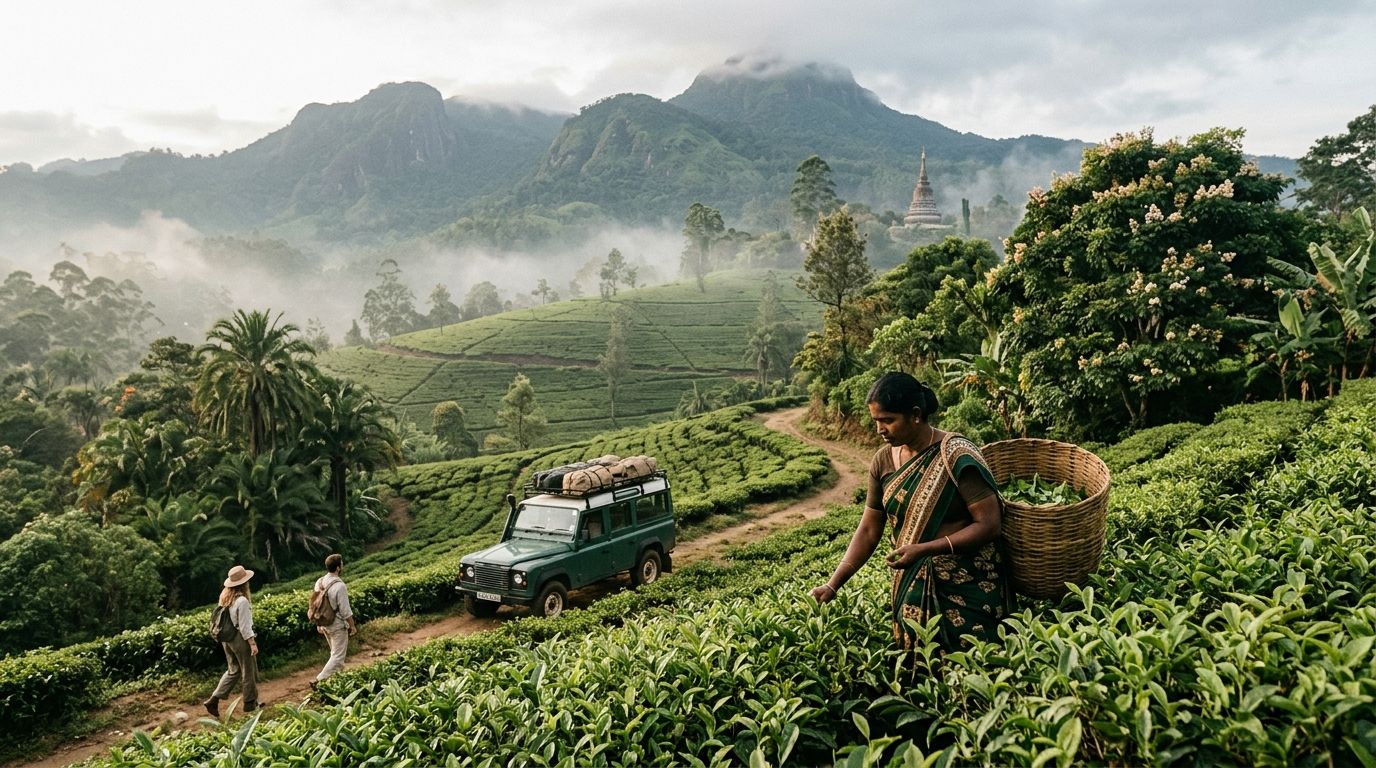
Sri Lanka: Where Monsoons Meet Mountains and the Tea Grows On
The train pulls out of Kandy station at dawn, and within ten minutes, you've left the city entirely. Your compartment is half-empty—just an elderly woman with a carrier bag of cinnamon sticks and you, pressed against the window as the tracks wind upward through tea plantations so green they hurt to look at. The air changes. It becomes cool, almost crisp. Below, villages appear and disappear, and somewhere in the distance, you can hear the sound of water hitting rock. This is the moment most people come to Sri Lanka for, except most of them don't actually experience it this way—they're photographing it from a moving vehicle or checking their phone in a tour bus. But if you sit quietly, you realize something: Sri Lanka doesn't feel like a tourist destination at all. It feels like a place that just happens to allow visitors.
This is an island of contradictions. It's small enough to circle in a week, yet somehow contains five distinct climates, three major religions, and a coastline so varied you'd swear you were visiting different countries. The beaches are genuinely excellent. The mountains are genuinely cool. The people are genuinely warm. But what makes Sri Lanka stick with you—what actually matters—is the strange, unhurried rhythm of ordinary life happening around you, regardless of whether you're there to witness it.
Why This Island Actually Lingers
Sri Lanka gets called a lot of things. A pearl. A teardrop. A spice island. The marketing language bounces off you after the first day, because you realize the island doesn't need hyperbole. What you actually notice is how tightly everything is packed—not in a stressful way, but in a logical way. You can start the morning in rainforest, have lunch at a colonial-era tea plantation, and watch the sunset over the Indian Ocean, and this isn't an exaggeration or a packed itinerary—it's genuinely just geography.
The second thing you notice is the food. Not because it's photogenic (though it is), but because it's built into the rhythm of living here. Every meal is a negotiation between Indian spice traditions, coconut cultivation, and whatever the fish market brought in that morning. The curry here isn't a single thing—it's a principle applied to everything. Jackfruit curry. Dhal curry. Lotus root curry. Crab curry. Each one is different, and each one tastes like someone actually understood what they were cooking.
The third thing—and this is harder to explain—is that Sri Lanka feels like a place that's becoming more itself rather than more touristy. Yes, there are elephant sanctuaries and tuk-tuk rides and yoga retreats. But there's also real work happening. Real farming. Real fishing. The tuktuks you ride aren't props; they're how people actually move around. The tea plantations you visit aren't heritage experiences; they're actively producing tea that goes to global markets.
What You'll Actually Find Here
The Central Highlands
Most travelers come for the tea. Here's what that actually means: you'll drive or take the train into hills where the landscape has been shaped by colonial-era agriculture into something that looks almost designed. The slopes are impossibly steep, and on those slopes, women in bright saris hand-pick tea leaves under sun that would kill you if you weren't acclimated. This is work, not a photo opportunity, though the visual landscape is extraordinary.
If you visit a plantation, you'll be shown the process—leaf sorting, drying, grading—and the guides are usually straightforward about economics. The price of tea on global markets dictates whether workers get a raise. Climate affects yield. These aren't abstract problems; they're why the manager is slightly worried when you meet him.
Stay in Nuwara Eliya, which is high enough that you'll need a light jacket at night—genuinely unusual in the tropics. The town is a hangover from British occupation, complete with a Post Hotel and golf course, but it functions as a genuine mountain town for the people who live here, not a theme park. The prices reflect this. A room at a colonial-era guesthouse costs roughly what you'd pay for a mid-range coffee in London.
The Coasts
The southern coast near Mirissa and Unawatuna exists in a strange space between developed beach town and working fishing village. Mirissa especially has transformed into something that wasn't quite intended—it's where digital nomads, surfers, and families with small children somehow coexist. The beach itself is perfect in an understated way. The water is warm. The seafood is cheap and fresh. You can rent a catamaran for whale watching (if the season aligns; most tours are January-April), or you can simply sit with a king coconut and read for three days straight.
Go north to Arugam Bay for a rougher, more genuinely local experience, or to the Jaffna Peninsula if you want to see a part of Sri Lanka that's still rebuilding and developing its own tourism infrastructure—which means fewer tourists, cheaper everything, and the feeling of arriving somewhere before it's fully announced itself.
Sigiriya and the Cultural Triangle
Sigiriya Rock is genuinely worth climbing, partly for the fifth-century palace remains and frescoes at the summit, but mostly because the physical act of ascending this impossible granite peak gives you perspective on how someone decided this was an acceptable place to build a fortress. The surrounding region—Polonnaruwa, Dambulla cave temples—contains Sri Lanka's archaeological center. You can spend days here and feel like you're moving through actual history, not curated history.
The crowds here are real, but they're distributed. Show up at Sigiriya by 6 a.m., and you'll have the climb mostly to yourself. By 9 a.m., it's genuinely crowded. This isn't a secret; it's just how crowds work.
Kandy and the Sacred
Kandy hosts the Temple of the Tooth (home to a Buddha relic) and sits beside a lake in the hills. The temple itself is profoundly busy—tourists and pilgrims mixed, shoes removed, devotion and observation tangled. This isn't a peaceful experience; it's an active one. The city beyond is a standard South Asian provincial center. But the combination of genuine pilgrimage location and functional city (rather than tourist town) gives it an interesting texture.
Planning an Actual Visit
When to Go
Sri Lanka has two monsoon seasons, and they hit different coasts at different times. This is actually useful information:
December-March: Best for the southern and western coasts. Dry, warm, good visibility for whale watching (especially January-February). This is peak season, which means higher prices and more people, but not unbearably so.
May-September: Best for the northern and eastern coasts. It's the monsoon season for those areas, which sounds bad, but means fewer tourists and the landscape is wet-green and alive. Afternoon rains are heavy but brief.
For the highlands (Kandy, Nuwara Eliya, tea plantations), December-May and August-September are best. The place is cool even when the lowlands are sweltering, which is why British colonists built their summer houses here.
If you want to avoid crowds entirely, shoulder seasons (April, October-November) are solid. You'll encounter some rain, but dramatically fewer people and 20-30% lower accommodation prices.
Duration and Movement
Most people spend 7-10 days here. It's enough to see multiple regions without exhausting yourself. A typical loop: Colombo (1-2 days) → Central Highlands via Kandy (3-4 days) → Sigiriya (2 days) → Southern beaches (2-3 days).
Transport is reasonably straightforward. You can rent a car with driver (recommended unless you really enjoy chaotic traffic), take trains (romantic but slow), or combine tuktuks and buses (cheapest, most immersive, requires patience). The distances are deceptive—what looks like 3 hours can take 4-5 depending on traffic around Colombo and Kandy.
Crowds and Realism
Popular sites like Sigiriya and Mirissa have gotten busier in recent years. This isn't because they're overrun, but because Sri Lanka's tourism infrastructure has improved and it's genuinely affordable. You can absolutely visit these places and have a fine experience; you just can't have them alone.
Less-visited places—the Jaffna Peninsula, the inland areas around Polonnaruwa, the coastal towns north of Negombo—exist, but they require more planning and longer travel times. The trade-off is generally worth it if solitude matters to you.
Nearby Worth Considering
The Maldives (45 minutes by plane from Colombo) is the opposite of Sri Lanka—expensive, isolated, marine-focused. If you're looking for pristine beaches with resort infrastructure, it's straightforward. But it's a different thing entirely.
South India (ferry from Jaffna, or flight from Colombo) is adjacent geographically but feels completely different culturally. Tamil Nadu and Kerala offer their own logic. Sri Lanka sits between India and Southeast Asia conceptually; you can feel it in the food, language, and architecture.
Is It Worth Your Time?
Yes, with the understanding that "worth it" means different things.
If you want beaches: yes, they're genuinely good, and significantly cheaper than equivalents elsewhere.
If you want mountains and hiking: yes, the central highlands deliver, and the elevation change is dramatic enough to feel like a different country from the lowlands.
If you want culture and history: yes, the combination of Buddhist, Hindu, and Christian heritage sites is real and worth exploring, not manufactured.
If you want a "spiritual awakening" or "life-changing experience": this is a heavy lift, and Sri Lanka—like any place—won't do that for you. What it will do is give you genuine experiences that you'll need to interpret yourself.
If you want digital detox and permanent relaxation: possible, but you'll need to pick quiet places and avoid November-February and organized tour groups.
Quick Facts
- Population: ~22 million
- Languages: Sinhala (official), Tamil widely spoken, English common enough
- Currency: Sri Lankan Rupee (1 USD ≈ 330 LKR, rates fluctuate)
- Visa: 30-day tourist visa on arrival or online (simple process)
- Vaccinations: Consult your doctor; typhoid and Japanese encephalitis sometimes recommended depending on where you're going
- Best time: Depends on coast, but generally December-February and August-September
- Getting around: Hire a driver, take trains, or use buses. Roads are better than you'd expect from the infrastructure level
Closing
Sri Lanka rewards curiosity more than it rewards a checklist. The people you meet matter more than the sites you tick off. The conversations—about politics, cricket, religion, the price of tea—will teach you more than any guidebook.
Start exploring your Sri Lanka trip with Touratu's interactive map—it shows you routes through the tea plantations, coastal roads, and mountain passes, with videos of what you'll actually encounter rather than highlight reels. See the real logistics of moving between regions, discover lesser-known stops recommended by people who've spent time here, and book activities that fit your actual travel style, not someone else's Instagram feed.
Loading activities…
