
Spain Travel Guide: Top Things to Do & Planning
Spain: A Country Where You'll Actually Want to Stay Longer Than You Planned
The first time you step off a train in Spain, you notice the light before anything else. It's not just bright—it's unapologetic. It falls at an angle that makes even ordinary plazas look like they've been lit for a film. You're standing on ancient stone, surrounded by people who are in absolutely no hurry, and you realize you've entered a place that operates on a fundamentally different understanding of what a day should contain.
Spain isn't a single destination. It's a country of distinct regions that share a language but little else in temperament or landscape. The Spain of Barcelona's geometric Modernisme architecture bears almost no resemblance to the whitewashed villages of Andalusia, which themselves feel separate from the green Basque country or the windswept meseta of Castile. This fragmentation is actually what makes Spain endlessly revisitable. You could spend ten visits here and still feel like you're discovering something new.
What Actually Makes Spain Worth Your Time
Most travel writing about Spain leans heavily on flamenco, paella, and passion. The reality is messier and more interesting. Spain is memorable because it's a country where culture hasn't been completely tidied up for tourism—not yet, anyway. You'll find yourself in conversations with shopkeepers who have strong opinions about everything. You'll eat food that tastes the way it's supposed to taste because no one here got the memo about presentation trumping substance.
The country also has an unusual relationship with time. Lunch is still the main meal. Dinner happens late, and nobody apologizes for this. Shops close in the afternoon. People sit in cafés for hours. This rhythm can initially feel frustrating if you're traveling with a checklist mentality, but if you surrender to it, you'll understand why Spaniards consistently rank among the happiest populations in Europe. They're not rushing toward the next thing.
Culturally, Spain offers legitimate intellectual depth alongside the leisure. You're not just visiting historical sites—you're walking through the actual architecture of how Western civilization developed. The Cathedral of Santiago de Compostela isn't just an Instagram backdrop; it's the destination of a pilgrimage route that's been active for over a thousand years. The Sagrada Familia isn't just Gaudí's fever dream; it's a theological argument in stone.
What to Expect When You Actually Get There
In Barcelona: Expect crowds, especially if you're visiting the Gothic Quarter or Park Güell. The city's energy is relentless and mostly young. You'll find yourself surrounded by people from everywhere else in the world, which is fine, but the Barcelona that locals actually inhabit tends to be in neighborhoods like Gràcia or Sant Antoni, where the pace slows considerably. The architecture is genuinely striking—not because it's "beautiful" in a postcard sense, but because Modernisme architects were solving real problems about how to pack human life into dense urban space while maintaining light, ventilation, and visual coherence. That's more interesting than pretty.
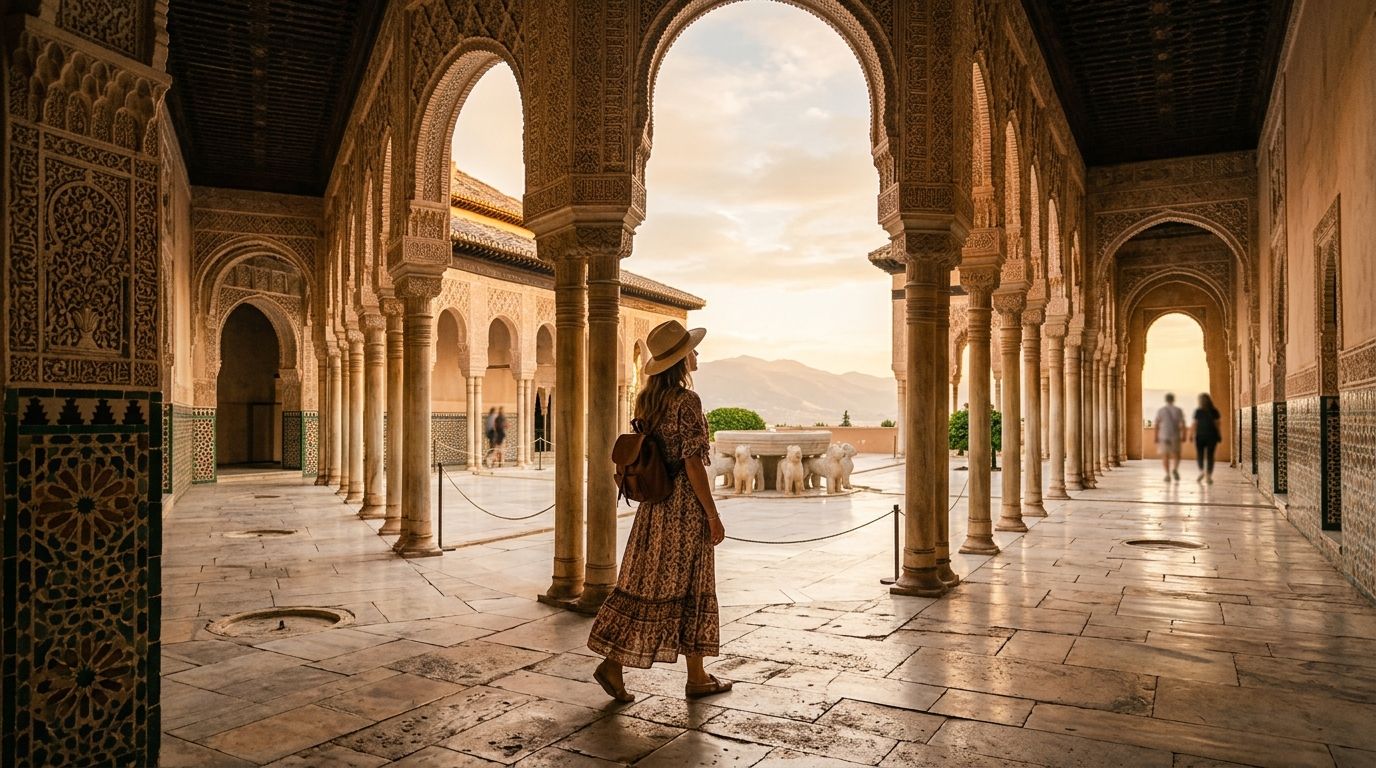
In Andalusia: This is where Spain's medieval Islamic and Christian heritage overlaps visually. Granada's Alhambra is extraordinary specifically because it's a complete palace complex, not a single monument. You can see how people actually lived, how they moved through water and light. Seville's Cathedral and Alcázar will make you understand why cities built on trade routes became so culturally sophisticated. But prepare yourself: these places are popular, and certain hours will feel like you're navigating a crowded marketplace. Go early, or go in the evening when tour groups have departed.
In Madrid: The city has a reputation as less "romantic" than Barcelona or Seville, which is accurate. It's a capital city that cares more about art museums, food, and nightlife than historical monuments. The Prado Museum is genuinely one of the world's great collections. You can spend days here. The city also has excellent neighborhoods for just wandering—Malasaña, Chueca, and Retiro aren't on most tourist itineraries but they contain the actual cultural life of the city.
In the Basque Country: This region (Euskadi) has its own language, culture, and distinct personality. San Sebastián is one of Europe's most sophisticated food cities, with more Michelin stars per capita than anywhere except Kyoto. If you're interested in food, this region validates the trip. Bilbao's Guggenheim Museum is architecturally audacious in a way that justifies the visit beyond being a famous building. The Basque landscape is genuinely different—greener, cooler, more Atlantic than Mediterranean.
On the Camino de Santiago: If you're considering a multi-day walking pilgrimage, understand that this is a real undertaking. The Camino Frances is about 800 kilometers from the French border to Santiago. People complete it in 4-6 weeks. It's become popular with diverse pilgrim types—spiritual seekers, fitness hikers, and genuine tourists—which changes the experience. It's still worthwhile, particularly in shoulder seasons (May or September) when the crowds thin out. Expect your feet to hurt. Expect profound conversations with other pilgrims. Expect to understand your own motivations more clearly by the end.
Planning Your Visit: The Practical Part
Best time to visit: May or September. August is when all of Spain takes vacation simultaneously, prices inflate, and heat in the south becomes genuinely uncomfortable. June and July are fine if you can handle crowds and heat. October through April is actually excellent—fewer tourists, pleasant weather, and you'll see Spain as it actually functions rather than as a tourism machine. Winter in the north is wet but real.
How long to spend: Minimum one week if you're focusing on a single region. Two weeks if you want to see both Barcelona and Andalusia. Three weeks reveals the actual texture of the country. Many people spend 10 days and feel perpetually rushed.
Getting around: Spain has excellent rail infrastructure. The Ave train system connects major cities efficiently. Regional trains are slower but cheaper and often more scenic. Rental cars make sense if you want to explore rural areas or travel at your own pace, but parking in cities is genuinely annoying. Buses are cheap and extensive, particularly with companies like FlixBus, but less comfortable than trains.
Money-saving reality: Food and accommodation are reasonable by Western European standards if you eat where locals eat (not in obvious tourist areas). Menu del día (lunch special) at midday often costs €12-15 and includes multiple courses. Wine is inexpensive and good. Museums often have free hours—research this in advance. Train travel is affordable with advance booking.
Language: English is spoken in tourist areas and by younger people, but learning basic Spanish opens doors. "Hola," "gracias," and "la cuenta, por favor" go further than you'd expect. Older people and people in rural areas may speak minimal English.
Nearby Places Worth Considering
If you're in Barcelona, consider: The Costa Brava coastline is literally 30 minutes away by train. Villages like Cadaqués have maintained something resembling authenticity despite tourism. The medieval fortified town of Montserrat offers hiking and spiritual history combined.
If you're in Andalusia, consider: The white villages of the Ronda region offer a complete change of scenery. They're inland, high elevation, and genuinely pretty without feeling manufactured. Córdoba is often overlooked but contains serious Islamic architecture and feels less exhausted by tourism than Seville or Granada.
If you're in the Basque Country, consider: The Rioja region is wine country and is only an hour away. Small towns there offer wine tasting and rural Spanish life without the crowds.
Is Spain Actually Worth Visiting?
Yes. With the caveat that Spain is worth visiting for different reasons than most people expect. It's not going to change your life or make you spiritual or solve your problems. It will, however, offer you excellent food, genuinely interesting architecture, and the chance to observe how a modern European country has decided to prioritize leisure over productivity. That's increasingly rare. The experience improves significantly if you release the assumption that you need to "see everything" and instead commit to understanding one region fairly deeply.
The one genuine complaint about Spain tourism is that it's becoming crowded in the obvious places at the obvious times. If you're visiting Barcelona or Granada in July, you're going to have a crowded experience. This doesn't make it worthless—it just means managing expectations matters.
Quick Facts
- Population: 47 million
- Currency: Euro
- Language: Spanish (plus regional languages—Catalan in Catalonia, Basque in the Basque Country, Galician in Galicia)
- Best region for first-time visitors: Barcelona and Andalusia
- Best region for return visitors: Basque Country
- Flight time from US East Coast: 7-9 hours
- Public holidays: Many. Check your travel dates—things close on Spanish holidays
- Electricity: 230V, Type C/F plugs
- Tipping: Not mandatory but appreciated (5-10% for good service)
Where to Go Next
The best way to explore Spain's regions, plan your routes, and discover lesser-known places is to check out Touratu's interactive map of Spain. You'll find detailed routes connecting different regions, practical information about travel between cities, and curated travel videos that show you what different neighborhoods and regions actually look like. Use this to build an itinerary that matches your actual interests rather than what you think you should visit. Your Spain experience will be better for it.
Loading activities…
