
Qatar Travel Guide: Best Things to Do
Qatar: A Desert Nation That Doesn't Apologize for Being New
You arrive in Doha at midnight, and the first thing that strikes you isn't the heat—it's the silence. The airport gleams with that particular kind of emptiness only the ultra-wealthy nations manage: everything works perfectly, nobody's rushing, and there's no sense that you've landed somewhere trying to prove itself. That's the first honest thing about Qatar. It's not performing for tourists. It's simply wealthy enough to build exactly what it wants and wait for people to show up.
The cab glides across flawlessly maintained highways. Glass towers puncture the night sky at angles that shouldn't work structurally but do. You pass the Lusail Stadium—that alien structure that hosted the 2022 World Cup final—and it occurs to you that you're looking at a country that decided to invent itself from scratch, and didn't compromise while doing it.
Qatar isn't what most people expect from the Middle East. It's too new, too shiny, too honest about its wealth. There's nothing ancient here—no weathered stone, no ghosts of empires past, no crumbling medinas where time has carved itself into the architecture. Instead, there's this: a desert nation that took natural gas revenue and asked itself, "What if we built the most efficient, beautiful version of a modern country?" Then they did.
What Actually Makes Qatar Worth Your Time
Most travel writing about Qatar either fawns over the luxury or dismisses it as soulless. Both miss something important. Qatar is genuinely interesting if you approach it with different questions than you'd ask elsewhere.
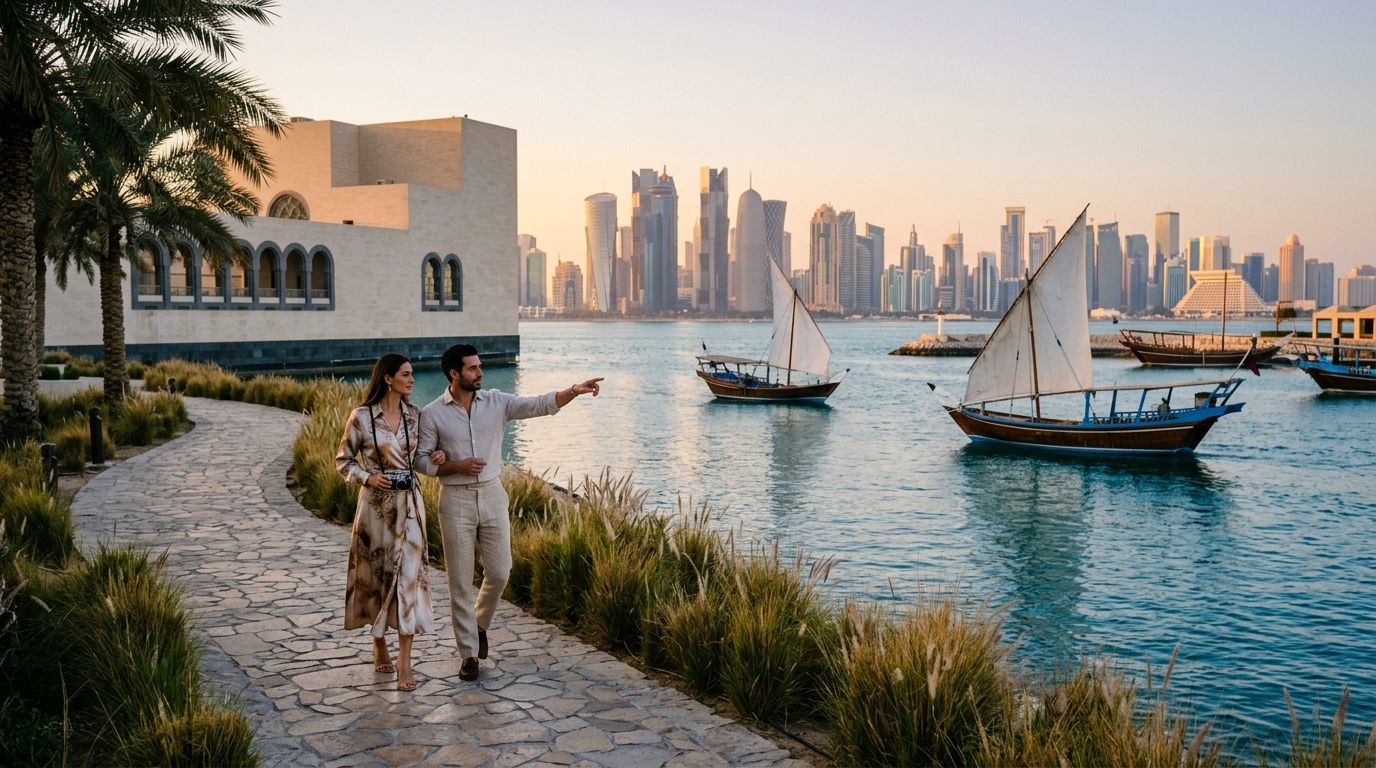
The architecture isn't decoration; it's philosophy. Walk through the Museum of Islamic Art and you're not just looking at historical objects in a pretty building. You're experiencing a deliberate argument about how contemporary design should acknowledge tradition without being chained by it. The building itself—by I.M. Pei—feels like it's in conversation with the courtyard mosques of centuries past. It's the opposite of kitsch. Whether you like the result is different from whether it's interesting.
The efficiency is almost unsettling in a good way. There are no touts, no unofficial guides, no hassle. The metro system opened in 2019 and it works the way it's supposed to. This isn't thrilling, but it's restful. You can actually spend mental energy on noticing things instead of navigating survival-level logistics. Some travelers find this sterile. I find it liberating.
The mixing is real, not performed. About 90% of Qatar's population is expatriate. The country runs on Indian construction workers, Filipino household staff, Lebanese restaurateurs, and Western professionals. This creates something you won't find elsewhere: a place where different cultures coexist without the "cultural tourism" framework. You go to a Filipino restaurant and it's not designed for tourists—it's designed for the 300,000 Filipinos who live here. The food is better because of it.
The desert is still the desert. Everything built in Qatar is built against this fundamental fact: you're in one of the hottest, most resource-starved places on Earth. Once you get outside the city, it's genuinely empty in a way that feels almost sacred. The contrast between Doha's glass towers and the void beyond the city limits is the real story of Qatar.
What to Expect: The Actual Experience
Doha's waterfront. The Corniche is where most visitors spend their time, and there's a reason. It's a 7km curved promenade where Qataris actually spend their evenings. You'll see families, couples, joggers, old men sitting on benches. It's not a tourist attraction—it's where locals live their lives. The water is the Arabian Gulf, and on clear evenings, the light does something extraordinary. The West Bay skyline reflects into it like a mirror that's slightly out of focus. This is where you understand that Qatar isn't trying to be Venice or Barcelona. It's just a wealthy, modern city built on the water, and that's enough.
Museum hopping. The Museum of Islamic Art is the heavyweight. Plan two hours minimum. The collection spans 1,400 years and continents. Then there's the National Museum of Qatar, which opened in 2019 and tells Qatar's story through architecture that mimics a mother-of-pearl shell. It's aggressively contemporary in design, which makes you question whether this is the right vessel for historical narrative. But that's precisely why you should go—it makes you think.
Souk Waqif. This is the one place in Qatar where it feels like you've stepped into a Middle Eastern market. The buildings are old (or carefully restored to look old), the alleyways are narrow, and vendors sell everything from spice to gold to falcon accessories. Here's the honest part: it's not undiscovered. It's the main tourist attraction. But it works. The perfume souk is actually worth your time—not as a shopping experience, but because you realize how olfactory the culture is. What smell means matters here in ways that it doesn't in Western cities.
The desert. This requires planning, but leaving the city is important. A desert safari usually means: a 4x4 pickup truck, a driver who knows the dunes, and a few hours of driving into actual emptiness. You'll likely visit Inland Sea (Khor Al Udeid), where saltwater has created a pocket of landscape that looks like somewhere else entirely. This is where you remember that Doha is a strip of development on the edge of something wild.
Planning Your Visit: The Practical Layer
When to go: November through March. Doha in July hits 50°C (122°F) and the city becomes indoor-only. Winter brings temperatures in the pleasant 20-25°C range (70-77°F), the humidity drops, and everything feels possible. August to October is the dead season—locals leave, tourists are rare, and even restaurants aren't fully staffed.
How long to stay: Four to five days feels right. Two days in Doha, one dedicated to a desert experience, one for museums and wandering, one as a buffer for what calls you. Less than three days feels rushed; more than five means you're finding things to do.
Getting there: Doha's Hamad International Airport is efficient and beautiful. It's not a grueling arrival. Qatar Airways is the national carrier and it's reliable (though expensive compared to Gulf competitors).
Getting around: The metro system is excellent, clean, and cheap. The old-fashioned way—hiring a car and driver for the day—costs roughly $80-100 and gives you flexibility. Taxis exist but Uber works better.
Money: Qatar uses the Riyal. The country is expensive by global standards, but not absurdly so. A good dinner is $40-60 per person. Museums are $15-20. You can spend $150-200 daily on everything (accommodation excluded) if you're moderate. Hotels start around $100 for decent quality and go up steeply from there.
Crowds: This is one of Qatar's genuine advantages. It's never crowded. The museums have quiet corners. The Corniche is populated but never packed. The souk gets busy in evenings but you can always find breathing room. This is a destination that doesn't overwhelm you with other people.
Nearby Destinations Worth Your Time
Bahrain (a 25-minute bridge away): This tiny island kingdom feels more traditionally Middle Eastern than Qatar. The souk is older, the atmosphere is more chaotic. Bahrain's museums are better—the Bahrain National Museum is genuinely excellent. A day trip works perfectly. The Causeway connecting Qatar and Bahrain is one of the most surreal drives you'll do.
Saudi Arabia (the border is real, entry is complicated): For most Western travelers, this remains difficult. But the kingdom is opening. If you manage it, the Empty Quarter (Rub' al Khali) is perhaps the most genuinely alien landscape on Earth. Not a casual day trip.
Is Qatar Worth Your Time?
Yes, but not for the reasons you might think.
It's not worth visiting for history—there's almost none. It's not worth it for "authentic experiences"—authenticity is complicated when 90% of your population arrived in the last 20 years. It's not worth it for budget travel—it's expensive.
But it's worth visiting because it's a genuinely interesting answer to a question most countries never ask: "What if we tried to build this well?" It's worth it because the efficiency is actually restful. It's worth it because the contrast between human civilization and the desert is starker here than in most places. It's worth it because you'll encounter people from everywhere and the mixing happens naturally, not as a tourist package.
And perhaps most honestly: it's worth visiting because it's almost nothing like anywhere else you've been, and in a world of homogenized tourism, that rarity itself has value.
Quick Facts About Qatar
- Capital: Doha
- Language: Arabic (English widely spoken)
- Best time: November–March
- Currency: Qatari Riyal (QAR)
- Population: ~3.4 million (vast majority expatriate)
- Size: 11,571 km² (4,471 sq mi)
- Religion: Islam (97%)
- Dress code: Modest dress recommended but not strictly enforced; swimwear fine at hotels/beaches
Qatar doesn't try to seduce you with mystery or romance. It simply presents itself: a modern nation built on a desert peninsula, efficient and confident. That honesty is actually refreshing. You know exactly what you're getting—which is precisely why you might find it more interesting than expected.
Explore Doha's neighborhoods, desert routes, and cultural landmarks on Touratu's interactive map. Watch our travel videos to see how locals navigate the city, visit museums, and experience desert safaris. Plan your Qatar journey with detailed route guides and discover what draws people to this unlikely destination.
Loading activities…
