
Poland Travel Guide: Top Things to Do & Costs
Poland: A Country of Unexpected Contrasts and Genuine Stories
There's a moment on the train from Warsaw to Krakow when the landscape shifts beneath you. The flat, industrial sprawl gives way to something older—forests that feel genuinely wild, villages where people still hang laundry between trees, sky that stretches until it bends. You realize you've entered a place that hasn't been simplified for tourists, a country that still asks something of you rather than promising everything.
Poland is one of Europe's most underestimated destinations, and that underestimation is precisely what makes it worthwhile. It's a country that has absorbed centuries of conflict, occupation, and reinvention, and somehow emerged with its character intact. When you travel here, you're not moving through a theme park—you're moving through a place where history is still being processed, where communities are actively reconstructing their own narratives.
What Actually Matters in Poland
Most travel guides will hand you a standard itinerary: Warsaw, Krakow, Auschwitz, Gdańsk. This isn't bad advice—these places exist in your consciousness for reasons—but it's incomplete. What makes Poland genuinely worth your time isn't the checklist. It's the texture.
Warsaw catches most visitors off-guard. You're expecting a capital city, and you get something more complicated: a place that was almost entirely destroyed during World War II and rebuilt by ordinary Poles with stubbornness and improvisation. The Old Town feels authentic precisely because it was reconstructed stone by stone. The Pałac Kultury dominates the skyline—a Soviet-era wedding cake that Varsovians have learned to tolerate with grim humor. Walk through the neighborhoods—Praga, Żoliborz, Mokotów—and you'll find a city that's genuinely gentrifying, with young people opening galleries in converted warehouses and cafés where the coffee is actually taken seriously.
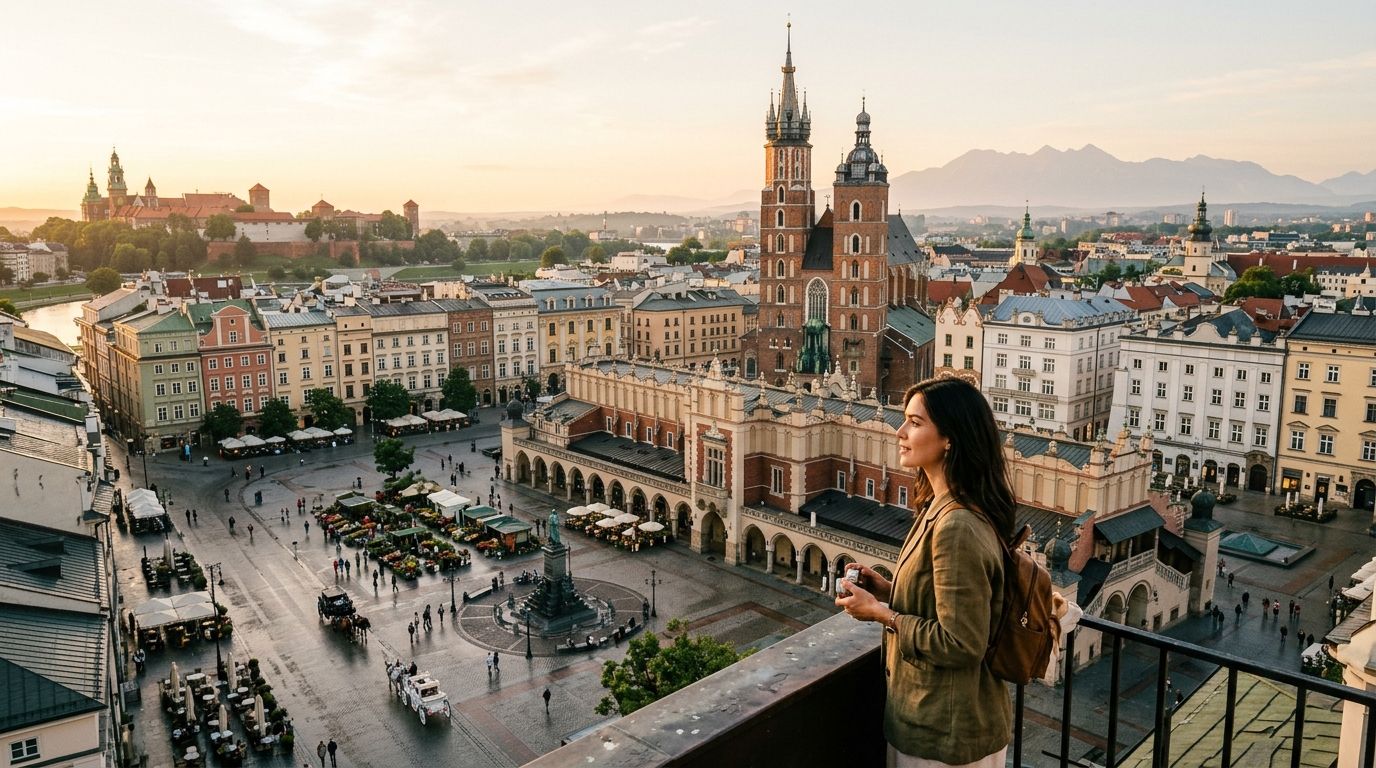
Krakow is busier, more tourist-facing, but also more beautiful. The Main Square is genuinely one of Europe's best—surrounded by merchant houses, centered on the cloth hall. Climb the tower at dusk. The city sits on a hill, and from above, the old town glows while the new city recedes. The Jewish Quarter tells a necessary, difficult story. Wawel Castle presides over everything, a reminder that this city was once the capital of a continental power. What saves Krakow from feeling museum-like is that people actually live here. You'll find genuine restaurants, good bars, universities full of students who aren't tourists.
Gdańsk surprises people. It sits on the Baltic, and has the color and maritime personality of a Hanseatic port town. The amber trade made it wealthy once. The waterfront has been carefully restored without becoming theme-park artificial. From here, you can understand that Poland wasn't always landlocked—that for centuries, it was a genuinely cosmopolitan, multi-ethnic place. The European Solidarity Centre is one of the best museums in Europe: it tracks the Solidarity movement, which essentially began the end of the Cold War, through personal testimony and careful curation.
Auschwitz is in Poland, and I need to address this directly. It's not a tourist attraction—it's a memorial and a history lesson. It's difficult. It should be. The camp sits outside Oświęcim, a town that tried to move forward with its own history. Visiting requires preparation, emotional space, and honesty about what you're encountering. Don't rush it. The audio guide is essential. Many visitors spend entire days here. This isn't something you add to a sightseeing list—it's a separate undertaking, one that fundamentally shifts how you understand human capacity for both horror and resistance.
Beyond the major cities, Poland reveals itself differently. The Tatra Mountains offer genuine hiking, small villages in Masovia have churches with hand-painted interiors, the Baltic coast has dunes and fishing villages. Wooden churches in eastern Poland—some dating to the 1600s—still serve their communities. The Białowieża Forest, one of Europe's last primeval forests, sits on the Belarus border and offers a sense of what this continent looked like before we remade it.
What to Expect: The Practical Experience
Moving around Poland: Polish trains are inexpensive, reliable, and actually enjoyable. A ticket from Warsaw to Krakow costs about £15-25 and takes four hours. Buses are cheaper but slower. The PKP railway website is functional once you understand it. Renting a car makes sense if you're exploring beyond major cities—Polish roads are good, driving rules are enforced, and petrol is cheaper than Western Europe. Drivers are relatively sane by European standards.
Polish food: This matters because it's genuinely good and nothing like Mediterranean or Nordic cuisine. Expect hearty, meat-forward, potato-heavy food. Żurek (sour rye soup) is an acquired taste. Pierogi (dumplings) are essential eating. Bigos (hunter's stew) is comfort food that works. Kielbasa is more subtle than the industrial versions exported internationally. Find a local milk bar—these are no-frills cafeterias that serve enormous meals for £2-4. They're not tourist experiences; they're where people actually eat. The Polish obsession with sour cream is real and worth embracing.
Language barrier: Not as significant as you'd expect. Younger people speak English, older people speak German or Russian. Learning a few phrases—"dzień dobry" (good day), "proszę" (please), "dziękuję" (thank you)—matters more than you'd think. Poles appreciate when you try.
The social reality: Poland is a Catholic country, conservative in many ways, with genuine political divisions. You'll notice this in small ways—fewer places open on Sundays, certain topics generate strong opinions. This isn't a reason to avoid Poland; it's simply reality. Polish people are generally warm, curious about foreigners, and willing to help if you're respectful. They're also blunt. Don't mistake directness for rudeness.
Costs: Poland is significantly cheaper than Western Europe but not drastically cheaper than before. A good dinner costs £8-15, a beer £1-2, a hotel £30-60. Your money stretches, but expectations about "cheap Eastern Europe" should be calibrated.
Planning Your Visit: Logistics That Matter
Duration: Two weeks is ideal, allowing you to see Warsaw, Krakow, Gdańsk, Auschwitz, and one or two secondary locations. Ten days works if you're selective. Five days will feel rushed.
Best time: May and September. Summer (June-August) brings crowds and heat. October is beautiful but increasingly cold. Winter is harsh. Spring and autumn are when Poland feels like itself—clear light, manageable weather, fewer tourists.
Getting there: Cheap flights to Warsaw from most European cities, direct flights from major North American airports. Once you're in, the internal transport network is efficient.
Auschwitz logistics: Visit with a guide. Dedicated tour groups leave from Krakow daily. Don't try to drive yourself—parking is managed and the experience deserves your full attention. Allow 6-8 hours minimum, including travel time from Krakow.
Crowds: Even Krakow's Main Square is manageable if you arrive early. Auschwitz draws crowds, but they're channeled respectfully. Warsaw is genuinely unhurried compared to Prague or Budapest. Gdańsk has crowds but feels less dense than you'd expect.
Nearby Worth Considering
Tatras Mountains: From Krakow, two hours south. Morskie Oko (Eye of the Sea) is a stunning alpine lake hike. Zakopane is the mountain town, touristy but genuine, full of traditional wooden architecture. If you hike, allocate 2-3 days.
Kraków: Wieliczka Salt Mine: Just outside Krakow. An underground cathedral carved entirely from salt, with chambers and lakes. It's touristy but undeniably strange and worth an afternoon.
Wrocław: West of Krakow, Poland's fifth-largest city and genuinely worth a stop. Market square rivals Krakow's, the university gives it life, and it sits on the Oder River. Less crowded than Krakow, equally memorable.
Is It Actually Worth Visiting?
Yes. Unequivocally.
Poland isn't a "weekend break" destination—it requires intention. It won't provide the convenience of Western Europe or the affordability of some Central European destinations. What it provides instead is texture, authentic community, genuine history processed in real time, and the satisfaction of traveling somewhere that doesn't depend on your tourism for its meaning.
You'll encounter Warsaw's complex relationship with Soviet architecture, Krakow's cosmopolitanism mixed with careful memorial, Gdańsk's maritime humility. You'll eat better than expected, move more easily than imagined, and leave understanding that this country—between Europe and Russia, shaped by both, beholden to neither—has something essential to teach about resilience and identity.
Quick Facts
- Capital: Warsaw
- Currency: Złoty (PLN; approximately 1 GBP = 5 PLN)
- Population: 37.8 million
- Language: Polish
- Religion: Predominantly Roman Catholic
- Visa: EU citizens unrestricted; US/Canadian/Australian citizens can visit for 90 days visa-free
- Time zone: Central European Time (UTC+1)
Explore Poland with intention. Use Touratu's interactive map to trace routes between cities, watch travel videos that show the country as it is, and book activities that connect you with Poland's actual communities. Whether you're planning that Warsaw-to-Gdańsk journey or researching smaller towns beyond the standard routes, Touratu's tools help you move through Poland thoughtfully—respecting both the country and your own experience of it.
Loading activities…
