
Norway Travel Guide: Planning Your Visit
Norway Travel Guide: What Actually Happens When You Go
The first time you see Norwegian light, it doesn't hit like a photograph. It hits like a correction to something you didn't know was wrong. You're standing on a platform in some small coastal town—say, Tromsø or Lofoten—and the sun isn't behaving the way suns behave anywhere else. It's not above you. It's around you, diffused through months of atmosphere, touching everything at once.
This is the Norway that people try and fail to describe. Not because it's indescribable—plenty of places are beautiful. But because the physical experience of being here reorganizes what you think geography can do.
Why Norway Actually Stays With You
Most countries offer you their attractions. Norway offers you its light, its weather, its relationship with water and mountains. The difference matters.
I've watched people stand on the Lofoten Islands in winter, watching the Northern Lights dance above them, and I've watched the exact same light show disappoint others who came expecting cinema and found themselves actually present instead. The difference is the visit itself. Norway demands you show up as yourself, not as a visitor collecting experiences.
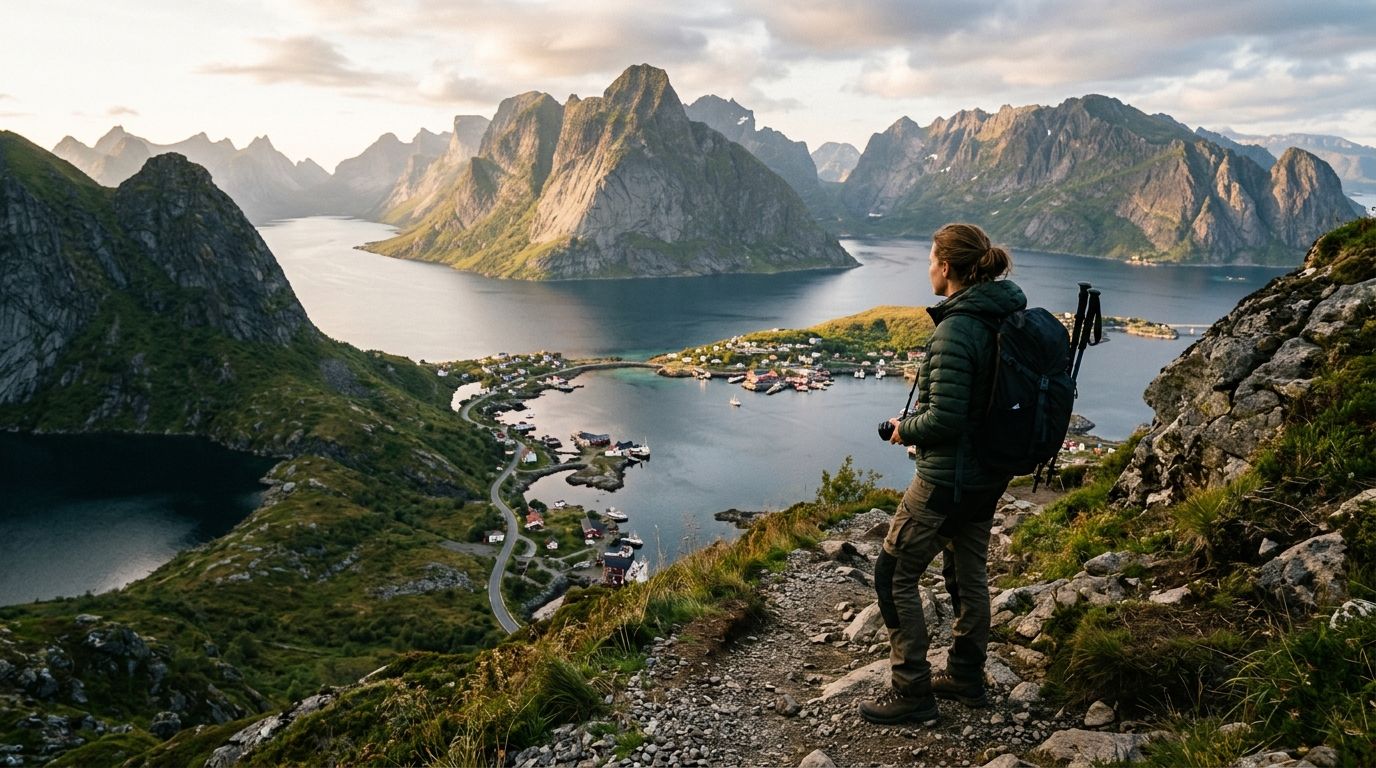
What makes this place genuinely memorable is simpler than the tourism board would tell you: it's the scale of the natural system and how that scale makes you recalibrate. You drive through a fjord not by passing beside it, but by traveling inside it—walls of stone rising 1,000 meters on either side, glaciers visible from sea level. You hike for six hours and see maybe three other people. You sit in a cabin with floor-to-ceiling windows and watch the light change every fifteen minutes.
The cultural part—the Scandinavian design, the coffee culture, the food revolution—these are real, but they're secondary. You come to Norway for what it does to your relationship with space.
What to Actually Expect When You're Here
Norway breaks into distinct regions, and your experience changes dramatically between them. Understanding this prevents the disappointed-tourist mistake of thinking you're doing "Norway" when you're really only doing one version of it.
Fjord Norway (Western coast) is the postcard version. The Geirangerfjord and Sognefjord are legitimate engineering marvels of nature—deep water surrounded by vertical cliff faces, waterfalls dropping straight from the rim. You experience this by boat, primarily. Some people drive the coastal roads and hike down to the water. This region works best in summer (June-August) when the light stays until 11 PM and the roads are open. Expect to move slowly. A fjord that looks like 50 kilometers on a map takes a full day to travel through properly.
The Lofoten Islands (far north) are different entirely. Here, mountains rise straight from the sea, and small fishing villages cling to the rocky shores. The light situation is dramatic—in summer you get nearly 24 hours of daylight; in winter (November-January) you get the Northern Lights against a twilight sky that never quite becomes night. The fishing villages here aren't restored theme parks. They're actual working communities where fishing still happens. The experience is more intimate, less crowded, more real.
Interior Norway and the mountains (Jotunheimen, Trolltunga) are where you go if you hike or ski. These aren't gentle highlands. They're serious mountainous terrain with unpredictable weather. Hikes that sound easy on paper will slow you down with exposure, altitude, and variable conditions. Summer trekking here is legitimate wilderness experience. Winter skiing in places like the Hemsedal valley puts you on European-standard slopes with considerably fewer people than the Alps.
Oslo and Bergen are the cities, and they're functional rather than overwhelming. Good museums, good restaurants, good design shops. Oslo has the Viking Ship Museum and the Vigeland Sculpture Park—both worth seeing because they're genuinely interesting rather than famous. Bergen is smaller and better positioned as a fjord access point than a destination in itself. Spend 2-3 days in either city and move on.
The weather is the variable that determines everything else. Norway in summer (June-August) is mild, long-daylight, and crowded. Norway in winter is dark, cold, and quiet—the Northern Lights are possible but not guaranteed, and you're restricted to lower elevations and maintained roads. Spring (May-June) and early autumn (September) are underrated for the simple reason that the light is good, the crowds have dispersed, and the weather is more stable than you'd expect.
What to expect for costs: Norway is expensive in a straightforward way. Restaurants cost roughly double what they cost in most of Europe. Accommodations range from reasonable (budget hotels, hostels) to extortionate (mountain lodges, fjord resorts). The efficient approach is to cook some meals, stay in smaller towns rather than Oslo, and use public transport (trains and ferries are excellent). Budget-conscious travelers can do Norway for €80-100/day if they're disciplined. Comfortable travelers should plan €150-200/day.
Planning Your Visit: The Practical Framework
Duration: The minimum meaningful visit is 5-7 days, and this assumes you're not trying to do everything. A week gives you time to reach the fjords, spend time actually looking at them, and maybe hike one good day hike. Two weeks is better and lets you add either the Lofoten Islands or some serious mountain hiking. Three weeks starts to feel like understanding the country rather than visiting it.
Best time depends on what you want:
- Northern Lights: October-March (with best chances in December-January)
- Summer hiking and midnight sun: June-August
- Shoulder season light and solitude: May or September
- Skiing: December-March
Transportation: The train system is excellent and covers the major routes efficiently. Buses fill in where trains don't and are cheaper. Renting a car is only necessary if you want to explore smaller villages and coastal roads without time pressure. In winter, you'll want chains or winter tires and a high tolerance for slow driving.
Crowds: Norway gets crowded in July-August, particularly the fjords and famous hikes (Trolltunga, Kjeragbolten). If you can travel in June or September, you'll have roughly half the people and better light. Lofoten stays relatively quiet even in summer because it requires more effort to reach.
Where to actually go (if you're deciding):
- First visit: Fjord Norway + one coastal town (Tromsø or Lofoten)
- Return visitor: Mountains + specific region deep-dive
- Winter specialist: Lofoten Islands for Northern Lights
Nearby Places Worth the Detour
Iceland is the obvious companion destination—direct flights from Oslo to Reykjavik, and you get similar landscape drama with a different character. More volcanic, less fjord-based. Good for 2-3 days added to a Norway trip.
Swedish Lapland (around Kiruna or Abisko) is reachable from northern Norway and offers Northern Lights viewing with less intensity than Lofoten but with good infrastructure. The trek from Kiruna to Abisko is a serious multi-day hike through actual Arctic tundra. Adds 4-5 days logistically.
The Faroe Islands are northwest of Norway, technically Danish territory. You get similar dramatic coastlines and cliff scenery in a more compact area. They're worth a side trip if you have the extra days and don't mind the ferry travel.
Is It Worth Visiting? The Honest Answer
If you're the type of person who travels to collect experiences and check boxes, Norway will feel expensive for what it delivers. You're not getting major historical cities or cultural immersion in the way you might in Italy or Spain.
If you're the type who travels to have your daily relationship with geography and weather shifted, Norway is genuinely valuable. Standing in a place where the light doesn't behave normally, where the scale of mountains forces you to recalibrate distance, where you can hike for a full day and see only other dedicated hikers—these experiences do something actual to your perception.
The Norwegians themselves are friendly but reserved. You won't get the social intensity you'd find in southern Europe, but you will get genuine helpfulness and an absence of tourist fatigue. People here are used to you being quiet.
It's expensive. The light is worth it. The hiking is worth it. The food has gotten genuinely good and is worth it. The crowds (in off-season) are smaller than they should be given the quality of what you're seeing.
So: worth it? Yes, but not for everyone and not in the way travel marketing suggests. You're not getting "magical fjords" or "breathtaking landscapes." You're getting a place that resets your expectations for what geography can do, and that reset is expensive, quiet, and genuinely valuable.
Quick Facts
- Location: Northern Europe (15° E, 60° N)
- Size: 323,802 km² (population 5.5 million)
- Language: Norwegian (English widely spoken)
- Currency: Norwegian Krone (NOK), approximately 10 kr = €1
- Best light season: May-September
- Best winter season: December-February
- Accessibility: Excellent public transport, well-maintained infrastructure
- Typical costs: €100-200/day budget-conscious to comfortable
- Visa requirements: EU/EEA nationals don't need visas; others check current regulations
Final Thought: Making It Real
What makes Norway different from the photographs isn't the mountains themselves—it's the time you spend looking at them. It's standing in a place where your phone signal drops, where the light is wrong in ways that your camera can't capture, where you have to be present because there's nothing else to do.
Start your planning with Touratu's interactive map—it lets you explore different routes through the country, watch travel videos from people who've actually been there, and see exactly how these regions connect. Use it to build your own version of Norway rather than following someone else's itinerary.
Then go. Bring layers. Don't expect the photographs to match. Sit still more than you think you should. Let the light do its work.
Loading activities…
