
48 Hours in Maldives: The Realistic 2-Day Itinerary
48 Hours in the Maldives: What Actually Happens When You Arrive
You step off the seaplane and the pilot cuts the engines. The silence hits you first—not the water, not the sky, but the complete absence of noise. Your guide nods at your expression. He's seen it a hundred times. This is the moment people stop thinking about whether the Maldives was worth the airfare.
The next forty-eight hours will feel nothing like a traditional holiday. There's no sightseeing in the conventional sense, no landmarks to tick off a list. Instead, you're entering a rhythm governed by tides, light, and the peculiar reality that you've reached one of the most remote inhabited archipelagos on Earth. Two days here teaches you something most two-week trips miss: constraint forces presence.
What Actually Makes the Maldives Memorable
Let's be direct about what you're paying for. The Maldives isn't architecturally stunning. There are no historic temples, no bustling markets, no museums. You're not coming here to see things—you're coming to experience a specific collision of elements: crystalline water, bioluminescent plankton, the weight of complete isolation, and the peculiar comfort of a private island.
What makes forty-eight hours here worthwhile isn't novelty for its own sake. It's the way the environment rewires how you perceive space and time. Most travelers spend their days in transit, checking schedules, navigating crowds. In the Maldives, the landscape does the opposite. The water demands slow observation. The house reef—the stretch of coral immediately offshore—requires you to spend time in one place, noticing how light changes the color palette throughout the day.
By day two, you'll notice something unexpected: you've stopped checking your phone not because there's no signal, but because your attention has genuinely shifted. That's not marketing. That's what happens when you remove the ambient stimulation of urban environments.
Day One: Arrival and Recalibration
Most international flights arrive late evening. Your seaplane departs Male airport at dawn (or sometimes late afternoon, depending on your resort's logistics). The flight itself is the first real experience—forty-five minutes watching the Indian Ocean reveal its geography. You see the atoll structure clearly from above: concentric rings of islands with lagoons inside, deep ocean outside. It's your first lesson in how the Maldives actually works as a place.
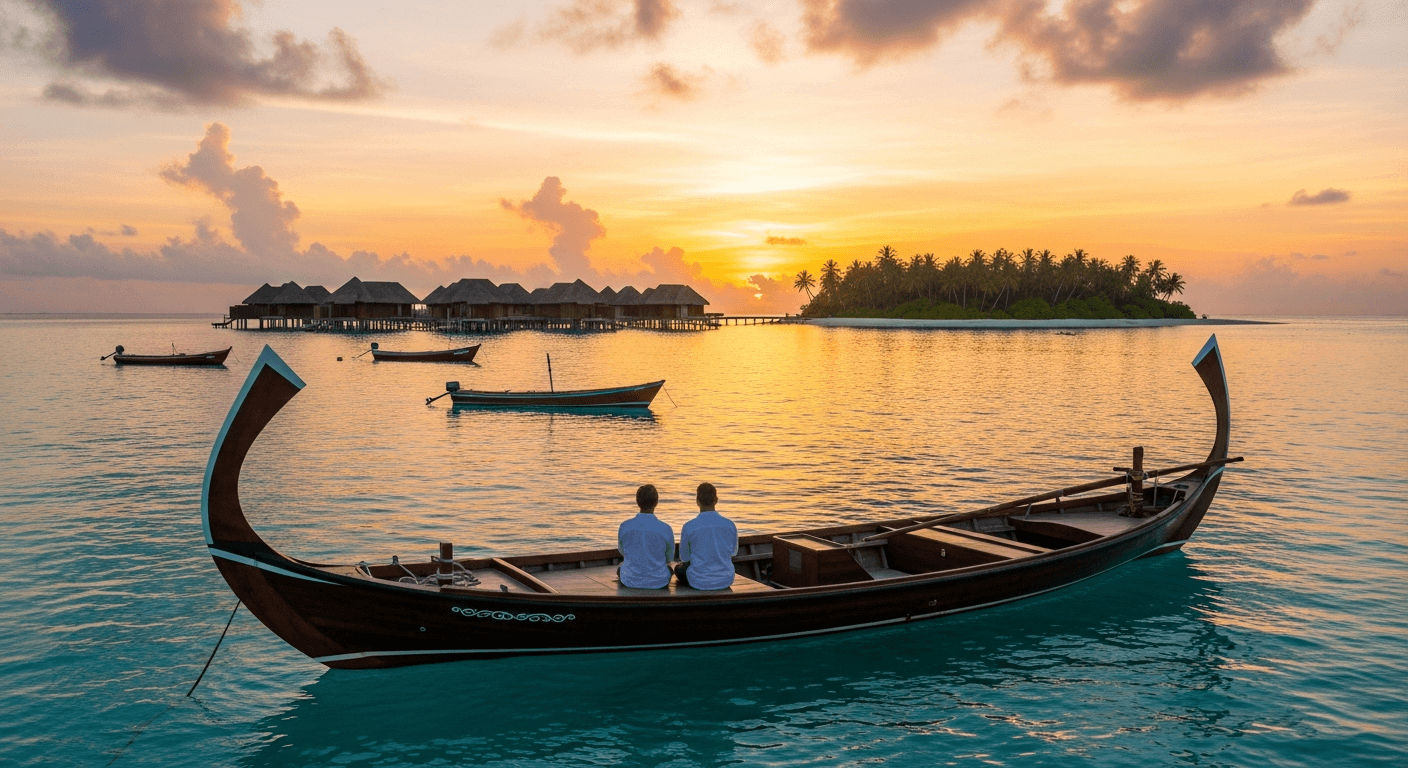
You land on your resort's landing pad or at the designated jetty. The transition is sudden. You're no longer traveling; you're arrived. Your room is steps from the water. Many resorts place overwater bungalows directly above the reef, which means you can observe fish without leaving your deck.
Your first afternoon is best spent doing very little. The seaplane journey is tiring in a specific way—the altitude change, the hours sitting, the sensory input. Spend your first hours swimming in the lagoon near your bungalow, acclimatizing to the water temperature (usually 28-30°C), and noticing the fish. There will be parrotfish. There will be rays. This seems ordinary until you realize you're watching it from your private deck, at 3 p.m., when you'd normally be in a meeting.
Dinner matters on day one. Most resorts offer beachside dining. The food quality varies significantly between properties, but the setting never does: sunset, your feet in sand, the ocean audible. The sun drops quickly here—there's no long twilight like temperate zones. It's bright, then it's dark. Plan accordingly.
If your resort has a house reef with a night snorkel, consider it. This is where the bioluminescent plankton often appears. You'll wade into the water with a guide, and with each movement, tiny organisms light up. It's not a guaranteed phenomenon—it depends on conditions—but when it happens, it rewires how you think about the ocean. You're not watching something; you're part of something.
Day Two: The Real Experience
By morning two, most travelers have already shifted their focus. The initial excitement of arrival has settled into genuine observation.
The primary activity in the Maldives is snorkeling. This needs context. Maldivian snorkeling is not like Caribbean snorkeling. You're not looking at dense coral heads from a boat. Instead, you're drifting along a reef wall, watching the gradient from shallow water to deep ocean. Schools of fusiliers move as one organism. Manta rays appear without warning. Sharks—reef sharks, entirely harmless—are common.
Book a guided house reef snorkel for early morning. The light is better, the water is clearer, and the fish are more active. A forty-five-minute snorkel here will likely include more species than you'll see in a week elsewhere. Bring an underwater camera if you have one, but don't let photography become your primary activity. Observation beats documentation.
Late morning, return to your bungalow, eat, and rest. The heat is significant this close to the equator. The smart move is a long lunch break, not a cultural cliché, but practical adaptation.
Afternoon offers options. Some resorts offer dolphin cruises—the reliability varies by season. Others have spa facilities. A smaller number offer island hopping to local islands, which is genuinely interesting if you want to see how Maldivian communities actually function, beyond resort life. This isn't tourism theater; you're seeing a functioning society with schools, shops, and ordinary life. It's a sharp contrast to the resort environment.
If your resort has a good house reef, spend your late afternoon there alone, snorkeling without a guide. You'll move slower. You'll notice details. The reef has a specific ecology—certain fish species appear in certain areas, certain coral formations attract certain creatures. Two hours of patient observation yields more understanding than a guided tour.
Dinner on day two can be your most memorable meal. Some resorts offer private beach dinners if arranged in advance. Even standard resort dining feels different on the second evening—you've already adjusted to the pace, already begun the slight disconnection that the Maldives offers.
Planning Your Visit: The Practical Reality
Timing: The Maldives functions year-round, but conditions vary. November to April is the dry season—calmer seas, clearer water, lower humidity. May to October is monsoon season—still swimmable, less crowded, occasional heavy rain. Most travelers choose dry season, which means higher prices and more crowds (though "crowds" in the Maldives is relative—you're still isolated).
Duration: Two days is genuinely minimal. You can do it and feel satisfied, but you won't fully adjust your circadian rhythm until day three or four. If possible, extend to four days. If you're committed to forty-eight hours, accept that you're experiencing the aperitif, not the full meal.
Transport: Seaplane or speedboat to your resort. Both have their merits. Seaplanes offer the geographical context mentioned earlier but cost more. Speedboats are cheaper and still beautiful but offer less perspective. Domestic flights to Malé airport are the entry point.
Resort Selection: The Maldives has properties across multiple price points, from budget guesthouses in local islands (₹8,000-15,000 per night) to ultra-luxury overwater villas (₹50,000+). Two days justifies a mid-range to upper-mid-range property (₹20,000-35,000). You want a house reef and reasonable service. Don't overpay for extras you won't have time to use.
Crowds: The Maldives doesn't have crowds in the traditional sense. Popular resorts in peak season are busy, but you're still in a fundamentally uncrowded environment. Even on a busy day, you'll snorkel with perhaps a dozen other people, not hundreds.
Nearby Consideration: Ari Atoll, Baa Atoll, Male City
If extending beyond two days, consider a second resort in a different atoll. Ari Atoll (south) has different marine life and fewer tourists. Baa Atoll (north) is famous for manta ray season (June-November). Male, the capital, is worth a few hours if you have time before departure—the fish market is genuine, the mosques are architecturally interesting, and it's a stark contrast to resort life.
Is It Worth the Journey?
This requires honesty. The Maldives works if you want mental space, underwater observation, and reasonable physical comfort. It doesn't work if you need cultural immersion, historical depth, or activities beyond water-based exploration.
Forty-eight hours isn't transformative, but it's sufficient for clarity. You'll return home with less noise in your head than you left with, which is increasingly rare. Whether that justifies the expense and travel time is personal. For many, yes. For others, the journey isn't proportional to the stay.
What you shouldn't expect: budget travel. The Maldives is expensive by design and geography. You shouldn't expect authenticity in resort settings—you're in a constructed environment. You shouldn't expect dramatic scenery or photogenic landmarks. You should expect singular focus: water, light, and the slight vertigo of isolation.
Quick Facts
- Location: 26.8°N, 73.5°E, in the Indian Ocean
- Getting There: International flights to Malé, then seaplane/speedboat
- Best Time: November-April
- Language: Dhivehi (English widely spoken in tourism)
- Currency: Maldivian Rufiyaa (pegged to USD)
- Visa: Most nationalities receive 30-day tourist visa on arrival
- Water Temperature: 25-30°C year-round
- Time Zone: UTC +5
Closing
Two days in the Maldives won't make you a travel expert. It won't yield dramatic stories or unique photography. What it will do is clarify why people return, why the archipelago has become a destination rather than a novelty, and why removing complexity from your environment can be more valuable than adding experiences to it.
When you're planning this trip, use Touratu's interactive map to explore the atoll systems, compare resort locations, and trace snorkeling routes. Our travel videos show real footage of house reefs, seaplane approaches, and what the pacing actually feels like—not the curated highlight reels that dominate travel content. That combination of planning tools and honest documentation will help you decide if forty-eight hours here is what you actually want, or if your time and money belong elsewhere.
Loading activities…
