
Laos Travel Guide: What to Do & How to Plan
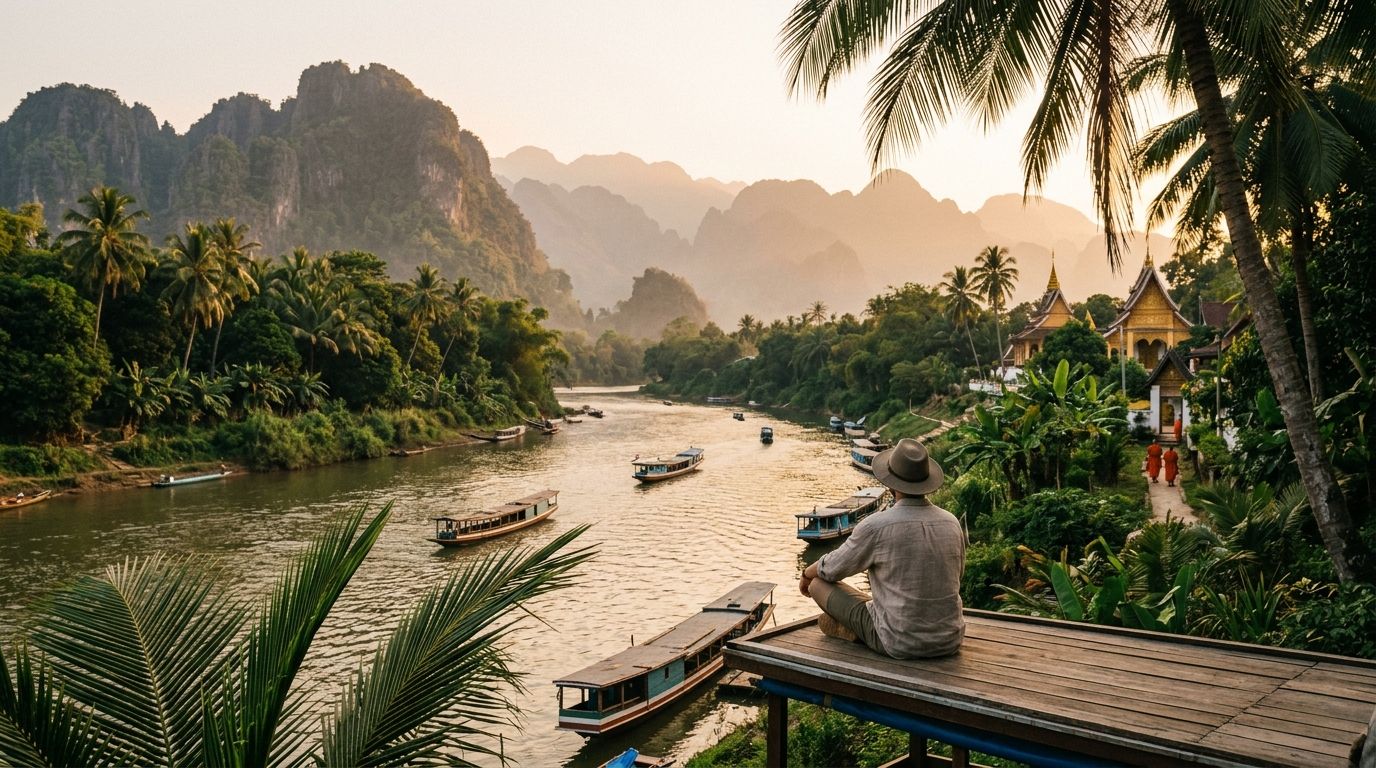
Laos: What Happens When You Stop Looking for Paradise and Find It Anyway
You're sitting in a wooden longboat, the Mekong River running brown and deliberate beneath you. It's early morning—that brief window before heat settles over everything—and the only sounds are the engine puttering and someone's chickens calling from a village you just passed. A monk in saffron robes nods from the riverbank. You nod back. Neither of you speaks. This moment isn't remarkable because it's postcard-perfect. It's remarkable because nothing here is performing for you.
That's Laos.
Most travel writing about Southeast Asia treats it like a theme park with opening hours and optimal photo angles. Laos doesn't cooperate with that framework. It's slower than you expect, cheaper than you remember, and fundamentally uninterested in rushing you through a list of checkboxes. After years of traveling through the region and multiple returns, I've come to understand why: Laos works backward from what most tourists expect.
Why Laos Feels Different
The numbers alone tell you something's off with typical travel narratives. Laos receives roughly 4 million visitors annually—substantial, yes, but tiny compared to Thailand's 35 million or Vietnam's 18 million. This isn't because Laos is undiscovered. It's because the country has implicitly decided not to become a monument to tourism.
This shapes everything. There's no tug-of-war between authenticity and commercial appeal because that tension barely exists. You'll find tourists everywhere worth going—Luang Prabang, Vang Vieng, the 4000 Islands—but they exist alongside daily life rather than replacing it. Markets function as markets. Temples remain functioning religious spaces. Families live in the stilted houses overlooking rivers; they're not museum exhibits.
The tourism infrastructure is deliberate in its modesty. Restaurants serve actual Lao food to actual customers; the "Western options" often appear as afterthoughts. Hotels range from genuinely beautiful guesthouses to mid-range business accommodations, but you won't find megaresorts orchestrating every detail of your experience. This lack of total infrastructure sounds like a limitation until you realize it's actually freedom.
What Actually Awaits You Here
Luang Prabang is where most first-time visitors land, and there's good reason. The old town compresses three centuries of architecture—French colonial, Chinese merchant, Buddhist temple—into walkable blocks along the Mekong. The morning alms-giving ritual is real spiritual practice, not a tourism performance, which means you observe quietly or don't at all. Night markets smell like grilled fish and lemongrass. The royal palace museum is genuinely interesting if you care about the region's political history.
But the real value of Luang Prabang is logistical: it's your entry point to understanding how travel works in Laos. You learn the pace. You practice ordering coffee (thick, sweetened condensed, served over ice). You figure out whether you're the type of traveler who can sit still long enough for this country to make sense.
Vang Vieng requires honesty because travel writing usually lies about it. The town exists at an awkward middle point: too developed for adventure seekers who want isolation, too raw for tourists who want convenience. The actual value proposition—kayaking and tubing through limestone karst scenery, exploring caves—is solid. The town itself is a collection of backpacker bars and guesthouses, many mediocre. You go for the geography, not the infrastructure.
The 4000 Islands (Si Phan Don) in the far south deliver something you actually can't replicate elsewhere: the Mekong slowed into an archipelago of small islands with irregular roads, strong coffee, and a rhythm that makes Vang Vieng seem frantic. You travel between islands by boat, stay in guesthouses owned by actual island residents, and develop that particular boredom-comfort that happens when you stop trying to optimize every hour. The Irrawaddy dolphins here are endangered and genuinely rare; you might not see them even trying, which feels like the appropriate level of difficulty for real wildlife viewing.
Vientiane, the capital, surprises most visitors by being unpretentious. No grand monuments demanding reverence, no government buildings designed to overwhelm. Instead: the That Luang stupa (genuinely spiritual, not staged), French-influenced neighborhoods where you can find decent coffee and bread, and a waterfront where locals actually congregate rather than tourists. Many travelers skip it for "more interesting" destinations, which means you can move through it without crowds.
Beyond these anchors, the real Laos appears in transit and smaller towns—Nong Khai across the Thai border, where you can sense two countries living as neighbors; Pakse as a functional south-central hub; and countless villages where you're not checking off sites but experiencing how people organize their days around rivers and monsoons.
How to Actually Plan This
Timing matters more than you'd think. Laos has a genuine dry season (November to March) when roads are passable, skies are clear, and traveling is straightforward. This is also when every traveler shows up. April and May are desperately hot—locals retreat indoors from noon onward. The wet season (June to October) transforms the landscape to absurd greens but makes some roads treacherous and boat schedules unreliable.
Budget clearly. Laos is cheap (roughly half Thailand's tourist prices), but "cheap" doesn't mean "free," and budget tourism here has different tradeoffs than elsewhere in Asia. You can stay adequately for $10-15 a night in guesthouses. Food is $2-4 per meal if you eat where locals eat. Activities are $15-40 per day. The catch: fewer shortcuts exist for rushing through things. You can't take a 15-minute tour; the boat ride takes three hours because that's how the river works.
Duration requires recalibration. Most travelers spend one to three weeks in Laos. Two weeks is reasonable for moving through Luang Prabang (3-4 days), north to Nong Khai (2-3 days), Vang Vieng (2-3 days), central areas (2-3 days), and the 4000 Islands (3-4 days). You could compress it to one week, but you'll mostly experience arrival and departure rather than the place itself.
Getting around: Buses connect major towns and are reliable if unglamorous. Night buses save accommodation costs but are uncomfortable. Flights between cities exist but cost more than you'd expect. Boats on the Mekong are meditative, slow, and worth taking even when driving is faster. Rental scooters work in towns but require comfort with moderate risk and significant heat.
Crowds: November through February sees genuine tourism volume. July-September is wet season with fewer travelers but weather complications. April-May and March are sweet spots for fewer crowds and better weather, though heat can be punishing.
Adjacent Worth Considering
Thailand's northeast (Isaan region) sits just across the Mekong and functions culturally as Laos's extension. Nong Khai is the bridge—Thai border town where you can cross into Laos for a day or vice versa. The 14km Friendship Bridge actually connects these worlds, and crossing it reverses your perspective on both countries.
Vietnam's west (Quang Binh, Quang Tri provinces) sits to the east and offers very different landscape—agricultural mountains, war history caves, dramatically less-developed tourism infrastructure. The road between central Laos and this region is rugged but functional, and the contrast between countries sharpens your understanding of each.
Southern Thailand (Yasothon area) connects to Laos's eastern border and offers similar landscape with more developed infrastructure. Most travelers skip it in favor of coastal islands, which means it stays quiet.
The Honest Assessment
Is Laos worth visiting? Not universally. If you're traveling with a detailed itinerary, expecting fast wifi and restaurant variety, or hoping for dramatic Instagram moments, you'll find it slow and frustrating. If you're looking for "authentic Asia," you'll discover that concept is more complicated than Instagram suggests—Laos is modern and traditional and transitional all at once, like everywhere else.
But if you can sit in a small boat watching the landscape shift, if you prefer meals without English menus, if you value time moving slowly over destinations accumulated quickly, then yes. Laos delivers something genuinely different from standard Southeast Asian tourism: a country that's developing on its own terms rather than to serve travelers. That's rare enough to be worth the friction.
The corruption of "off the beaten path" language means describing Laos that way now feels dishonest. It's well-worn by travelers. What's actually true: it's a place where being a tourist feels less scripted, where your presence changes things less obviously, where you might actually get bored—which, paradoxically, is when travel becomes most interesting.
Quick Facts
- Visa: Most nationalities get 30-day tourist visas on arrival
- Currency: Lao Kip (roughly 20,000 kip = $1 USD); ATMs available in cities
- Language: Lao; English spoken inconsistently; learning basic phrases pays dividends
- Electricity: 220V; two-pin plugs (Thailand compatible)
- Transportation: Buses reliable; flights pricey; boats romantic and slow
- Food: Sticky rice, fish-based dishes, fresh herbs; vegetarian options require communication
- Best season: November-February (dry, cooler)
- Vaccinations: Consult your country's health authority; dengue and malaria risks exist in some areas
Laos doesn't need another writer insisting it's paradise or warning it's changing too fast. What it deserves is accurate information and honest observation—which is exactly what you'll find when you use Touratu's interactive map to plan routes, explore how travel actually flows through the country, and watch videos showing what a day here genuinely looks like. The map lets you build your route before arriving, and the videos remove some of that travel-writing mythology by just showing what exists. That combination—planning tools and real reference material—is how you move through Laos on your own terms rather than someone else's itinerary.
Loading activities…
