
Japan Travel Guide: Top Things to Do & Plan Your Trip
Japan: A Country That Challenges You to Look Closer
The train pulls into Tokyo Station at dawn. Through the window, you watch salarymen in identical dark suits file onto platforms with the precision of ants. A group of schoolchildren in navy uniforms huddles near a vending machine, giggling. An elderly woman in traditional dress walks past a storefront advertising ramen made by robots. Someone is eating a square watermelon. This is Japan—a place where the ancient and the absurdly futuristic share the same sidewalk, and no one seems to think it's strange.
Japan isn't a country you visit to check boxes. It's a place that rewards your willingness to sit in silence, eat something you can't name, and get lost in a neighborhood you've never heard of. It rewards curiosity more than most places on earth.
What Makes Japan Genuinely Worth Your Time
Travel writers spend a lot of breath describing Japan's "contrasts," as if seeing a temple next to a pachinko parlor is the whole story. The real draw runs deeper. Japan is a country where the entire culture is built on the principle of kaizen—continuous, incremental improvement. You see this in everything from the way a convenience store worker folds your bag to how a chef spends thirty years perfecting a single bowl of ramen.
This philosophy creates an experience that's almost tactilely different from other places. A Japanese hotel room isn't just clean; the cleaning process has been optimized so completely that you notice the absence of dust the way you'd notice wind. Train stations aren't just efficient; they're designed so thoroughly that moving through them feels less like navigation and more like being part of a choreographed system. This isn't cold perfection—it's obsessive care.
The cultural specificity is real, too. You'll encounter rituals and social practices that have survived centuries of modernization because they serve a genuine function. The way people remove shoes, sit in seiza position, or handle business cards isn't theatrical—it's embedded in how society actually works. Understanding this, even partially, shifts how you see the country.
What to Expect: Walking Through Japan
Tokyo is where most people begin, and it's the right call. The city is less monolithic than its reputation suggests. Shibuya Crossing really is packed with the density of a small nation's population at peak hours, but it's choreographed so well that the apparent chaos dissolves once you stop fighting it and just move with the flow. Shinjuku offers pure sensory overload—neon, crowds, restaurants stacked vertically, pachinko arcades with the sound intensity of a jet engine. But wander ten minutes into a residential side street, and you'll find a yakitori joint run by the same family for forty years, with six stools and no English menu.
The real Tokyo lives in its neighborhoods. Harajuku is worth an afternoon—not for the costume shops and teenage chaos (though that exists), but for the quiet shrines hidden between boutiques, and for understanding how young Japanese people define themselves through hyper-specific subcultures. Shibuya's quieter sibling, Omotesando, shows you how luxury retail looks when it's done with restraint. Asakusa, with its massive temple gate and crowded shopping street, feels like the Tokyo of fifty years ago, which is precisely why it shouldn't be missed.
Kyoto is Japan's cultural repository. It has 2,000 temples and shrines, which sounds excessive until you realize they're not tourist attractions trying to justify their existence—they're active places of worship, practice, and community. Fushimi Inari is famous for its thousands of vermillion torii gates, and yes, it's crowded. Go early, or go at dusk, and you'll have the surreal experience of walking through an actual forest of gates while most tourists have left. The geisha district of Gion is overhyped as a photograph location, but walking through it after dusk, you might glimpse an actual geisha moving silently through the streets. The simple gardens of Ryoanji temple—stones arranged in gravel—reveal their depth only if you sit with them for twenty minutes without checking your phone.
Kyoto's countryside is criminally underexplored. The mountain villages around Kuramae and Arashiyama offer bamboo forests that feel less like a photo opportunity and more like actual displacement. The Philosopher's Path, a quiet canal-side walk, gives you Kyoto without the crowds. The smaller temples here—places like Nanzenji—carry the same spiritual weight as Fushimi Inari with a fraction of the visitors.
Osaka functions as the practical hub. It's less traditionally beautiful than Tokyo or Kyoto, but it's where Japanese people actually live and eat. The food scene is serious—okonomiyaki (savory pancakes) shops, ramen alleys, street food that requires no English to order. It's also the entry point to Japan's regions.
The Japanese Alps and mountain towns like Takayama and Shirakawa-go show you pre-modern Japan preserved through actual necessity. These towns aren't museums—they're functioning communities where people still farm, work, and live. Shirakawa-go's gassho farmhouses (with A-frame roofs) were designed that way because heavy snow made steep roofs practical. Staying overnight in one of these villages, eating dinner prepared with local ingredients, then waking to mist in the mountains—this is where Japan's pace truly shifts.
Hiroshima is essential, not optional. The Peace Memorial Museum is heavy, necessary work. It's not inspirational or uplifting in the way tourism marketing wants memorials to be. It's a direct confrontation with what happened and what the city has chosen to do since. Seeing the city rebuilt, thriving, and unashamed of its history makes a particular kind of sense in a country as forward-focused as Japan.
Planning Your Visit: The Practical Framework
Best time to visit: This depends on what kind of crowding you tolerate. Spring (late March to April) brings cherry blossoms and pleasant weather—also about 40% of annual tourism. Autumn (September to November) offers cooler temperatures and clear skies, slightly fewer tourists. Winter is emptier and colder; summer is hot, humid, and features significant festival culture. None of this is wrong; it's just preferences.
Duration: Two weeks is the minimum for actually absorbing anything. One week means you'll see Tokyo and one other region. Three weeks gives you time to sit in cafes, eat poorly at 3 AM, miss trains, and recover. Most people do a week and feel vaguely unsatisfied, which is fair.
Getting around: The Japan Rail Pass is worth it if you're doing regional travel. Train punctuality is genuinely extraordinary—average delays are measured in seconds, not minutes. Navigate using Google Maps; the transit directions are more reliable than most travel guides. Pocket WiFi or a SIM card is essential.
Cost: Japan is expensive relative to Southeast Asia, roughly equivalent to Western Europe. Meals range from $3 for excellent ramen to $60 for kaiseki. Accommodation is competitive if you avoid central Tokyo. Budget $50-100 per day for food if you eat like travelers do (mix of street food, convenience stores, and restaurants).
Crowds: This matters if it matters to you. Popular temples are genuinely crowded at midday. This doesn't ruin them; it's just good to know. Going to sites at opening time or near closing saves this problem entirely.
Nearby Places Worth Inserting Into Your Route
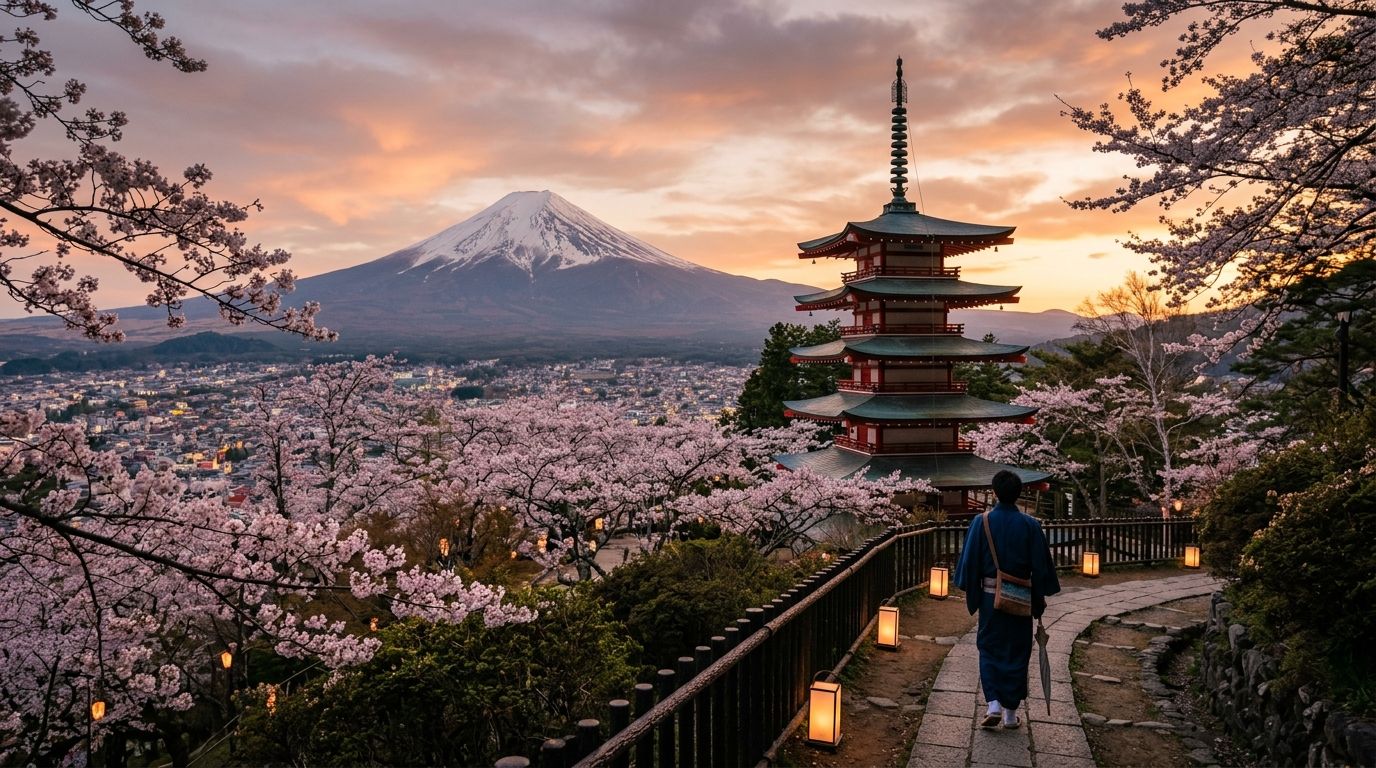
Mount Fuji isn't a hike unless you want it to be. Most people climb it; most climbers aren't prepared for the altitude. The better move is viewing it from the Hakone area, riding cable cars up mountains, soaking in onsen (hot springs), and seeing the mountain from distance. The climbing attempt often disappoints.
Nikko is a day trip from Tokyo through mountains. The shrines are extraordinary, and the area served as a historical religious center. The drive itself, through tall forests and small villages, matters as much as the destination.
Hiroshima's nearby islands like Miyajima, home to the famous floating torii gate, are accessible by short train rides. The gate is legitimately striking, especially at high tide. The island itself is worth exploring beyond the main shrine.
Is It Worth Visiting? The Honest Assessment
Yes, with a caveat: Japan rewards visitors who've done the basic internal work of curiosity. If you're hoping for transformative revelation or Instagram-worthy epiphanies, you'll be disappointed. If you're interested in seeing how a nation with extreme resource constraints developed a culture around efficiency, restraint, and continuous refinement—and in experiencing that culture firsthand—then absolutely.
Japan is also somewhat resistant to the typical tourist narrative. You won't have a story about "making friends with locals" unless you actually invest time. You won't have a story about discovering an "authentic" village—they're real places, not performance art. What you will have is a month or two afterward where you think about how a particular meal was prepared, or how public spaces functioned, or why someone bowed that specific way. That's the real value.
Quick Facts
- Language: Japanese; English is limited outside major cities. Translation apps help.
- Currency: Japanese Yen; ATMs at convenience stores accept most international cards.
- Visas: 90 days visa-free for most Western visitors.
- Toilets: Incredibly advanced; bring your own paper for older facilities.
- Earthquakes: They happen; they're prepared for far better than most countries.
- Cash culture: Still dominant; credit cards are less universal than expected.
- Tipping: Not expected; considered insulting in some contexts.
Your Next Step: Exploring Japan Deeper
The practical infrastructure for traveling in Japan is excellent. The harder work is deciding what you actually want to understand about it—whether that's food, architecture, art, efficiency systems, or just the texture of daily life in a developed nation with different priorities than your own.
Start mapping your route on Touratu's interactive map, which lets you plot regional movements, see travel times between cities, and understand how regions connect. Watch Touratu's travel videos to see how streets actually move, how crowds flow through stations, and what silent mornings in small towns actually feel like. The difference between reading about Japan and seeing it move in real time is significant.
Japan is ready for you. The question is whether you're ready to slow down enough to meet it where it is.
Loading activities…
