
Ireland: 20 Places Travelers Keep Returning
Ireland: Why Travelers Keep Coming Back to These 20 Places
There's a particular quality to returning somewhere. It's not the thrill of discovery—that edge-of-seat excitement that keeps first-time travelers awake on flights. Instead, it's something more settled. A recognition. You find yourself drawn back to the same weathered pub corner, the same coastal walk at golden hour, the same curve of countryside that made you feel, for a moment, like you belonged there.
Ireland has this effect on people. Not through grand gestures or engineered spectacle, but through something quieter and more persistent: the way light hits the River Liffey at dusk, how a barkeeper remembers your name on your second visit, the peculiar comfort of rain on a stone-walled village. Travelers return to Ireland not because they've conquered a checklist, but because the country itself has a way of becoming familiar while remaining fundamentally mysterious.
This is a list of twenty places that explain that pull. Not destinations to tick off, but spaces that reward both first visits and fifth ones—where the experience deepens with repetition, where you notice something new each time you return.
1. Dublin's Temple Bar District
The temptation is to dismiss Temple Bar as touristy, overcrowded, a caricature of Irish pub culture. And yes, it's busy. But there's a reason people keep returning: on a weeknight in November, with rain streaming the windows and a session musician tuning a fiddle in the corner, the district becomes something genuine. The tourist energy recedes. You're left with the actual texture of the place—creaking wooden floors, the smell of Guinness and old wood, conversations that spiral into unexpected philosophy.
The experience matters here more than the sights. Come for a pint, stay for the music. The sessions are most authentic mid-week, when visitors are fewer and the musicians aren't performing for a crowd.
Best time: October through March, avoiding peak summer.
Insider note: Skip Temple Bar itself if crowds feel suffocating. Cross to Norseman or Toners a few streets over—same energy, half the audience.
Photography moment: Wet cobblestones at night, pub windows glowing amber, the architectural geometry of narrow streets reflecting in puddles.
Practical tip: Pints are expensive here (€7–9). Eat beforehand at a local bakery or café to avoid inflated food prices.
2. Cliffs of Moher
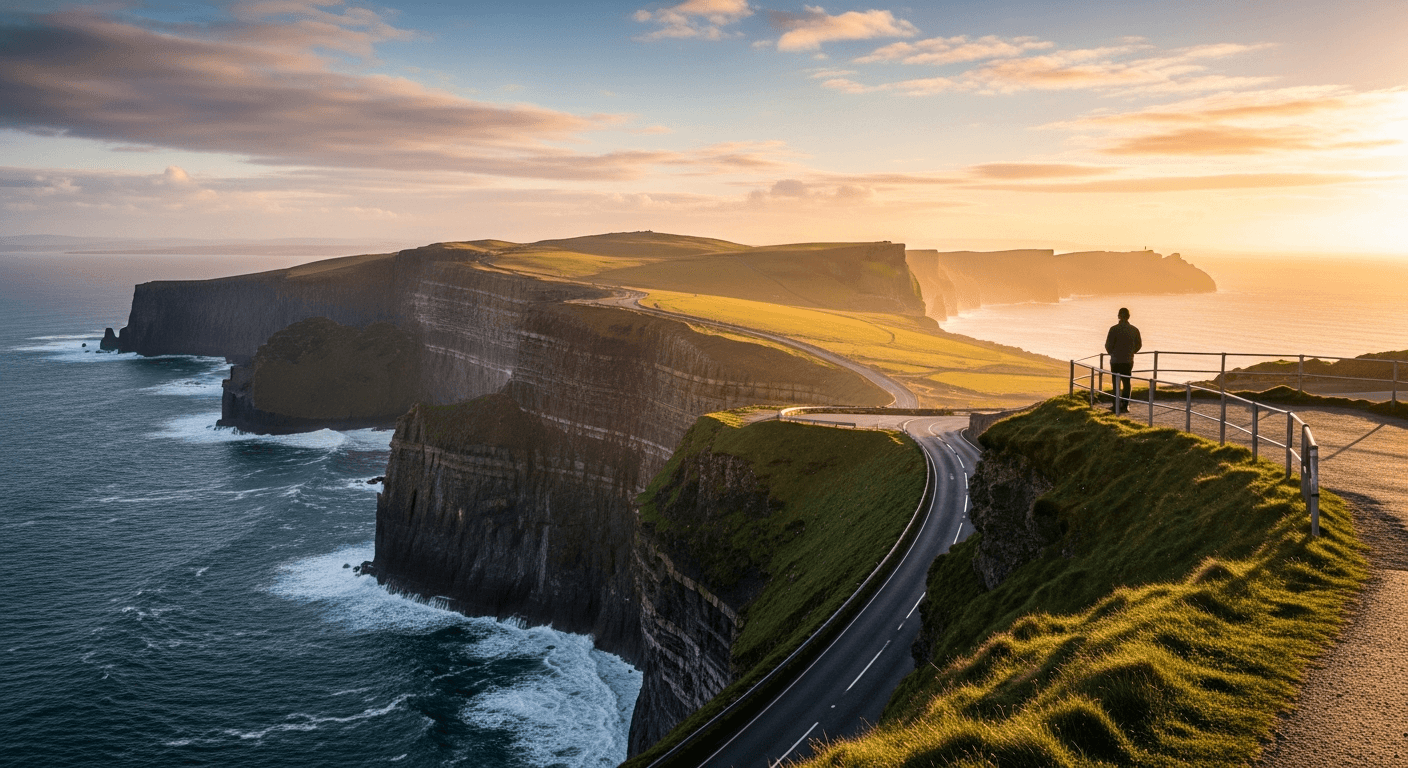
You've seen the photographs. Sheer cliff faces dropping to the Atlantic, the kind of landscape that makes dramatic desktop backgrounds. Yet somehow, standing at the edge on a grey morning with wind pressing against you, the reality surpasses the image. It's not about the view—it's about the feeling of insignificance, of being at the absolute edge of something.
Travelers return because the cliffs change with season and weather. Summer light transforms them into something amber and generous. Winter storms make them feel genuinely dangerous. Spring brings wildflowers that confound the scale entirely.
Best time: Late spring (May–June) or early autumn (September) for balance between manageable crowds and compelling light.
Insider note: Most visitors never venture beyond the main viewing platforms. Walk the clifftop path northward for thirty minutes. The human presence dissolves. You're alone with geology and weather.
Photography moment: The moment light breaks through clouds onto a distant section of cliff, illuminating it like a painting being revealed.
Practical tip: The visitor center can feel corporate. Skip it unless weather truly drives you inside. The real experience is outdoors, in the elements.
3. Inismore (Aran Islands)
Getting there is part of the point. The ferry across Galway Bay separates you from mainland rhythms. You arrive on an island where cars are sparse, where horses still pull carts, where the pace exists in a different timezone entirely.
Inis Mór is the largest island, and people return for the walk to Dún Aengus—not just the fort itself, but the journey across stone walls and empty fields, the sensation of being genuinely removed from the modern world.
Best time: July and August for guaranteed ferry service; June or September for fewer tourists and better light.
Insider note: Stay overnight. The island reveals itself differently after day-trippers leave. The light at dusk is unforgettable.
Photography moment: Stone walls creating diagonal lines across fields, vanishing toward the horizon; the shadow geometry at Dún Aengus at late afternoon.
Practical tip: Bring cash (ATMs are limited). Rent a bike rather than hiring a taxi—the speed matches the landscape's pace.
4. Galway City
A place that feels smaller and more intimate than it has any right to. Galway City somehow maintains a genuine bohemian energy despite its popularity. The harbor remains the heart—colorful shop-houses reflecting in the water, musicians setting up for evening sessions, the sense that anything could happen here.
Travelers return for the Friday and Saturday night energy, but also for solitary mornings when they can wander Quay Street without feeling herded.
Best time: May through September for reliable weather; October for lower crowds but maintained social energy.
Insider note: The best sessions happen in smaller pubs away from the main tourist zone. Ask locals where they're actually drinking, not where tourists are told to go.
Photography moment: Shop reflections in wet harbor pavement at dusk; the moment a street musician's audience spontaneously grows.
Practical tip: Stay west of the river in Salthill for a quieter base with coastal walks. The city center is walkable from there.
5. The Ring of Kerry
This is a loop, a journey rather than a destination. 180 kilometers of coastline that curves around a peninsula, revealing itself in fragments—a mountain vista, a small fishing village, a sudden vista of islands.
What keeps travelers returning is that the Ring never feels the same twice. Different seasons reveal different color palettes. Different paces of travel—driving versus cycling versus walking—create entirely different experiences.
Best time: June for maximum daylight and wildflowers; September for clearer light and fewer tour buses.
Insider note: Counter-clockwise is often less crowded than clockwise (most tours go one direction).
Photography moment: The moment Skellig Michael becomes visible across the water; morning mist in the Gap of Dunloe.
Practical tip: Take three days. The experience of the Ring isn't in driving the full loop at speed—it's in stopping repeatedly, walking into the landscape, arriving somewhere unexpected.
6. Cork City
Smaller and less obvious than Dublin, Cork has personality that feels earned rather than branded. The River Lee creates an intimate geography. Georgian architecture crowds the center. The food scene has genuine depth—not trend-driven, but rooted in actual culinary tradition.
People return for the human scale of the place, for the ability to know a neighborhood quickly, for pubs that feel like extensions of someone's living room.
Best time: Year-round, though October–April brings clearer light and fewer tourists.
Insider note: The English Market is essential, but go at 8:30am before foot traffic intensifies. The vendors are more generous with conversation.
Photography moment: Georgian doors in soft morning light; the reflection of St. Fin Barre's Cathedral in the river.
Practical tip: Stay on the north side of the river (Shandon area). It's quieter, more residential, and you'll understand how locals actually live.
7. Killarney National Park
Mountains, lakes, woodland—the elements of landscape sublime arranged into one contained space. Travelers return because the park rewards different approaches. Hiking the higher peaks, boating on the lakes, walking forest trails—each creates a different relationship to place.
Best time: May–June or September for solitude combined with reliable weather.
Insider note: Most visitors never venture beyond Muckross House. The woodland paths are empty even in peak season.
Photography moment: Morning mist rising from the lakes; the sudden clarity when you emerge from forest into mountain vista.
Practical tip: Pick one deep walk rather than sampling many. The landscape reveals itself through commitment to a single direction.
8. Dingle Peninsula
Westernmost point, where land genuinely seems to end. Dingle town itself maintains authenticity—colorful harbourside buildings, excellent seafood restaurants, traditional music that happens organically rather than for tourists.
The drive to Slea Head loop offers one of Ireland's most compelling coastal drives, with mountains rising directly from water, archaeological sites scattered across empty fields.
Best time: May–June or September–October for weather combined with manageable crowds.
Insider note: Stay in Dingle town proper (not the peninsula outskirts). The evening and early morning social rhythm is the real experience.
Photography moment: Slea Head at sunset, with the Blasket Islands silhouetted offshore; the curve of Coumeenoole Beach.
Practical tip: Eat at Out of the Blue (no reservations, queue essential) for fish so fresh it redefines the category. The wait becomes part of the experience.
9. Wicklow Mountains
A proper wilderness within an hour of Dublin, which explains why locals return constantly. Glendalough—a monastic settlement in a glacial valley—is the primary draw, but the real revelation is hiking the surrounding peaks and woodland, understanding how much genuine remoteness exists in this small country.
Best time: August–September for clear views and reduced muddy sections.
Insider note: Walk down into Glendalough rather than starting there. You approach the lakes like a discovery rather than a tick-box.
Photography moment: The round tower emerging from mist; the reflective surface of the upper lake at dawn.
Practical tip: Bring proper hiking boots. The terrain is wet year-round. This isn't a casual country stroll.
10. Kinsale
A fishing town that tourism has tried to pretty up, but which retains genuine character underneath. Narrow streets, excellent restaurants, a working harbor where you actually see fishing boats. It's close enough to Cork for a day trip, far enough to feel genuinely removed.
The charm here is understated. It doesn't perform for visitors; it simply exists, and that's why people return.
Best time: September through May for the actual Kinsale vibe without summer tourist saturation.
Insider note: Skip the main harbor walk. Instead, wander the residential streets in the early morning. You'll see actual life.
Photography moment: Weathered fishing boats at dawn; the geometry of colorful buildings stacked on hillside.
Practical tip: If you do one restaurant meal, make it Bastion. Book days ahead. It's the real deal.
11. Beara Peninsula
Less famous than Dingle, less developed than Ring of Kerry, but potentially more beautiful. Mountains meet sea directly here—passes cutting through high moorland, sudden descents to rocky beaches, a landscape that feels genuinely untamed.
Travelers return because it feels like a secret they've discovered, even though it's marked on every map.
Best time: June–September only, as mountain passes close during winter.
Insider note: The Healy Pass drive is the spine of the experience. Do it slowly, stopping frequently. The engineering is clever and the views justify the detours.
Photography moment: Mountain passes disappearing into cloud; the sudden contrast of rocky coast beyond the pass.
Practical tip: Base yourself in Kenmare or Castletownbere. Single-night stays don't justify the driving distance.
12. Achill Island
Attached by bridge to County Mayo, this feels like the absolute end of something—the cliffs at Clew Bay's edge, Golden Strand beach creating curves of golden-brown sand, a landscape of proper Atlantic exposure.
It's windswept and dramatic. Photographers return repeatedly. So do hikers and contemplative travelers who come here to clear their heads.
Best time: May–October for passable weather; October–November for optimal dramatic light.
Insider note: The beauty compounds the further west you travel on the island. Don't stop at Achill Head. Drive to Clare Island if you have the time.
Photography moment: Achill Head from the south, with the dramatic drop and cliff detail visible; the light transformation at golden hour.
Practical tip: Bring layers. The wind here changes conditions unpredictably. What seems pleasant can become harsh in thirty minutes.
Timing, Transport, and Neighborhood Wisdom
Ireland rewards slow travel, and this is non-negotiable. A two-week itinerary might touch ten of these places; a month might genuinely engage with them. Each place has rhythm—daily, seasonal, cultural—and you only access it through patience.
For transport, rent a car if you're comfortable driving on the left side. If not, buses cover most routes, though schedules assume less urgency than North American travel. Trains connect major cities but skip rural areas entirely.
Neighborhoods matter. Even in small towns, where you stay changes the experience. Tourist zones cluster around specific blocks. Live three streets back and you're in actual Ireland.
Timing your visits: spring brings wildflowers and improving light but also school holidays; summer is crowded but has longest daylight; autumn offers clear skies and fewer people; winter is quiet, sometimes melancholic, with early darkness and frequent rain. Each season creates a different Ireland. Seasoned travelers time trips around their personal weather and crowds preferences, not around a destination's "best" season, which often just means "most crowded."
On etiquette: Irish hospitality is genuine but never servile. Locals appreciate curiosity without condescension, interest without performance. In pubs, don't expect rapid service—ordering is a conversation, not a transaction. Don't photograph people without asking, even on streets. And perhaps most importantly: listen more than you talk. Ireland's entire culture is built on storytelling, and locals share generously with travelers who actually listen.
Discovering Traveler Routes on Touratu
On Touratu's interactive map, you can explore the routes others have created across Ireland—not pre-packaged "two-week tours" but actual traveler journeys showing where people have spent time, where they've returned, which small villages captured their attention, which coffee shops became daily rituals. These aren't recommendations; they're breadcrumbs from people who've learned the country intimately. Follow them or diverge completely. Either way, you're learning what makes places memorable.
Why They Come Back
What draws travelers back to Ireland isn't conquering a list. It's the recognition that familiarity doesn't diminish mystery—it deepens it. You return to the same pub and notice something you missed before. You walk a familiar trail and the light makes it entirely different. The country becomes less like a destination to visit and more like a place that exists in you, calling you back to understand it more completely.
This is why people keep returning—not because Ireland is flawless, but because it's genuinely alive, and part of that aliveness is the way it changes based on who's experiencing it and when. Every return is different because you're different.
Loading activities…
