Interactive Travel Map: See What Every Destination Looks Like
Introduction: Seeing a Destination Is Different from Understanding It
One of the biggest challenges in travel planning isn't finding places to visit—it's understanding what those places are actually like.
A destination may look spectacular in carefully edited photographs, yet leave travelers wondering:
- What's the atmosphere really like?
- How crowded is it during the day?
- What's the walk from the parking area?
- Are nearby attractions worth visiting?
- Is this somewhere I'd actually enjoy spending time?
Modern travelers no longer rely solely on brochures or travel guides to answer these questions. Instead, they watch videos, browse reviews, study maps, and compare experiences across multiple platforms.
While access to travel information has never been greater, the research process has become increasingly fragmented.
A traveler may watch a video on one website, search for the attraction on another, read reviews somewhere else, and finally open a map to understand where everything is located.
The information exists.
It simply isn't connected.
At the Touratu Research Desk, we believe travel planning becomes far more effective when destinations are explored visually through an interactive map that combines places, videos, attractions, and nearby experiences into one connected journey.
The Problem with Traditional Travel Research
Most travel planning begins with search engines.
People search for:
- Things to do in Bali
- Best beaches in Greece
- Hidden gems in Japan
- Places to visit in Iceland
The results usually include travel blogs, videos, review websites, social media posts, and booking platforms.
Each resource provides valuable information, but each tells only part of the story.
Travelers often spend hours moving between tabs trying to answer simple questions.
- Where exactly is this attraction?
- What else can I visit nearby?
- Is this worth adding to my itinerary?
- How much time should I allow?
The challenge is not finding information.
The challenge is connecting it.
Why Photos Are No Longer Enough
Beautiful photographs inspire travel.
They capture dramatic sunsets, mountain peaks, crystal-clear beaches, and iconic landmarks.
But photographs also have limitations.
They show a single moment.
They don't reveal:
- Walking conditions
- Local atmosphere
- Crowd levels
- Street sounds
- Weather
- Accessibility
- Scale
Travel decisions increasingly depend on understanding these practical details.
That is why videos have become one of the most trusted forms of travel research.
Videos provide movement, perspective, and context that still images cannot.
Interactive Maps Add Geographic Context
Even videos have limitations.
A traveler may watch an incredible video of a hidden waterfall but still have no idea where it is located relative to nearby attractions.
Interactive maps solve this problem.
Instead of viewing destinations individually, travelers begin seeing how places connect geographically.
For example, while exploring a city, a traveler can immediately understand:
- Which attractions are within walking distance
- Which viewpoints are nearby
- Where local restaurants are located
- Which museums can be visited on the same day
- How neighborhoods relate to each other
Maps transform isolated recommendations into complete travel experiences.
What Makes an Interactive Travel Map Different?
Traditional maps are designed for navigation.
Interactive travel maps are designed for discovery.
Instead of simply showing roads and directions, they combine multiple layers of travel information.
These may include:
- Tourist attractions
- Traveler videos
- Hotels
- Activities
- Restaurants
- Scenic viewpoints
- Markets
- Festivals
- Hidden gems
The result is a map that helps travelers understand destinations rather than simply navigate them.
Seeing Destinations Through Traveler Videos
One of the biggest shifts in travel planning has been the rise of traveler-generated content.
Unlike promotional videos, traveler videos often capture authentic moments.
They reveal:
- Real walking experiences
- Weather conditions
- Crowd sizes
- Scenic viewpoints
- Transportation options
- Local atmosphere
Watching these videos helps travelers answer an important question:
"Can I imagine myself here?"
This emotional connection plays a significant role in travel decision-making.
Why Exact Location Matters
Videos become far more valuable when they are connected to the places they represent.
Instead of simply watching content, travelers can immediately understand:
- Where it was filmed
- What attractions are nearby
- How far it is from the city center
- Which hotels are close
- Which experiences are available nearby
Geographic context transforms videos from entertainment into planning tools.
How Touratu Connects Videos with Places
Touratu approaches travel discovery differently.
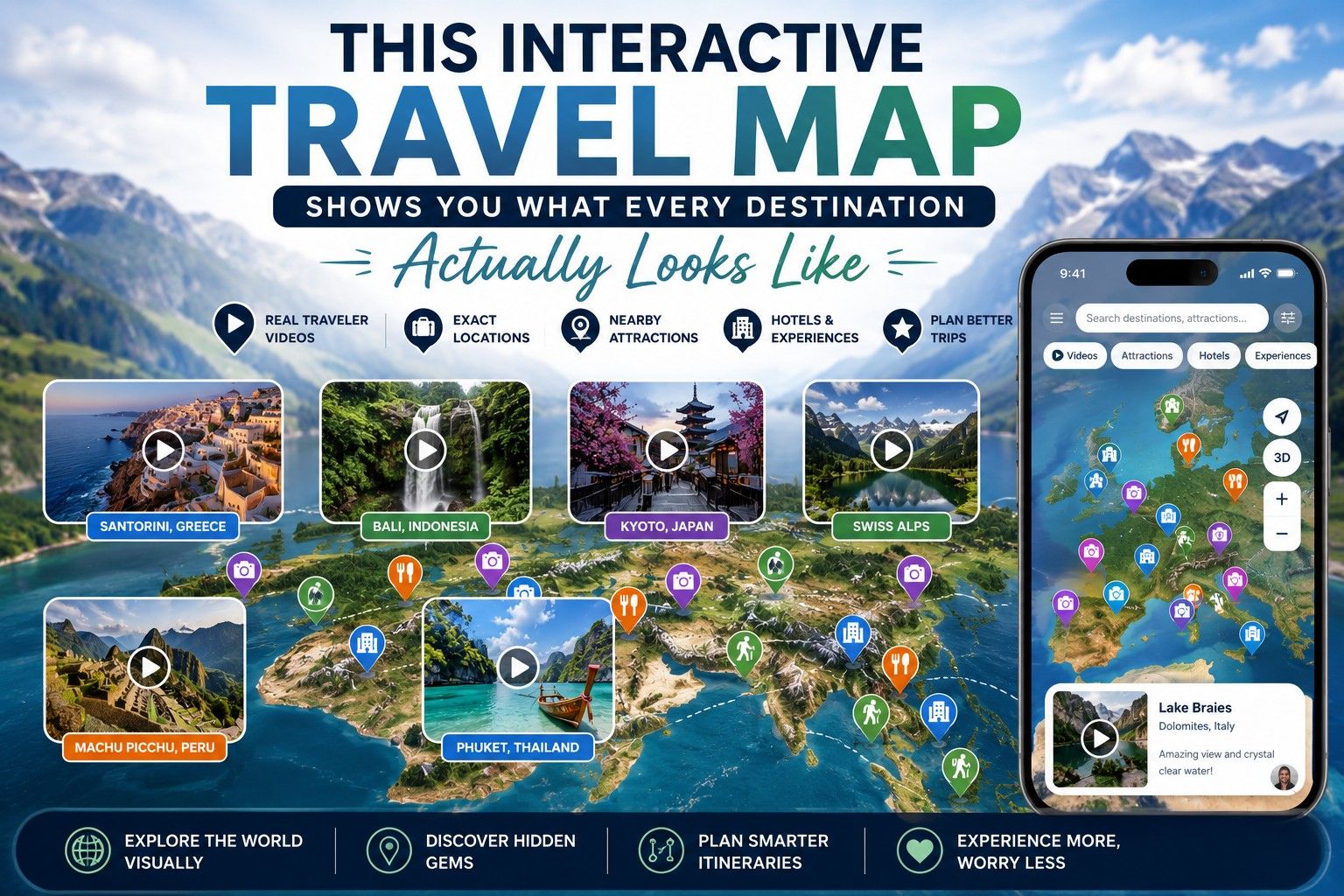
Every traveler video is pinned to its exact geographic location on an interactive map.
Instead of searching separately for maps and videos, travelers can explore destinations visually while understanding where every experience fits within the surrounding area.
As users zoom from countries to states, cities, neighborhoods, and attractions, they can discover videos created at those exact locations.
The map becomes more than navigation.
It becomes a visual guide to the destination.
Travelers can move naturally between:
- Attractions
- Traveler videos
- Nearby hotels
- Activities
- Guided experiences
- Hidden gems
without leaving the map.
Discovering More Than Famous Attractions
Many travel websites focus primarily on iconic landmarks.
While these places deserve attention, they rarely tell the complete story of a destination.
Interactive exploration encourages curiosity.
A traveler watching a video from a famous temple might notice:
- A nearby walking trail
- A traditional village
- A scenic café
- A lesser-known viewpoint
- A local market
These unexpected discoveries often become the highlights of a trip.
Instead of searching specifically for hidden gems, travelers find them naturally while exploring the map.
Planning Smarter Itineraries
One common mistake travelers make is choosing attractions based solely on popularity.
Without understanding geography, itineraries often involve unnecessary travel between distant locations.
Interactive maps allow travelers to group nearby attractions efficiently.
This creates itineraries that are:
- More relaxed
- More realistic
- Less time-consuming
- Better balanced
Instead of spending hours in traffic, travelers spend more time experiencing destinations.
From Inspiration to Booking
Travel planning usually follows several stages.
Inspiration.
Research.
Discovery.
Planning.
Booking.
Experience.
Interactive maps help connect these stages.
A traveler may begin by watching a video, continue exploring nearby attractions, compare experiences, review accommodation options, and eventually book activities that match their itinerary.
Rather than interrupting the planning process, each step builds naturally on the previous one.
The Future of Travel Discovery
Travel planning is becoming increasingly visual and location-aware.
Artificial intelligence will improve recommendations.
Traveler videos will become even more influential.
Interactive maps will evolve from navigation tools into complete travel discovery platforms.
Rather than searching for information across dozens of websites, travelers will increasingly expect everything they need to understand a destination in one connected experience.
Maps, videos, attractions, hotels, experiences, and itineraries will become part of a single exploration journey.
Final Thoughts
The best travel decisions are rarely made from photographs alone.
Understanding a destination requires context.
It requires seeing how attractions connect, how neighborhoods feel, and how real travelers experience a place.
Interactive travel maps bridge the gap between inspiration and understanding by combining geographic context with authentic travel content.
Touratu brings this concept to life by pinning traveler videos to their exact map locations, allowing travelers to explore destinations visually before they arrive. Instead of asking, "What does this place look like?" travelers can begin asking richer questions:
- What else is nearby?
- How can I spend the day here?
- Which experiences fit my interests?
- What hidden places might I discover?
Travel planning is no longer just about finding destinations.
It is about understanding them.
And the journey begins with seeing every destination as it truly is.
Loading activities…