
Iceland: 20 Places Travelers Return to Again
Iceland: Why Travelers Keep Coming Back to These 20 Places
There's a particular kind of silence in Iceland that stops you mid-breath. It's not empty silence—it's the opposite. It's the sound of geothermal steam rising from earth's seams, of waterfalls collapsing into valleys with the violence of creation, of wind that seems to carry stories in its gusts. First-time visitors arrive expecting drama. They leave understanding that Iceland isn't dramatic so much as it is honest—a place where nature doesn't perform for an audience but simply exists in its most unfiltered state.
What draws travelers back, again and again, isn't the singular experience of Iceland but the impossible variety within it. A country smaller than Ireland contains deserts of black sand, glaciers the size of small countries, hot springs that warm your skin in winter darkness, and cliffs so precise they seem designed by an architect rather than weathered by time. People return because one visit leaves you with questions. Several visits later, you're still discovering layers.
This isn't a bucket-list guide. It's a map of the places that make visitors rearrange their lives to return.
The Places That Pull People Back
1. Skaftafell: Where Glacier Meets Green Valley
Most travelers encounter Skaftafell while moving through the southeast, treating it as a pit stop on the ring road. Those who stay discover something quieter. This corner of Vatnajökull National Park holds a valley of impossible green—birch trees and arctic wildflowers thriving beneath the gaze of Öræfi glacier, a river of ice that has shaped this land for millennia.
The experience here isn't summiting anything. It's the shorter walks—the trail to Svartifoss, where you stand beneath a waterfall framed by hexagonal basalt columns, or the gentler paths that loop through moss-covered forests where light filters golden even on grey days. The glacier feels present but not threatening, a monument you're allowed to walk beside rather than conquer.
Best time: June through September. Winter visits are possible but require serious winter hiking preparation.
Insider note: Most visitors rush the main waterfall loop in two hours. Return in the evening when afternoon crowds dissolve. The light transforms after 5 PM, and the valley grows contemplative.
Photography moment: The basalt columns at Svartifoss create perfect geometry against falling water—bring a tripod to capture the texture without tourists.
Practical tip: Stay overnight in nearby Skaftafell village rather than pushing onward. The area opens up differently when you're not watching the clock.
2. The Blue Lagoon: Reclaimed by Intention
The story of the Blue Lagoon is distinctly Icelandic: a geothermal power plant's wastewater created an accidental thermal pool. Rather than hide it, Iceland turned it into something deliberate and beautiful. Now thousands soak in milky-blue water while steam rises into Arctic air.
It would be easy to dismiss this as too touristy, too engineered. But there's something honest about reclaiming industrial consequence and making it ceremonial. The lagoon works because hot water actually is transformative—your skin changes, your breathing changes, your relationship to your own body changes when you float in 40-degree water while the air around you hovers near freezing.
Best time: Winter visits carry more magic. Soaking in darkness under starlight (rare but possible) feels like an intimate act rather than a tourist moment.
Insider note: Arrive at opening or just before sunset. The golden hour visitors miss the quality that makes regulars return—the lagoon at its least crowded holds a different spell.
Photography moment: The silhouette of bathers against steam and darkening sky. Skip the selfies and watch light work.
Practical tip: Premium entry includes a facial mud mask. Use it. The minerals are real, and the ritual matters.
3. Landmannalaugar: The Realm of Many Colours
At Landmannalaugar, the earth seems uncertain what color it should be. Rust-red mountains slope beside moss-green valleys. Obsidian-black volcanic fields give way to patches of arctic buttercup yellow. Geothermal hot springs emerge between these fractured hills like nature's own bathhouses.
This is where serious hikers converge, but also where casual walkers discover something disorienting—a landscape that looks absolutely nowhere else on Earth. The light here is strange and urgent. Even on cloudy days, the earth seems to generate its own illumination.
Best time: July through early September. The trails are snow-free and the thermal springs most accessible. After September, the plateau becomes increasingly treacherous.
Insider note: Don't just hike the famous trails. Wander between waypoints. The most memorable moments happen when you're slightly lost among chromatic mountains, checking your map against impossible terrain.
Photography moment: The view from Brénnisteinshæld looking across the multicoloured ridges at golden hour—it's a photograph that makes people believe you've doctored the colors.
Practical tip: Bring proper hiking boots. The terrain is more technical than it appears, and weather shifts dramatically.
4. Jökulsárlón Glacier Lagoon: Time Made Visible
Jökulsárlón is a lagoon that shouldn't exist. Vatnajökull glacier retreats, leaving a chasm that fills with meltwater. Now fragments of ice—some centuries old—drift in dark blue water between black sand banks. Some icebergs are translucent, their interior striations visible like tree rings recording centuries of snowfall.
There's something profoundly unsettling about this place. You're not admiring the glacier from a distance; you're watching its dissolution in real time. The icebergs are calving, shifting, changing color as light angles through them. It feels like witnessing geology at the moment of transformation.
Best time: Summer (June-August) for fullest ice activity and accessibility. Winter visits offer different drama—fewer tourists, more volatile conditions.
Insider note: Take the boat tour. Walking the shore is fine, but the lagoon reveals itself from within. Getting close to drifting ice changes your sense of scale.
Photography moment: An iceberg against the black sand, capturing the translucent blues and the debris frozen within. Arrive early or late for less crowded compositions.
Practical tip: The adjacent black sand beach is equally compelling and far less visited. Walk it after the lagoon.
5. Dyrhólaey: The Peninsula of Impossible Stone
Dyrhólaey is a volcanic peninsula that decides to do several extraordinary things at once. There's a lighthouse overlooking obsidian cliffs. There's a natural arch carved through stone, massive enough to feel Biblical. There's a colony of puffins (in season) perched improbably on grass-covered ledges. There's black sand beach extending toward nothingness.
The peninsula feels like a geography test—how many geological features can exist in one place? But the answer is: Iceland is that place, and Dyrhólaey concentrates that abundance into a few square kilometers.
Best time: May-August for puffins. Spring through fall for general accessibility. Winter makes the drive treacherous and often impossible.
Insider note: The arch is the photographic prize, but the cliffs surrounding it hold more character. Walk the edges carefully. The wind has opinions.
Photography moment: The arch framing the sea and sky—dramatic but almost too obvious. Try capturing the adjacent cliff faces with their geometric striations instead.
Practical tip: The road is often closed in winter without warning. Check conditions before committing. The single-lane access means planning around other visitors.
6. Geysir: The Hot Spring That Built Its Own Legend
The Great Geysir—from which all geysers take their English name—no longer erupts with regularity. Its neighbor, Strokkur, explodes every few minutes like clockwork. But standing in the geothermal field surrounded by hissing vents, mineral-stained earth, and water that simmers just below the surface, you understand why medieval Icelanders thought they'd discovered portals to something divine.
The science is remarkable, but the experience is older than science. This is the landscape humans first feared and then learned to worship.
Best time: Year-round accessibility, though winter ground conditions make walking more challenging. Summer provides better light for photography.
Insider note: Watch Strokkur carefully. Seconds before eruption, the pool bulges upward slightly. Begin anticipating, and you'll catch the moment of release rather than react to it.
Photography moment: The moment just before eruption—that pregnant pause when the earth is about to do something impossible. It requires patience and many attempts.
Practical tip: The ground gets extremely hot. Thick-soled hiking boots are essential.
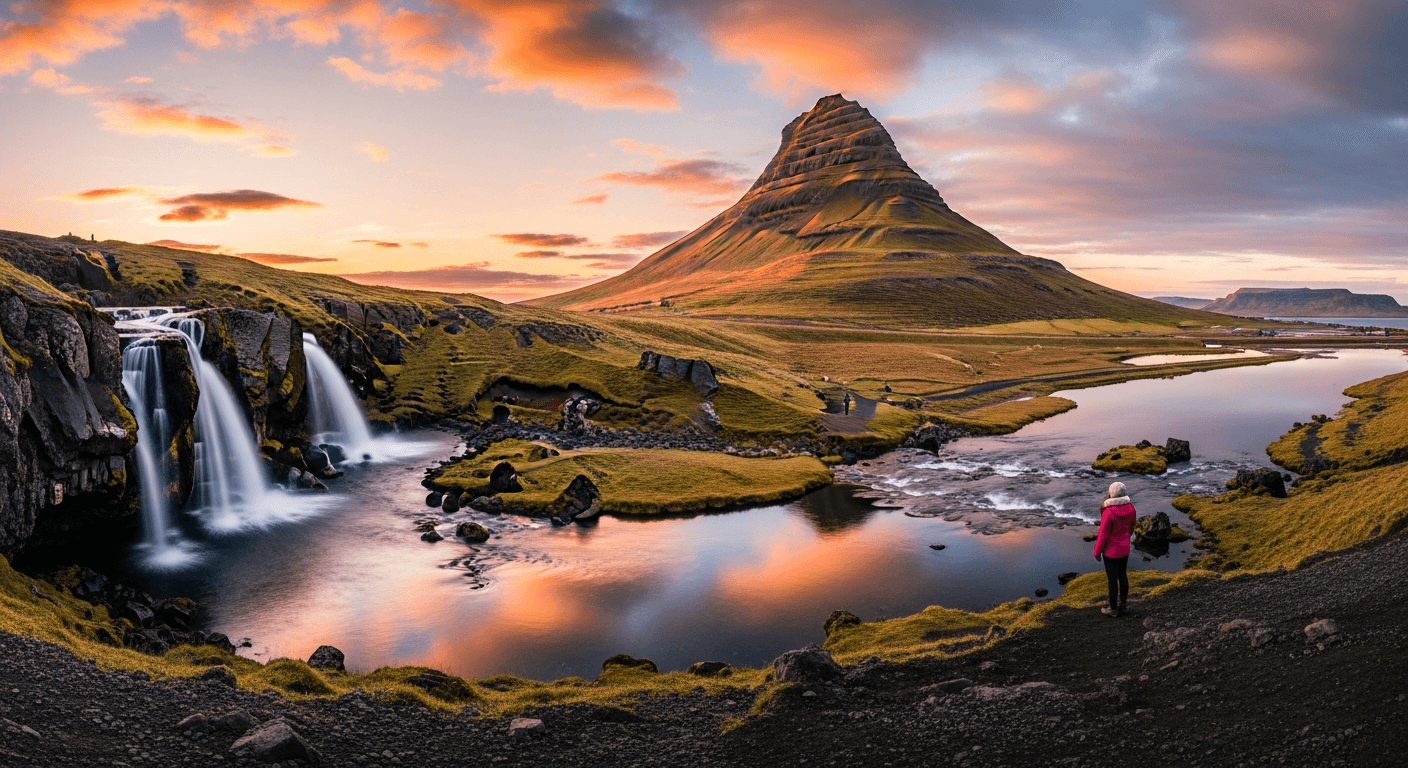
7. Kirkjufell: The Mountain That Shouldn't Look Real
Kirkjufell is a mountain that appears designed rather than geological. Its three-pronged peak rises from flat terrain with almost comic perfection. Viewed from certain angles, it's almost abstraction—a shape so pure it challenges belief.
But the real magic isn't the mountain itself. It's the light that transforms it. The same peak photographed at 2 AM under midnight sun looks entirely different from the same mountain at dusk, and different again in winter darkness with northern lights ascending behind it.
Best time: The mountain is visible year-round, but midnight sun (June) and potential aurora (September-March) offer different magical contexts.
Insider note: Every photographer converges on the same viewpoint—the one from the parking area. Wander the surrounding trails. Kirkjufell looks equally compelling from unexpected angles, and you'll have them to yourself.
Photography moment: Kirkjufell reflected in a stream with wildflowers in the foreground (summer) or with aurora behind it (winter). Both are nearly cliché but earned for reason—they're genuinely spectacular.
Practical tip: The hike to the summit takes 45 minutes and rewards you with perspective. Most visitors photograph from below and move on.
8. Mývatn: The Lake of Quiet Extremes
Lake Mývatn is shallow, volcanic, and biologically abundant in a way that makes the water shimmer with life. Midges—mý in Icelandic—cloud the shore in summer, but they feed the birds and fish that make this ecosystem improbable and resilient. Nearby are pseudocraters, geothermal fields, and bird sanctuaries where arctic species gather.
This isn't the dramatic Iceland. It's the generous Iceland, the one that sustains rather than astonishes.
Best time: Summer (June-August) for bird activity and accessibility, though the midges are legendarily frustrating. Winter offers silence and sometimes northern lights.
Insider note: Visit the birdwatching shelter at dawn. The variety of arctic species visible from this single viewpoint is extraordinary.
Photography moment: Birds in flight over water with volcanic terrain in the distance—captures the biological and geological drama simultaneously.
Practical tip: Stay in nearby Akureyri. It's a larger town with actual restaurants and accommodations beyond hostels.
9. Snæfellsjökull: The Glacier That Guides Legends
Snæfellsjökull is a glacier-crowned volcano at the tip of the Snæfellsnes Peninsula. It appears and disappears based on weather, creating a mountain that's both constant and ephemeral. Jules Verne set his Journey to the Center of the Earth in a cave at its base, suggesting humanity's persistent need to imagine what lies beneath.
The glacier is accessible to serious hikers but equally rewarding to observe from distance—a white peak emerging from dark volcanic landscape, ice against basalt.
Best time: Summer through early fall for climbing. Winter for viewing from the peninsula's coastal trails.
Insider note: The full peninsula hike—Snæfellsnes Loop—circumnavigates the volcano over several days. It's arduous and rewarding and makes the glacier's dominance visceral.
Photography moment: The glacier at sunrise with the sea visible beyond. Requires an early start but the light is worth it.
Practical tip: If not hiking to the summit, explore the peninsula's western coast. The basalt cliffs and beaches here rival the glacier in visual drama.
10. Vatnshellir: The Cave Beneath the Ice
A glacier-filled cave system accessible only by boat across a glacial lagoon and then by climbing rope into chambers of ice. Vatnshellir is Snæfellsjökull's secret—a geological theatre that few experience. The ice walls glow blue in certain light. Water drips from formations that take millennia to accumulate.
This is geology as architecture, and you're walking through a space that's constantly in flux, melting subtly even as you stand within it.
Best time: Summer-early fall when the glacier lagoon is navigable and cave ice is stable.
Insider note: This is a guided experience only, which makes it less accessible but more thoughtfully paced. The guides understand the rhythms that make the experience work.
Photography moment: Ice formations backlit by the guide's headlamp—otherworldly blue visible nowhere else.
Practical tip: This is genuinely difficult. Ropes, climbing, cave passages, significant exertion. Go only if comfortable with serious outdoor risk.
11. Skógafoss: The Waterfall With Persistence
Waterfalls are abundant in Iceland, but Skógafoss is the one that refuses to be ignored. It's massive, powerful, creates its own weather system (bring rain gear even on clear days), and holds a particular kind of authority. There's a walking trail beside it where spray mists everything, and from certain angles, the water seems to be falling upward as much as down.
The name means "forest waterfall," though the forest is now gone. The waterfall remains, a reminder of what this land was and what it persists in being.
Best time: Year-round, though summer provides best light. Winter ice formations around the falls are remarkably beautiful.
Insider note: Most people view from below. Climb the hiking trail alongside—the perspective from above is humbling, and the vantage point reveals the waterfall's raw power differently.
Photography moment: The waterfall with hikers for scale, or captured with slower shutter speed so the water becomes abstract motion.
Practical tip: The spray will find its way into your camera. Bring protective cases and wait for brief sunny moments when light hits the mist at angle.
12. Snaefellsnes Peninsula: The Concentrated Masterpiece
The Snæfellsnes Peninsula is where Iceland practices everything it's known for—waterfalls, black sand beaches, basalt cliffs, glacier-topped mountains, fishing villages, and spaces of profound emptiness. It's a curriculum in Icelandic geography compressed into a few driving hours.
People return here not to check boxes but to sit with the repetitive experience of being moved by light and stone and water in different configurations. It's meditative in that way—not peaceful, but deeply absorbing.
Best time: Summer offers accessibility and long daylight. Winter's storm season creates different drama and genuine solitude.
Insider note: The peninsula rewards slow driving. Stop at every pullover that speaks to you. The unnamed beaches and cliffsides often outweigh the famous stops.
Photography moment: Kirkjufell (detailed earlier) is iconic, but the basalt columns at Hellnar and the beach at Djúpalónssandur are equally compelling and less crowded.
Practical tip: Fuel up in Borgarnes before heading north. Services thin considerably once you're on the peninsula.
The Rhythms That Make Return Possible
Getting around Iceland requires understanding that it's less a place to visit than a place to move through. The Ring Road—Route 1—circumnavigates the country and passes near most destinations. Driving here means accepting that distances are significant, roads are sometimes treacherous, and weather changes faster than predictions suggest.
Most visitors rent cars and drive independently, which allows for the kind of slow discovery that makes Iceland feel like something more than tourism. Stop where instinct suggests. The finest moments rarely align with guidebook recommendations.
Timing matters here more than elsewhere. Winter (October-March) offers northern lights and dramatic weather but limited daylight and road accessibility. Summer (June-August) provides endless daylight and easier driving but shares the roads with other travelers. Spring (April-May) and fall (September) exist in a narrower band—fewer tourists, unpredictable weather, but genuinely magical light that combines warmth with darkness in ways summer never achieves.
Etiquette in Iceland runs quiet. People are courteous but reserved. Respect natural boundaries—stay off fragile moss, don't disturb nesting birds, and understand that some areas close seasonally for genuine ecological reasons, not bureaucratic theater.
Mapping the Return
On Touratu's interactive map, you can trace these routes through traveler reels and visual discoveries—watching how other visitors have moved through these spaces, where they've paused, what light caught their attention. The map becomes a conversation with other curious travelers, a way of understanding not just where to go but how to see.
Why They Return
Iceland stops offering itself at first glance. You need to return to understand it—to see how the same landscape transforms through seasons, how the light's behavior changes, how you yourself change in relation to it. Each return visit reveals not new places so much as deeper relationships with places you thought you'd finished with.
The travelers who return—and there are many—aren't chasing something they missed. They're deepening their conversation with a place that's genuinely alive, genuinely complex, and genuinely indifferent to whether you understand it or not. That's precisely why it matters.
Loading activities…
