
Georgia Travel Guide: Top Things & Activities
Georgia: A Country That Doesn't Announce Itself
The Mtkvari River cuts through Tbilisi's old town in the way rivers do in cities that have learned to live alongside water rather than against it. You notice it first—not because someone told you to, but because you turn a corner after getting deliberately lost in narrow streets, and there it is, the light hitting it differently than you expected. A sulfuric spring steam rises somewhere nearby. You smell it before you place it. A man carrying fresh bread walks past you, utterly unbothered by the layers of history stacked around him like geological strata.
This is Georgia. Not the American state. Not the usual travel superlatives either.
What strikes you about Georgia isn't its Instagram moments, though those exist. It's the absence of the carefully curated exhaustion that defines modern tourism in most places. Georgia is a country that seems genuinely puzzled by the idea of performing itself. It has a 5,000-year wine history and doesn't lead with it. Mountains that rival the Swiss Alps in drama don't dominate the national branding. Ancient churches sit in valleys and on cliffs like they've always been there, because they have. And locals will invite you to a family supra—a traditional feast—with the casualness of someone asking if you want tea.
What Makes Georgia Actually Worth Your Time
I've sat in enough travel forums to know what gets recycled: wine regions (yes, Georgia makes wine), mountain hikes (yes, steep ones), cultural crossroads (yes, between Europe and Asia). But here's what those descriptions miss: the feeling of discovering something that hasn't been commodified into a checklist yet.
Start with Tbilisi. The capital is a city of contradictions that somehow coheres. Soviet-era apartment blocks sit next to Ottoman-influenced bathhouses, which sit next to hypermodern restaurants. You can have breakfast at a tiny family-run khachapuri stand where the owner's mother is literally making the cheese bread in a room barely larger than a closet, then dinner at a Michelin-recognized restaurant where a chef is deconstructing Georgian food philosophy. Neither experience feels like tourism. Both feel like eavesdropping on someone else's life.
The wine isn't a museum exhibit. Winemaking in Georgia happens in clay vessels buried in the ground called qvevri, a method unchanged for millennia. This isn't preservation for preservation's sake—this is how people actually make wine because it works. You can visit vineyards in Kakheti where families have been doing this for generations, and they'll give you warm hospitality and honest conversation over amber-colored natural wine. No sommelier pretension required.
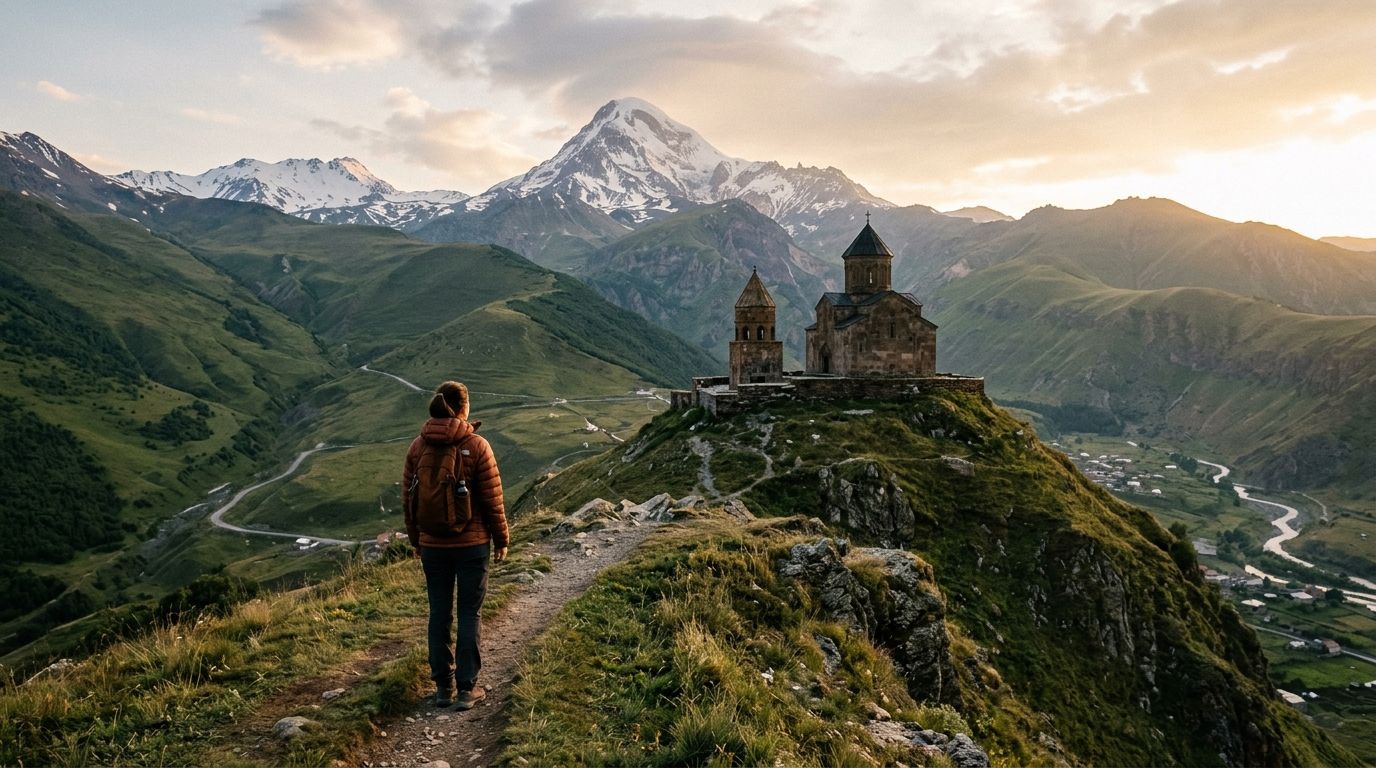
The Caucasus Mountains to the north are genuinely dramatic. Kazbegi sits at the base of Mount Kazbek, where a monastery called Tsminda Sameba clings to a hillside at 2,170 meters. The drive there alone—switchbacks that require focus and unfolds views that make you forget what you were focusing on—is the kind of journey that explains why people write about travel but can't quite capture it in words.
And then there's Gonio Fortress, just outside Batumi on the coast. Built in the 15th century but with layers reaching further back, this fortress on the Turkish border sits where the Sarpi River meets the sea. It's been captured and recaptured so many times that its walls have absorbed the logic of several empires. You walk those ramparts and you're not reading history; you're standing in it.
What to Expect: Walking Through the Experience
Arrival and First Hours
You'll land at Shota Rustaveli International Airport, which is clean, orderly, and refreshingly unstressful. A shared minibus to the city center costs around 2 GEL (less than a dollar). Welcome to Georgia's pricing: everything costs roughly a quarter of what you'd pay in Western Europe.
Tbilisi hits you first with sensory information. The old town's narrow streets are steep. Buildings lean toward each other like they're sharing secrets. There's street food everywhere—khachapuri (cheese bread), khinkali (soup dumplings), pkhali (vegetable pâté)—and none of it is expensive or disappointing. You eat standing up. Everyone eats standing up. This is normal.
The Reality of Getting Around
Georgian public transport is chaotic but functional. Minibuses called marshrutkas run fixed routes but pick up and drop off anywhere. They're packed, warm, intimate in the way only shared transport can be. Signs are sometimes in Georgian script only, which you can't read. Ask someone. Georgians will help with the patience of people who remember when everyone struggled with their language.
To reach places beyond Tbilisi—Kakheti for wine, Kazbegi for mountains, Batumi for the coast—rent a car if you're confident driving in less predictable conditions, or hire a driver through your accommodation. Day trips exist, but Georgia deserves more time than a day trip allows.
The Supra: A Note on Food Culture
A supra is the only word you need to understand Georgian social life. It's a feast where a tamada (toastmaster) gives elaborate toasts, everyone eats meat and bread and homemade khachapuri, and wine flows because this is Georgia. If you're invited to one, go. Come hungry. Stay longer than feels polite. This is how Georgians live together.
Solo Travel, Safety, Logistics
Georgia feels safe in the way many places do when you're not anxious. Women travel solo here without the particular exhaustion it requires in some countries. People speak English in the tourist zones, less so outside them. Download offline Google Maps. Get a local SIM card. The Georgian language has its own alphabet and will defeat you, but "thank you" (shukleba) and "hello" (gamarjoba) carry you far.
Planning Your Visit: When, How Long, How to Move Through It
Season and Crowds
September through October is ideal: summer heat has backed off, the light becomes golden, and you're not navigating spring mud or winter snow. May and June are beautiful but slightly warmer. Winter closes mountain roads and some higher-altitude attractions. August brings crowds and heat. July is hot enough to deter the casual wanderer.
How Long to Stay
Ten days is the minimum to stop feeling rushed. Three days for Tbilisi itself, two or three for a wine region like Kakheti or Tsinandali, two for mountains (Kazbegi), two for the coast (Batumi) if you want it. Anything less and you're sprinting.
How to Move Between Regions
From Tbilisi: Kakheti is 2-3 hours east (wine and small town charm). Kazbegi is 4 hours north (mountains, hiking, one of those experiences that rewires you slightly). Batumi is 6-7 hours southwest (beach, Black Sea, subtropical feel that doesn't match the mountains you just crossed). Gonio Fortress is 15 minutes from Batumi. These connections are the story as much as the destinations.
Costs (Real Numbers)
Accommodation ranges from 15-30 GEL for guesthouses (clean, local, breakfast included) to 80+ for hotels. Meals at family restaurants: 10-20 GEL. Wine by the glass: 5-8 GEL. A full day tour with a driver: 100-150 GEL. You can travel well here for $30-50 daily if you're budget-conscious, or spend more if you want Michelin-star dinners.
Nearby Worth Visiting: Three Extensions
Armenia (2-3 Days)
The border opened and closed with geopolitical complications, so check current status before planning. If open: Geghard Monastery and Garni Temple show Armenia's architectural distinctiveness. The drive there crosses the heart of the Caucasus. It's a different country entirely, with its own ancient wine history and architectural language. Not a detour; a completely separate story.
Azerbaijan (Not Straightforward)
The border situation is complex. Skip unless you know current conditions and have significant time. Baku is interesting but feels different in energy and purpose.
South to Turkey
Sarpi village is Georgia's only seaside settlement before the Turkish border, and the sea here meets a small river. Simple guesthouses, fresh fish, minimal tourism infrastructure. Stay a night. Swim if it's warm enough.
Is It Actually Worth Visiting?
Yes, but not for the reasons tourism marketing would list.
Georgia rewards curiosity and punishes preconceived itineraries. If you arrive expecting to check boxes—wine country ✓, mountains ✓, authentic culture ✓—you'll find those things but miss the actual texture of what makes Georgia distinct. But if you arrive willing to get lost in Tbilisi's old town and eat breakfast with strangers and watch mountains change color in evening light, you'll understand why people return.
It's not a place designed for tourists. It's a place that tourists have started visiting, and the locals haven't yet built the machinery to make it feel processed. This window won't stay open forever. That's both what makes it worth going and what makes it fragile. Go thoughtfully.
Quick Facts
- Language: Georgian (Kartuli). English spoken in tourism zones.
- Currency: Georgian Lari (GEL). 1 USD ≈ 2.7 GEL (rates fluctuate).
- Visa: Most nationalities get 365 days visa-free. Check official sources.
- Best Time: September-October, May-June.
- Average Daily Cost: $30-60 (budget to mid-range).
- Flight Time from London: ~5 hours. From New York: ~11 hours.
Closing: Your Next Step
Georgia isn't difficult to reach, but it does require slightly more planning than Europe's usual suspects. The reward for that small friction is a country that still feels like a discovery rather than a destination you've already seen in forty Instagram stories.
Use Touratu's interactive map to explore routes between Tbilisi, Kakheti, Kazbegi, and Batumi—see the actual distances, the switchbacks of mountain roads, and how these regions connect. Watch travel videos from people who've moved through Georgia to get a sense of what those drives feel like, what the light looks like at different hours, what a supra actually involves.
Then go. Spend time. Eat khachapuri from street stalls and at family tables. Climb toward that monastery. Taste wine made in a clay vessel in the ground. Get lost in a city that doesn't perform itself.
Georgia is waiting, unannounced.
Loading activities…
