
Georgia's 20 Most Compelling Places for Return Visitors
Georgia: Twenty Reasons Travelers Return Again and Again
There's something about Georgia that doesn't quite let you go. You might arrive for the wine, the mountains, the sticky sweetness of khachapuri cheese bread fresh from a wood-fired oven. But what keeps you returning—what pulls you back through the same airports, the same winding streets, the same family-run guesthouses—is something more elusive. It's the particular quality of light at dusk in Tbilisi's Old Town. It's the way a stranger will insist you're their cousin, their sister, and mean it. It's the discovery that traveling here feels less like tourism and more like being slowly adopted into an extended, boisterous, endlessly hospitable family.
Georgia operates on different logic than Western Europe. Time moves according to conversation length, not clock precision. Meals are negotiations of abundance rather than service transactions. Skepticism dissolves quickly here—the Georgian tradition of supra (feast) is not performance; it's theology. After your first experience of this, you understand why people come back. They've felt something genuine in a world increasingly filtered through screens and marketing departments.
The Twenty Places That Haunt Your Travel Journal
1. Metekhi Church and Shardeni Statue, Tbilisi
The equestrian statue watches over Metekhi with a melancholic permanence that no amount of tourism can diminish. King David the Builder, cast in bronze, surveys the Mtkvari River with the expression of someone who's seen empires rise and collapse. Inside the church, the centuries settle into your chest—the smell of frankincense, the weight of accumulated devotion, the quiet insistence of icons in candlelight.
What distinguishes this from other religious sites is the authenticity of daily worship alongside the flow of photographers. Locals genuflect while tourists frame shots. There's no uncomfortable tension between these worlds; both simply exist. Visit early morning, before the tour groups reorganize the square into neat formations. The light at 7 AM reveals what photographs never quite capture: the almost melancholy grace of the place.
The photography moment arrives when the sun catches the statue's face—usually around 6:15 PM in summer. Locals burn candles around the base year-round, creating an accumulation of wax that speaks to genuine devotion rather than curated aesthetics. Respect this by standing back, observing before photographing.
2. Sighnaghi: Wine Country Time Slip
This small town didn't intend to become a destination. That's precisely why it endures. Sighnaghi sits elevated above the Alazani Valley with the demeanor of a place that's been waiting for centuries for visitors to finally notice its importance. The town walls loop protectively around terracotta roofs and cobblestones that haven't been aggressively restored into pastiche.
The real experience involves staying overnight and experiencing the quiet that descends after the day-trippers depart. Sit in a small wine bar (taverna) in early evening. Order local Saperavi—the wine tastes like the terroir (earth) actually tastes here, not like marketing nostalgia. Watch the valley deepen into shadow. This is when the place reveals its genuine character: neither performing for tourists nor resenting them, simply existing.
The light transforms everything around 5 PM. Wine-colored light floods the valley. Photograph the old town walls from the valley road below—they frame perfectly against the Caucasus ridgeline. The contrast between the linear human architecture and the chaotic beauty of mountains creates compelling images. Best visited September to early November when the harvest season creates genuine activity rather than enacted tourism.
3. Gelati Monastery: Solitude in Stone
The drive to Gelati takes you from Kutaisi through increasingly rural landscapes where cars feel anachronistic. The monastery emerges not with fanfare but with quiet inevitability, its churches arranged like thoughts in meditation. Founded in the 12th century, Gelati represents a moment when Georgia's artistic ambitions reached their apex—before Ottoman incursions, before Soviet confiscations, before the slow erosion of empire.
What strikes most visitors isn't the architecture alone but the surrounding emptiness. Acres of overgrown courtyard. Churches inhabited by genuine silence rather than reverberating footsteps. You might encounter one other visitor, or none. This is the inverse of Rome's Vatican experience—Georgian religious sites often retain authentic quietude despite their magnificence.
The frescoes inside the Akademia Church still possess an otherworldly luminescence, their pigments drawn from mineral compounds that refused to fade. Stand long enough and the figures begin to communicate across centuries. This requires time—minimum two hours to let the place settle into your consciousness rather than your camera roll.
Visit in afternoon light (2-4 PM) when the sun angles through aged stones in ways that create natural illumination without glare. The outer courtyard photograph works best from the northwestern corner where the perspective includes all three churches with the valley behind. Respectfully, remove shoes when entering interior spaces and observe any ongoing worship without intrusion.
4. Vardzia: Carved Into Belief
The cave monastery city spans 13 stories into a mountainside, carved by hand in the 12th century—not as a single act but as a continuous negotiation between faith and geology. Walking through Vardzia, you're moving through intentional spaces: living quarters, kitchens, churches, libraries, all extracted from stone as if they'd always existed there and merely required revelation.
The river running below (the Mtkvari) still defines life here, just as it did for the monks who inhabited these caves. The place hasn't transformed into a museum so much as an archaeological record of how people actually lived when conviction required action. The absence of electricity in most caverns, the smoke stains on ceilings from centuries of candles, the stone cups worn smooth from use—these details communicate more than any historical plaque.
The walk between cave sections involves genuine climbing, stairs carved narrowly, passages that demand respect for historical dimensions. This physical engagement keeps Vardzia from becoming passive consumption. You must move deliberately, carefully, mindfully. Children under 8 struggle here; it's not universally accessible. This limitation inadvertently preserves something authentic—the place hasn't been designed to accommodate infinite visitation.
Photograph the interior frescoes with available light only; understand that your camera will struggle here, and that's appropriate. The human eye often sees more than cameras can render. The exterior photograph works best from the opposite valley side, shooting across the river at late afternoon light. Visit May through September when all caves remain accessible; winter snows occasionally close upper sections.
5. Tusheti: Where Mountains Contain Myth
Arriving in Tusheti requires commitment. The road is single-lane dirt, precipitous, occasionally impassable, regularly terrifying. You gain 1000 meters elevation over several hours. Mobile phone signals fragment and disappear. This friction is precisely what preserves Tusheti—it remains impractical enough to discourage casual tourism while rewarding travelers who understand that some places demand effort.
The villages cluster at high altitudes with a density that seems geometrically impossible. Stone towers punctuate the landscape—defensive architecture from centuries when border raids defined life here. The cultural distinctiveness remains visible: traditional dress still marks some locals, linguistic peculiarities persist, the pace of life follows mountain logic rather than urban rhythm.
What keeps travelers returning isn't photo-friendly vistas (though those exist) but rather the sensation of traveling through time as much as space. You're encountering patterns of living that predate modern convenience, cultures that developed in near-isolation, landscapes that haven't been aggressively developed for tourism. It's humbling and destabilizing in the best way.
Photograph the tower villages from distance first—the linear arrangement against the mountains tells the settlement story. Portraits work extraordinarily well here because locals, while cautious initially, engage genuinely once trust develops. The light remains clear and sharp at altitude; dawn and dusk create dramatic contrasts. Visit July through early September; other seasons render the road occasionally impassable. Hire a local driver who knows the road logic. Respect photography boundaries—always ask before photographing people, and be prepared for refusal without resentment.
6. Kazbegi: Where Earth Meets Heaven
This mountain town doesn't whisper; it declares. The Caucasus encircles everything—there's literally no direction without dramatic peaks. Kazbegi functions as a base for mountain adventures, but the town itself possesses a particular character: the main street buzzes with hikers and mountaineers, small guesthouses offer genuine hospitality rather than service, local restaurants serve food calibrated for mountain metabolism.
The surrounding terrain accommodates virtually any experience level. Casual walkers enjoy the paths to local villages and valleys. Serious trekkers tackle multi-day routes through pristine wilderness. Rock climbers migrate here seasonally. The range of accessibility means Kazbegi never feels like a single-note tourism destination—it serves actual mountain culture while welcoming visitors into that culture.
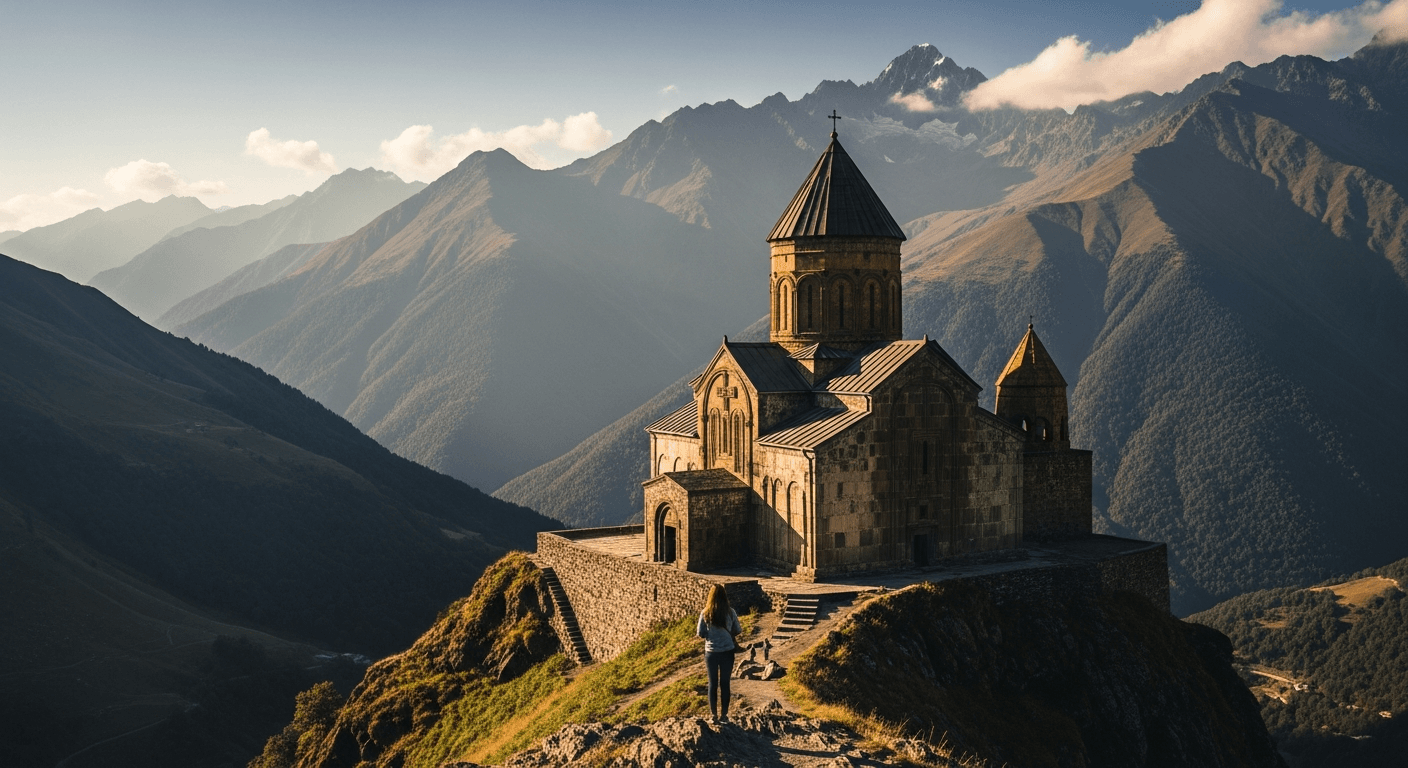
Gergeti Trinity Church, perched on a peak above town, offers the "climbing church" experience that photographs suggest, but the genuine magic emerges from sitting in the church itself at dusk, watching the valley darken while remaining at elevation. The temperature drops. Peaks turn crimson and orange. The simplicity of the stone structure gains power from this dramatic context.
Sunrise from Gergeti works photographically but attracts crowds. Consider sunset instead—fewer photographers, similar light quality, more contemplative atmosphere. The walk up takes 45-60 minutes; start around 4:30 PM for optimal light. The herding paths from town to Sno village provide excellent photography of mountain settlement patterns without the crowds. Visit May through October; winter transforms Kazbegi into a ski destination with different character entirely. Hire local guides for peak climbs—the mountains demand respect and local knowledge.
7. Black Sea Coastline: Batumi's Unexpected Urbanism
Batumi performs the remarkable trick of being simultaneously touristy and genuine—a Georgian port city that's embraced development without entirely discarding character. The Soviet architecture sits comfortably alongside Art Nouveau facades. Turkish influences surface in cuisine and urban texture. Modern shopping malls neighbor tiny family-run cafés that serve food unchanged for decades.
The beach culture here differs from Mediterranean resort expectations. Georgians come to Batumi for seaside socialization, not performative sunbathing. Families spread multiple generations across beach stretches. Elders in full dress wade in. Music emerges from competing speaker systems. It's chaotic, joyful, authentically social.
What distinguishes Batumi's appeal is that it doesn't apologize for tourism development while simultaneously resisting homogenization. The Botanical Gardens offer genuine horticultural interest. The Old Town's narrow streets contain dozens of small restaurants where eating happens naturally alongside local clientele. The seafront promenade works as social theater rather than postcard backdrop.
Photograph the contrast between old and new architecture—dramatic juxtapositions abound. Early evening light on the Soviet buildings reveals their unintentional beauty. Portraits of bathers offer genuine cultural documentation rather than staged tourism imagery. Visit September through May for reliable beach weather without summer crush. The city vibrates with slightly different energy in shoulder seasons.
8. Jvari Monastery: Overlooking Convergence
Perched above Mtskheta where two rivers merge, Jvari possesses the kind of architectural clarity that makes it appear inevitable—as if the location demanded exactly this form, and the builders simply revealed what was already present. The church's cross-dome design influenced regional architecture for centuries. But beyond historical significance, Jvari offers genuine peace.
The walk up winds through neighborhoods where Georgians live genuinely (not for tourists) and then transitions to the rural approach—gradually, naturally, giving psychological preparation for the monastery's intensity. Arriving at the top and realizing the convergence of rivers, the spread of valleys, the positioning of the church within this geography creates a moment of perfect spatial coherence.
The view encompasses Mtskheta's cathedral complex below, establishing a visual relationship between religious sites that illustrates medieval Georgia's spiritual landscape. Standing here, you understand how these locations weren't randomly positioned but intuitively placed for maximum sacred geometry.
Visit early afternoon for optimal light on the church's east-facing façade. The steps up provide excellent compositional depth. Photograph people arriving at the church—the moment of approach often reveals genuine emotion without posed performance. Visit any season; the location's elevation means weather changes dramatically. Allow at least 45 minutes in and around the church; rushing undermines the contemplative purpose.
9. Gonio Fortress: History's Layered Expression
At the Turkish border near Sarpi, Gonio Fortress contains centuries within its walls. Ottoman, Georgian, Russian occupations each left architectural testimony. Walking through the fortress functions as walking through competing historical narratives—each period claiming the space differently. This layering prevents any single interpretation from dominating; you encounter history as contested, negotiated, rebuilt.
The fortress itself rises from strategic positioning—dominating river access, controlling maritime traffic, providing defensive advantage. But what strikes most visitors is how the space doesn't feel like a museum reconstruction. Damage persists. Repairs from different eras show visibly. The place retains authenticity that over-restoration destroys.
The underground dungeon, still in use centuries ago, generates a particular emotional weight. Standing in spaces designed for imprisonment creates discomfort that photographs can't transmit—physical understanding of historical darkness.
Visit late afternoon when light rakes across walls at angles that reveal texture and time. Photograph architectural details rather than the whole structure initially—the layered history becomes apparent in details. The river view from the highest point works compositionally with the fortress foreground. Visit April through October; November through March weather creates challenging conditions without discouraging genuine visitors.
10. Svaneti's Towers: Mountains That Built Themselves
The towers rise from villages in Svaneti like thoughts that have achieved stone permanence. These aren't decorative architecture but practical defensive structures—when raids defined life, towers offered survival. The clustered villages of Mestia and Ushguli maintain dozens of these towers, creating landscapes that feel medieval because they are, functionally, still engaged in medieval settlement logic.
The towers compress multiple stories vertically, compensating for scarce horizontal space. They provided refuge, storage, defensive advantage, and social hierarchy simultaneously—architecture that performed multiple functions while expressing cultural values. Walking through these villages means moving through genuinely maintained historical space, not restored pastiche.
What surprises most visitors is that Svaneti isn't a museum. Locals live here, work here, maintain these towers because they're still useful, still valued. The living culture surrounding ancient architecture prevents the place from calcifying into heritage performance.
The villages reward wandering without agenda. Small paths between towers reveal details—traditional wooden carvings, family shrines, community spaces. Late afternoon light on stone towers creates dramatic shadow patterns. Photograph towers in isolation when possible—the solitary tower against mountains creates compositional strength. Portrait work here yields extraordinary results; locals, while initially reserved, warm to respectful engagement.
Visit June through September when mountain passes remain open and weather reliably cooperates. Hire local guides for village photography—they navigate permissions and cultural navigation that visitors would struggle to accomplish independently. Svaneti's altitude demands acclimatization; allow at least 24 hours before strenuous activities.
11. Kvareli Wine Region: Earth's Medicine
The wine produced here tastes like geology made drinkable. The terroir expresses with almost embarrassing clarity—you taste soil, elevation, ancient cultivation practices, family history. Unlike famous wine regions that function partly as marketing phenomena, Kvareli remains primarily a production region where tourism serves local culture rather than replacing it.
Small wineries welcome visitors for genuine tastings rather than choreographed experiences. Winemakers discuss fermentation with the intensity of people who've spent lifetimes understanding yeast behavior. Wine sits in traditional kvevri (clay vessels) buried in earth—the same techniques used for centuries, not revived for authenticity performance.
The surrounding landscape combines cultivated vineyards with genuinely wild forest and high terrain. Driving through the region, you encounter multiple Georgias simultaneously: agricultural development, wilderness preservation, settlement clusters, empty expanses.
Photograph vineyard patterns during harvest season (September-October) when activity generates authentic imagery. Portraits of winemakers—aging hands, focused expressions—communicate decades of work. The kvevri chambers photograph exceptionally well with available light; the clay's color deepens dramatically in afternoon light. Visit September through November for harvest season energy; other seasons provide quieter experience with less activity. Arrange tastings through guesthouses or visitor centers rather than appearing unexpectedly—wine culture here respects formal introduction.
12. Sarpi Beach: Where Empires Touch
This small coastal village marks Georgia's western boundary with Turkey (and formerly Russia). The beach itself is black sand, dramatic, unwelcoming to passive sunbathing but compelling for those interested in geography as drama. You can stand with one foot in Georgia, see Turkey across a river mouth, and feel the weight of geopolitical complexity dissolve into simple human curiosity.
The village itself retains small-scale character despite tourism growth. Local restaurants serve catch-of-the-day without pretension. Accommodations range from basic to comfortable without luxury theater. The essential character—working fishing village that happens to accommodate visitors—remains intact.
The light at Sarpi possesses particular quality, perhaps from the meeting of river and sea, perhaps from the unusual geology. Sunsets here don't perform; they simply occur with the validity of daily recurring phenomena rather than tourist spectacle.
Photograph the black sand texture—evening light renders it nearly silver. The lighthouse, modernly rebuilt but still functional, creates compositional interest. Portraits of fishermen working, mending nets, handling catch communicate genuine labor. Visit April through October; winter storms transform the beach into something more austere and less welcoming. The river mouth is swimmable but requires caution regarding currents; ask local guidance before entering water.
The Practicalities of Multiple Returns
Getting between places in Georgia requires patience with infrastructure that's improving but remains subject to Georgian logistics philosophy. Marshrutka minibuses connect most destinations, requiring flexibility regarding departure times—they leave when full, not when scheduled. The experience provides authentic local travel but demands comfort with unpredictability.
Tbilisi functions as the connection hub, a city that deserves multiple visits across different seasons. The Old Town reveals different personalities in different light. The neighborhoods beyond the obvious tourist circuit—Vake, Saburtalo, the areas beyond the Mtkvari—contain real daily life that tourists rarely penetrate.
Guesthouses throughout Georgia often surpass hotels in hospitality quality. Families running these spaces view hosting as genuine cultural exchange rather than service transaction. Booking directly through guesthouses rather than international platforms frequently yields more authentic experiences and often better pricing.
Learn basic Georgian phrases—not for practical communication (English works reasonably well with younger generations), but for cultural respect. Georgians perceive language effort as honor shown to their nation. Attempting conversation, even when English would be simpler, shifts the entire tone of interaction.
Visit during shoulder seasons (May-June and September-October) when weather cooperates, tourism pressures ease, and local culture remains visible alongside visiting presence. July-August transforms many locations into crowded performances of themselves. Winter visits to higher elevations become mountaineering adventures rather than casual tourism.
Seeing Georgia Through Traveler Routes
On Touratu's interactive map, you can explore visual journeys through Georgia—following the routes that travelers documented through wine tastings, mountain passages, and Old Town wanderings. Browse through reels and photographs that capture those quiet moments when Georgia's character reveals itself fully: light changing on tower villages, hands preparing khachapuri, conversations extending across impossible language gaps. The map shows not just destinations but the paths of experience that visitors documented while discovering why Georgia, once encountered, never entirely releases its claim on the imagination.
The Reason for Returning
Georgia doesn't trade in the grand gestures other destinations deploy for appeal. It offers no superlatives, no "world's largest" or "once-in-lifetime" hyperbole. Instead, it provides the particular satisfaction of encountering genuineness—places where tourism exists alongside living culture rather than replacing it, where travelers arrive as guests in someone else's ongoing story rather than consumers of pre-packaged experience.
You return because the mountains didn't disappoint. The wine tasted like promise. Strangers became temporary family. The light at dusk reminded you why light matters. The quiet in monasteries rewired something in your nervous system. The feast went on for hours because the point wasn't eating but gathering. You understood, finally, that the most compelling destinations aren't those that announce themselves loudest, but those that welcome you patiently and let you discover gradually what they've been all along.
Loading activities…
