
Finland Travel Guide: Winter Activities & Bookable Trips
Finland: Where Winter Becomes a Sensory Experience
There's a moment, usually around 2 AM on a clear February night, when you step outside and the world goes silent. Not the silence of absence, but the silence of deep cold—when the air becomes so still that even snow sounds loud beneath your boots. Above you, a faint glow starts to spread across the sky like someone slowly turning up a dimmer switch. Within minutes, the northern lights are moving above you in shades of green and purple, rippling like curtains caught in an invisible wind. You're standing in Finland, and you understand why people keep coming back.
Finland doesn't announce itself. It doesn't have the dramatic peaks of Norway or the architectural spectacle of Stockholm. What it has instead is something quieter and somehow more compelling: a landscape that has learned to thrive in extremes, and a culture built on finding meaning in isolation and stillness.
What Actually Happens Here
Finland occupies a peculiar place on the traveller's mental map. Most people think "Northern Lights and ice hotels," which isn't wrong exactly, but it's like defining Italy entirely through pasta. The country is genuinely shaped by its relationship with winter and water—there are 188,000 lakes, more per capita than anywhere else on Earth—but the experience of being here is far more textured than the postcard version suggests.
The northern lights themselves are real, and yes, they're worth the trip. But what stays with you isn't just the visual. It's the particular cold that makes stars seem sharper. It's the clarity of sound. It's sitting in a wooden sauna that overlooks a frozen lake, then stepping outside into subzero air with wet skin, which should be unpleasant but somehow feels like a reset button for your entire nervous system.
The other thing that catches people off guard is how liveable Finland is, even (especially) in winter. The Finnish have spent centuries figuring out how to not just survive seasonal darkness and cold, but how to build genuine pleasure into it. There's a concept called sisu—often translated as resilience or stoicism, but really closer to "we will not be defeated by discomfort"—that underpins everything from sauna culture to winter swimming to the cheerful design of a coffee shop on a day when sunrise doesn't happen until 10 AM.
What to Expect: The Actual Experience
Helsinki in winter feels like stepping into a film about Nordic understatement. The architecture is clean-lined and deliberate—beautiful without trying too hard. The city has maybe ten hours of twilight rather than proper darkness by January, which creates this perpetually atmospheric quality. You'll find good design shops, interesting museums, and restaurants where the chef's mindset seems to be "what can we do with these particular ingredients?" rather than "how can we impress people?" The market square near the waterfront is genuinely worth a morning, less for shopping than for the sense of how a city can organize itself.
But Helsinki is a gateway, not the main event. Most people head north or toward the lakeland interior.
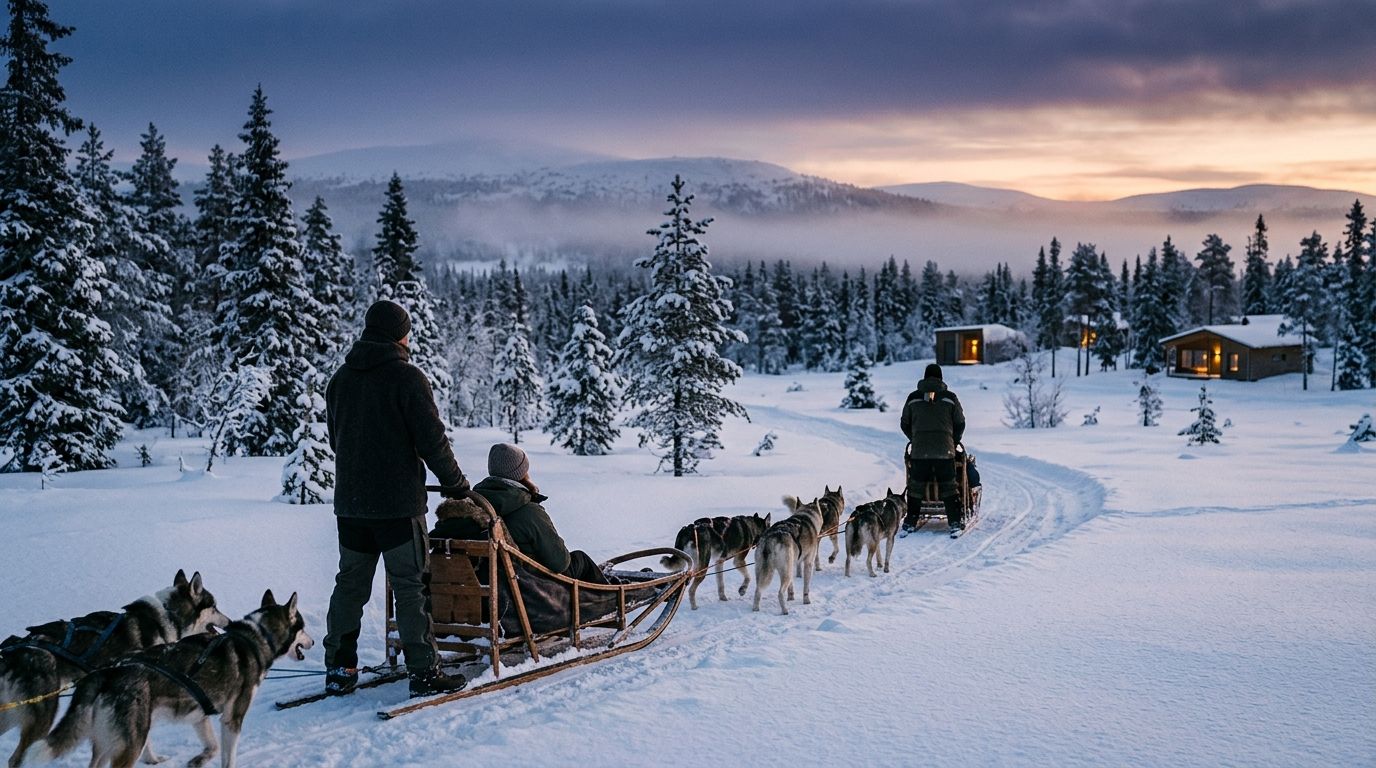
In Lapland (the far north), you're looking at serious winter infrastructure built around the simple fact of darkness and snow. Towns like Rovaniemi are surprisingly functional—this isn't frontier camping, it's civilization that's learned to operate at 66 degrees north. The tourist economy here is built on activities: snowmobile safaris, dog sledding, ice fishing on frozen lakes. The quality varies wildly depending on your operator, but when it works well, there's something meditative about sitting on a sled behind running dogs, or drilling a hole in meter-thick ice and fishing in what feels like the end of the world.
The northern lights hunt is the draw, but manage your expectations carefully. They happen reliably between September and March, but "reliably" means maybe 50-70% clear sky nights when they're active enough to see. You can book tours that chase cloud cover across the region, but you can also just stay somewhere and hope. Some people see extraordinary displays; others get a faint greenish glow and learn to be grateful for it.
The lake region (central Finland—places like Jyväskylä or Tampere) is a different proposition entirely. In summer, it's cottage-country culture with forest and water in every direction. In winter, the lakes freeze solid enough for ice hotels and winter swimming. The ice-hotel experience is exactly what it sounds like: a structure built from ice blocks that melts every spring. It's clever, it's cold, and it's more comfortable than you'd think (cold chambers, heated common areas, good insulation). Whether it's "worth" the cost depends on whether you're the person who goes to places because they're unusual or because they're genuinely pleasurable. It's more the former.
Sauna culture is the connective tissue between regions. There are more saunas than cars in Finland—estimates hover around 3 million saunas for 5.5 million people. A proper sauna visit isn't rushed. You get hot, you cool off (either in a lake or outdoor shower), you get hot again, and you sit in the cooling-off area drinking water and talking to whoever else is there. Public saunas still exist—Löyly in Helsinki is the modern version, more social than private—and many accommodations have one. Winter sauna followed by rolling in snow is a legitimate Finnish pleasure that looks mad from outside and feels logical when you're actually doing it.
Planning Your Visit: Practical Matters
Best time: This depends entirely on what you came for. November through January is darkest and best for northern lights, though coldest. February and March are still cold enough for winter activities but have slightly more daylight. Summer (June-August) is short, bright, and pleasant—midnight sun in the far north, near-24-hour daylight further south. Winter is harder, more expensive, and more rewarding if you're interested in the actual Finnish winter experience. Summer is easier and better if you want landscape photography or want to move around the country.
How long: Three nights minimum if you're flying all that way. If you're chasing northern lights, 3-5 nights gives reasonable odds. If you're doing Helsinki plus a Lapland excursion, budget 5-7 days. The country isn't enormous—Helsinki to Rovaniemi is about 1,200 km—but winter travel isn't fast.
Getting around: Helsinki has an airport with decent international connections. Domestic flights connect Helsinki to Rovaniemi and other northern towns (about 2.5 hours). Trains are reliable but slow; buses are cheaper but also slow. Winter driving is possible if you have experience and hire a proper winter car, but it's not recommended for visitors unfamiliar with snow driving. Book activities through established operators—the industry is well-developed and safety standards are high.
Costs: Finland is expensive. A sauna, a meal, and a night's lodging in an ordinary hotel runs 150-200 EUR easily. Winter activities (dog sledding, snowmobile safaris) add 100-300 EUR per person per activity. The ice hotel is 200+ EUR per night. Flights from northern Europe are reasonable; from further away, you're looking at 600+ EUR. Budget accordingly—this isn't a bargain destination.
Crowds: Winter outside the far north is quiet. Lapland gets busier December 15-January 5 (Christmas/New Year) and late February/early March (school holidays). Summer is busier throughout. Shoulder seasons (May, September) are peaceful and the weather is reasonable.
Nearby Places Worth the Detour
Stockholm, just across the border, is 3-4 hours by train or flight. It's a completely different aesthetic—water-based and architecturally grander—but geographically nearby if you want to combine Nordic trips.
Norwegian Lapland (around Tromsø) is actually easier to reach for northern lights than Finnish Lapland if you're coming from the south, though you'll be in Norway rather than Finland.
The Aland Islands, between Finland and Sweden, are technically autonomous and Swedish-speaking. In summer, they're pleasant cycling country with minimal tourism infrastructure. In winter, they're less relevant for most visitors.
Is It Actually Worth Visiting?
Yes, but only if you're the right kind of traveller. Finland requires something that not everyone brings to a trip: patience with cold, comfort with quiet, and interest in places that don't constantly signal their own importance. If you want constant activity and visual drama, go to Iceland or Norway. If you want food and style, go to Stockholm or Copenhagen.
But if you want to understand what it means to build a genuinely functional, pleasant life in a place where winter tries very hard to defeat you, Finland rewards the trip. The northern lights are real but honestly secondary to the experience of sitting in a sauna, swimming in a frozen lake, and realizing your body is entirely capable of handling things your mind thinks are impossible.
It's not for everyone. But for the people it's for, it's difficult to overstate.
Quick Facts
- Capital: Helsinki
- Language: Finnish (Swedish widely understood, English very common in tourist areas)
- Currency: EUR
- Best northern lights odds: February-March
- Best weather: July-August
- Visa: Schengen (check current requirements)
- Time zone: UTC+2 (UTC+3 in summer)
Finland reveals itself slowly—not through grand gestures but through accumulated sensations and quiet realizations. Whether you're chasing the northern lights above Rovaniemi or learning to appreciate sauna culture in Helsinki, the country works on you gradually.
To explore Finland's routes, plan your activities, and watch authentic travel videos from people who've actually been there, visit Touratu's interactive map. Browse bookable activities, read detailed route guides, and see the country through the experiences of real travellers—not just the winter postcard version, but the full texture of Finnish travel.
Loading activities…
