
Ecuador Travel Guide: Best Things to Do & Bookable Activities
Ecuador: Why This Small Country Packs More Biodiversity Than Entire Continents
There's a moment on the equator—literally standing with one foot in each hemisphere—where you realize Ecuador isn't famous for being big. It's famous for being concentrated. The country doesn't sprawl like its continental neighbors. Instead, everything essential to understanding South America gets pressed into a space smaller than the UK: volcanic peaks that scratch the clouds, a rainforest that exhales 10% of Earth's oxygen, and a capital city built at 9,350 feet where the weather changes four times daily.
This is what happens when geography decides to show off.
I'm not here to tell you Ecuador is undiscovered. Tour groups fill the colonial squares of Quito, gap-year travelers flood the Amazon lodges, and Galápagos permits cost more than monthly rent in most places. What I'm here to tell you is that Ecuador genuinely deserves the attention—not because it's trendy, but because it teaches you something about Earth that you can't learn anywhere else.
What Actually Makes Ecuador Memorable
Ecuador isn't a country you visit to cross off a checklist. You visit because the checklist becomes irrelevant once you arrive.
The Galápagos Islands exist in a parallel universe. I've been to wildlife sanctuaries across Africa and Asia, and nothing compares to snorkeling alongside a hammerhead shark while a sea lion photobombs your mask. More importantly, nothing compares to the absolute absence of fear in the animals. A blue-footed booby won't move. A marine iguana won't care. You're the anomaly. The ecosystem doesn't revolve around you—you're just visiting. This perspective shift is worth the plane ticket alone.
But Galápagos is expensive and requires advance planning, so let's talk about what most people actually experience: mainland Ecuador.
The Amazon rainforest here feels different than Peru's or Brazil's sections. It's more accessible without losing its teeth. A three-day lodge stay puts you in genuine primary forest where your guide spots pink river dolphins at dawn and you're reading by kerosene lamp by evening. The biodiversity stat—Ecuador contains 10% of all species on Earth despite being 0.1% of the planet's surface—stops being abstract when you realize your lunch lodge has a poison dart frog living in the bathroom.
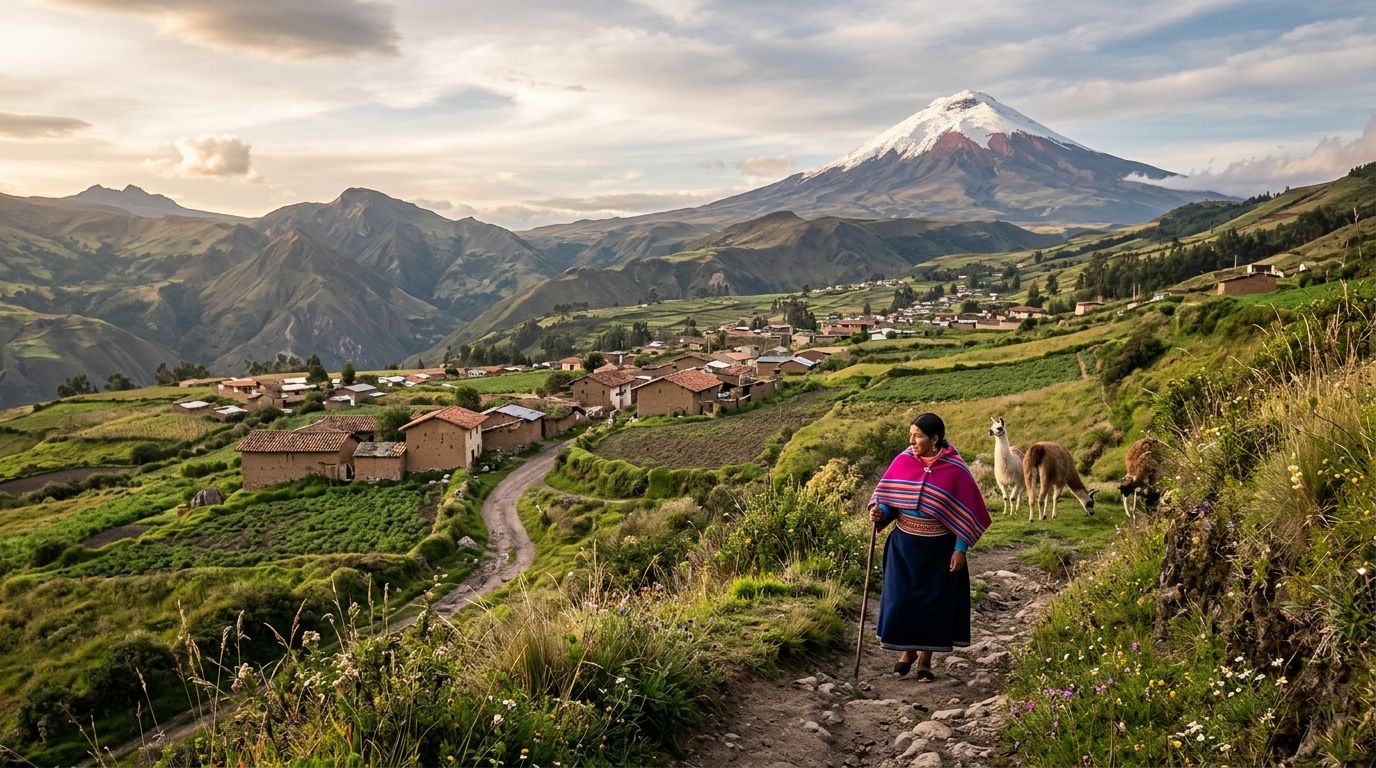
The Andes cut through the middle of the country like a spine. Quito, Otavalo, Cuenca—these are mountain towns that have existed for centuries at altitudes where most foreigners feel short of breath for the first 48 hours. The architecture isn't preserved like a museum piece. It's lived in. Women wear traditional dress because it's theirs, not because tourists expect it. Markets operate the way they have for decades, not the way Instagram recommends.
The coast is the part most visitors skip. The Pacific beaches aren't Caribbean-postcard perfect, but they're honest—pelicans dive for fish, fishing boats actually fish, and you can walk an hour and see maybe three other people. Puerto López is a working town where you can book whale-watching trips (June to September) or snorkeling expeditions to Isla de la Plata without the Galápagos price tag.
What to Expect: Walking Through the Experience
Arriving and Acclimating
You'll likely land in Quito. The airport sits at 9,220 feet, and your body will immediately negotiate with this fact. Drink water. Skip the coffee. Take a gentle walk. The altitude hits differently than other mountain cities because Ecuador's equatorial position means the air is thinner but the light is fierce—you burn and breathe hard simultaneously.
Quito's Old Town is real architecture, real history, real people. You'll see colonial churches with interiors that look like they were dipped in gold leaf, plazas where locals actually congregate, and streets where the electricity cables look like urban spiderwebs. The New Town (north Quito) is where the modern infrastructure lives—restaurants, bookstores, tour operators. Plan a minimum of three days here to feel oriented.
Moving Through Regions
If you're doing the classic route: Quito → Otavalo → Amazon → back. This takes about two weeks to feel substantial, not rushed. Otavalo is a market town in the highlands where indigenous Kichwa people sell handwoven textiles at prices that make you question every other craft market you've visited. The town itself isn't architecturally remarkable—it's the people and economy that matter. You can see real commerce, real craftspeople, real markets.
Getting to the Amazon requires a flight (1-2 hours) from Quito to towns like Coca or Misahuallí, then a canoe ride into lodge territories. The lodges vary wildly in quality and philosophy. Some are research-focused and serious. Some are tourist-comfort-focused. Some split the difference. What's universal: you'll be wet, you'll be itchy, and you'll see animals you thought only existed in documentaries.
The Physical Reality
Ecuador is humid and wet. Even the highlands surprise you with sudden downpours. Insect repellent (30%+ DEET) isn't paranoia—it's logistics. Altitude sickness affects maybe 40% of visitors in Quito and the highlands. It's rarely dangerous, usually just irritating (headache, mild nausea, weird sleep). Coca tea helps, as does not rushing around your first day.
Transportation is inexpensive and works, but isn't comfortable. Inter-city buses are the main transit. They're clean, frequent, and reliably late. Plan accordingly.
Planning Your Visit: Practical Considerations
Duration
Minimum: 10 days (Quito + either Amazon or Otavalo region) Better: 14-18 days (Quito, highlands, Amazon, coast, or Quito, Amazon, Galápagos) Ideal: 21 days (all regions, some breathing room)
Galápagos adds a minimum 4-5 days and requires separate budgeting ($200-400+ per day).
Best Time
Ecuador has two seasons: wet and less-wet. The wet season (October-May) brings afternoon rains everywhere. The dry season (June-September) is more reliable but means higher prices and more tourists.
Galápagos-specific: June-August offers whale sharks (the largest fish on Earth) and clearer skies. December-January is warmer but rougher seas. September-October is the transition—fewer people, mixed conditions.
Cost Reality
Budget travelers: $40-60/day (hostels, street food, local buses) Mid-range: $80-150/day (decent hotels, restaurant meals, paid activities) Comfortable: $150-250+/day (good hotels, guided tours, flights included)
Galápagos is entirely separate—add $200-400+ daily on top of this.
Amazon lodge costs range from $80-300 per person daily depending on lodge quality and what's included.
Getting Around
Domestic flights connect the regions affordably ($50-100 between major cities). Buses connect everything cheaper but slower. Taxis in cities are metered and reasonable. Hire a driver for multi-day trips if you want to stop at specific places without bus schedule constraints.
When You'll Actually Encounter Crowds
June-August and December-January are busier. Otavalo's Saturday market draws tourists, but the town itself manages the flow. Amazon lodges book solid in these periods. Quito's Old Town has perpetual tourism but never feels overcrowded like other colonial capitals. Galápagos is perpetually at capacity (permit restrictions).
Nearby Places Worth Your Time
Cuenca (3-4 hours south of Quito via bus)
A mountain city that actually feels like a place people live in. The architecture is Spanish colonial but the vibe is slower and less touristy than Quito. Good food scene, decent museums, and the surrounding countryside is genuinely beautiful—cloud forests, indigenous villages, and waterfalls. Spend 2-3 days here if you want to understand highlands Ecuador beyond Quito.
Baños (4 hours southeast of Quito)
A small adventure-sports town in a valley surrounded by waterfalls. The town itself is touristy-young-backpacker energy, but the location is spectacular. Waterfall hikes, river rafting, and mountain biking are legitimately good here. More touristy than other regions, but worth 1-2 days if you're interested in activities.
Montañita (coastal town, requires a bit of planning to reach)
A beach village that's part surfing destination, part party town, part working fishing community. Less polished than Caribbean beaches, more interesting because of it. Good base for exploring Ecuador's Pacific coast without the resort feel. 1-2 days if you're heading to the coast.
Is Ecuador Actually Worth Visiting?
Yes, but not for the reasons you've probably read.
It's worth visiting because you can stand on the equator and feel how arbitrary that line is—the landscape doesn't change. It's worth visiting because the Amazon lodge owner will tell you about the specific trees in ways you've never heard before. It's worth visiting because Quito's museums contain genuine history artifacts, not replicas. It's worth visiting because you can negotiate prices at markets and actually respect the person's business, not feel like you're stealing. It's worth visiting because the food is unpretentious—fresh fish, plantains, ceviche, corn—and the restaurants aren't trying to impress you.
It's not worth visiting if you need resort comfort, pristine beaches, or a country that's "discovered" all its tourism infrastructure. Ecuador still has rough edges. Infrastructure works but isn't polished. Accessibility is improving but isn't guaranteed. You might spend a day figuring out something that "should" be simple.
What Ecuador offers is genuine geography, genuine culture, genuine biodiversity—all within reach. That's increasingly rare.
Quick Facts
- Capital: Quito
- Population: ~18 million
- Language: Spanish (plus Kichwa in highlands)
- Currency: US Dollar (adopted 2000)
- Visa: Most nationalities get 90 days tourist entry
- Time Zone: UTC-5 (no daylight saving)
- Electrical Outlet: Type A/B (US-style)
- Vaccination: Yellow fever recommended for Amazon regions
- Tipping: 10% if you feel the service warrants it
Final Thoughts
Ecuador doesn't sell itself on superlatives, which is ironic given that superlatives actually apply here. It's not trying to become the next Thailand or Mexico. It's content being itself—a small country with enormous biological density and genuine complexity.
You come to Ecuador not to have your worldview confirmed but to have it genuinely expanded. The Galápagos teaches you about evolution. The Amazon teaches you about systems. The highlands teach you about culture that's specific and alive. The coast teaches you that tourism doesn't have to dominate everywhere.
This is worth two weeks of your life.
Ready to start planning? Use Touratu's interactive map to explore Ecuador's regions, route options, and discover bookable activities across the country. Watch travel videos to get a genuine sense of what awaits in Quito, the Amazon, the Galápagos, and everywhere in between—then build your actual itinerary based on what genuinely appeals to you, not what the algorithm suggests.
Loading activities…
