
Colombia Travel Guide: Routes, Culture & Activities
Colombia: A Country That Changes You Before You Realise It
You'll know you're getting close to Cartagena's old town when the air shifts. It's not the humidity—you've already accepted that. It's the smell of salt and centuries, the sound of a cumbia melody drifting from somewhere you can't quite locate, the sudden appearance of street vendors selling fresh lulos with lime. Your taxi driver doesn't rush. Nobody rushes in Cartagena. By the time you step out onto those terracotta streets, you've already begun to understand something about Colombia that no guidebook can tell you: this country doesn't perform for tourists. It lives, and it invites you to witness it.
Colombia feels like a country finally introducing itself to the world properly, after years of being misread. Travel here now, and you're arriving at a peculiar moment in its story—when the infrastructure for tourists has arrived, but the country hasn't yet been smoothed into a commodity. You still encounter genuine surprise when locals meet travellers. You still find yourself in conversations that feel like real exchanges rather than transactional encounters. This matters more than you'd think.
What Actually Makes Colombia Distinct
Colombia's draw isn't a single landmark. There's no Machu Picchu moment, no singular vista that validates the trip. Instead, it's the accumulation of contrasts that live without irony in the same country. You can climb through cloud forests thick enough to feel like stepping inside a cloud, then descend into Caribbean heat within hours. You can meet coffee farmers in the morning and salsa dancers by evening. You can walk through neighbourhoods that are actively reinventing themselves, past murals that weren't planned by tourism boards but painted by people processing their own reality.
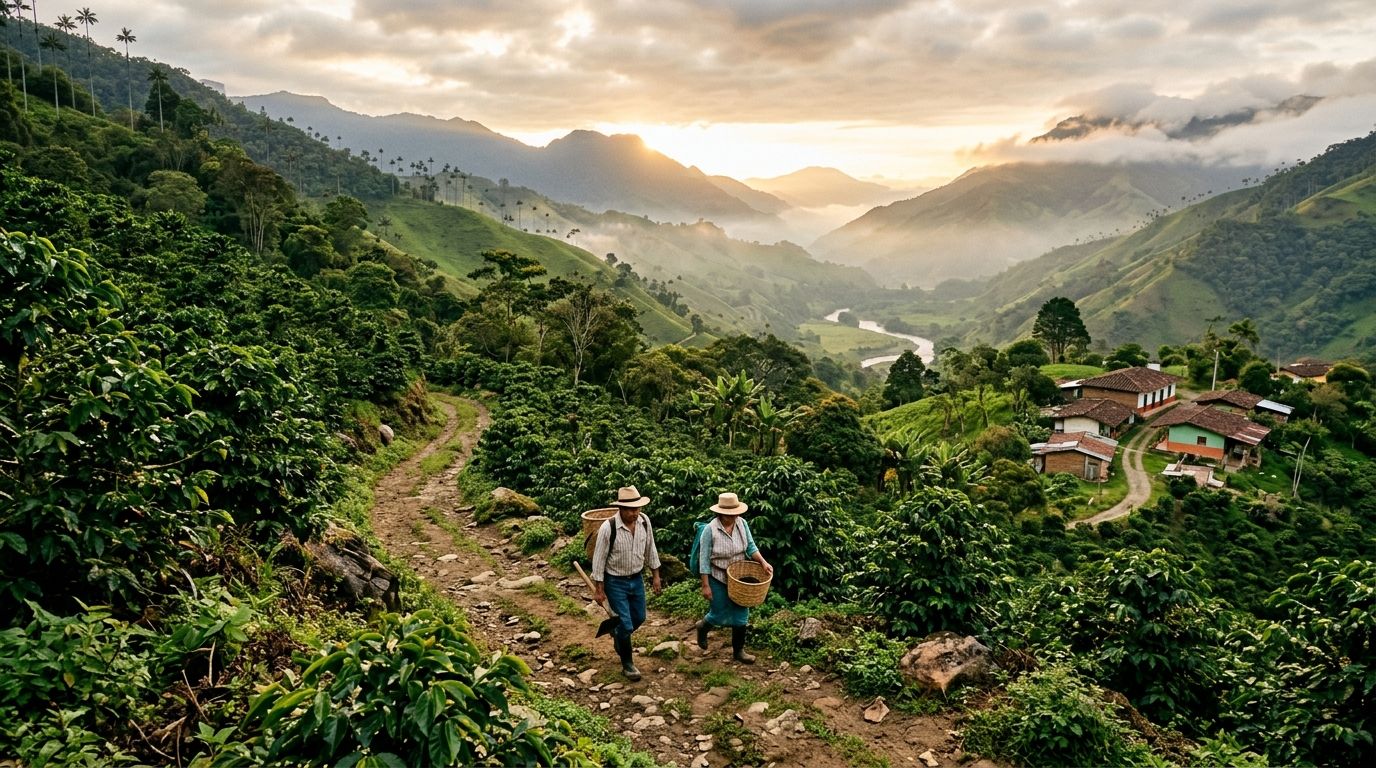
The coffee region—the Eje Cafetero—is worth understanding not as a destination where you take pretty photos, but as a place where coffee isn't a commodity to be discussed in specialty shops thousands of miles away. Here, it's simply how people live. The logistics of growing, fermenting, and roasting matter. The generations of knowledge matter. When you visit a finca, you're not touring a working museum; you're interrupting a business that happens to welcome visitors while continuing its actual work.
Santa Marta offers access to Ciudad Perdida, a trek that reveals why Colombia's interior remained largely unmapped until recently—the landscape simply doesn't cooperate with easy navigation. But the real insight comes less from reaching the archaeological site and more from understanding the ecosystems and communities that exist because of the terrain's resistance to development.
Bogotá is neither Madrid nor Mexico City, despite assumptions. It's a high-altitude city built on a plateau, where you'll feel the elevation if you rush around. The street art is genuine—artists here preceded the trend by years, painting because they had something to say, not because Instagram existed. The Monserrate sanctuary offers perspective, but not the manufactured kind. Gold Museum contains artifacts that shift your understanding of pre-Columbian cultures.
The Experience: What You'll Actually Encounter
Coming to Colombia as a traveller now means navigating a country in the midst of its own reorientation. Medellin transformed dramatically over the past two decades, moving from one of the world's most dangerous cities to one of the world's most interesting. You'll hear this story constantly, and it's true, but what matters is how you experience it: walking through neighbourhoods like Laureles and Belén, where street art covers every surface and local entrepreneurs are building things. The energy is unmistakably creative, not because tourism told it to be, but because the city actually is.
The Caribbean coast—Cartagena, Santa Marta, Tayrona—exists in perpetual warmth and humidity. This affects everything: the pace of conversation, the necessity of siestas, the structure of the day around water and food. You'll adapt faster than you expect. The beaches are excellent without being extraordinary. What distinguishes them is the people and the architecture and the history of the colonial era maintaining actual presence in daily life.
In the interior, the coffee region's rhythm revolves around weather and cultivation cycles. If you visit during the wetter season, you'll experience the landscape at its most dramatic—mist descending through valleys, everything greening visibly. The temperature variation between high mountains and their valleys means you'll need clothes for different seasons within a single afternoon. This isn't inconvenient; it's part of understanding how people live here.
The food is straightforward and serious. Ajiaco in Bogotá is a mountain of a soup meant for altitude and cold. Ceviche on the coast is refreshing without affectation. Arepas are present at every meal, in infinite variations. Bandeja Paisa in Medellín is a plate designed for people who work physically. Food here isn't trying to be anything other than what it is, which makes it genuine in ways that overly refined cuisine often isn't.
Crowds are present but manageable outside of December-January and July-August. Cartagena's old town becomes exhaustingly packed during these periods. Bogotá maintains its own pace regardless of season. The interior coffee region remains relatively undiscovered by mass tourism, which says something about what travellers are currently prioritising.
Planning a Proper Visit
Duration and timing: Three weeks is the minimum for this country to reveal itself. Two weeks gets you Cartagena, the coffee region, and perhaps Bogotá, but you'll be in constant motion. One month allows actual breathing room and the possibility of coincidental discovery.
October through November and March through April offer the best combination of weather and crowd-manageable tourism. December through February means Christmas humidity and higher prices. May through June brings rain to the interior but clears the coasts. September is the shoulder month—fewer people, but erratic weather.
Transport: Flying between regions makes sense. Bogotá to Cartagena, then down to the coast via Santa Marta, then to Medellín and the coffee region. Buses are reliable and cheap but slow. Flying costs more than many expect but less than you'd pay in other Latin American countries. The road network is improving but mountainous terrain means distance takes longer than maps suggest.
Where to base: Cartagena for 4-5 days minimum if you're starting there. Bogotá deserves 3-4 days; it's a city that reveals itself through neighbourhood exploration, not landmark checking. The coffee region works best with 4-5 days split between multiple fincas or a single location where you slow down. Santa Marta for access to Tayrona and Ciudad Perdida. Medellín increasingly attracts longer stays, and it rewards them.
Practical realities: Altitude affects most people arriving in Bogotá. The first two days are slower than you'd like. Spend them walking gently, staying hydrated, not overcommitting. The Caribbean coast is humid but manageable if you're not wearing dark jeans and expecting to be cool. Spanish helps significantly, particularly outside Cartagena. English is sparse in interior towns.
Nearby Places Worth Knowing About
Tayrona National Park: Between Santa Marta and Cartagena, where jungle genuinely meets Caribbean coast. The hike is straightforward but hot. The landscape is dramatic without theatrical exaggeration. Stay overnight if possible; day-tripping works but misses the quiet parts.
San Andrés Island: Caribbean island territory that feels politically and culturally separate from the mainland. Creole English, island pace, different food entirely. A detour, not essential, but genuinely distinct.
Salento and Valle de Cocora: Small town in the coffee region surrounded by valleys and the world's tallest wax palms. Overvisited compared to other regions but for good reason. The landscape is genuinely unusual.
Is It Worth Your Time?
Yes, but not for the reasons tourist marketing suggests. Colombia is worth visiting because it's still discovering how to be a tourist destination, which means your experience likely won't be manufactured. You'll encounter people processing their country's recent history, entrepreneurs building things, artists creating without committees. You'll arrive expecting one thing and leave understanding something more complicated.
The beaches won't shock you if you've seen Caribbean coast elsewhere. The mountains won't surprise you if you've trekked in Central America. But the accumulation—the constant contradictions, the genuine warmth of interactions, the evidence of a nation actively redefining itself—creates something worth the time and expense.
Come for the landscapes and the heritage sites if you need reasons. But stay for the realisation that Colombia is interesting not because it's performing itself for you, but because it's genuinely busy with its own life.
Quick Facts
- Best time to visit: October-November, March-April
- Duration: Minimum 2 weeks, ideal 3-4 weeks
- Currency: Colombian Peso (exchange rates are reasonable)
- Language: Spanish (English is limited)
- Approximate cost: $40-80 USD per day depending on location and choices
- Flights: Most international arrivals through Bogotá or Cartagena
- Altitude variations: From sea level to 2,600m in Bogotá—acclimatise properly
If you're beginning to construct your own route through Colombia, Touratu's interactive map makes planning measurable distances and transport times straightforward. Explore regional movements, watch travel videos showing actual transit experiences, and discover the pacing that works for your own style of movement. The videos in particular offer realistic perspectives on what transport, accommodation neighbourhoods, and daily rhythm actually feel like—the unglamorous details that shape whether a journey genuinely works for you.
Loading activities…
