
Chile Travel Guide: Top Things to Do
Chile: A Long Ribbon of Landscape That Changes Every 500 Kilometers
The first time you drive south from Santiago, you realize Chile doesn't follow the usual rules. Most countries sprawl horizontally, but Chile stretches itself thin—a 2,670-kilometer thread stitched down the spine of South America. You might start your morning in the Atacama Desert where it hasn't rained in 400 years, and by evening, you're watching fog roll off the Pacific. This isn't a destination with one definable character. It's a country that seems deliberately designed to challenge how you think about landscape.
What makes this work—what makes Chile genuinely worth the planning effort—is that this geography isn't just scenic backdrop. It creates fundamentally different experiences depending on where you point yourself. You're not visiting "Chile." You're visiting the Norte Grande's otherworldly salt flats, then Patagonia's granite towers, then the wine country that California wishes it had. Each region requires different seasons, different packing, different expectations.
The Real Geography of Experience
The Norte Grande (Far North) is where you understand why the Spanish called this the "end of the world." The Atacama Desert isn't empty—it's distilled. San Pedro de Atacama sits at 2,400 meters, the base for exploring moonscapes that have actually been used to test Mars rovers. The colors aren't metaphorical. The rocks really are violet and rust and the orange of old blood. The Salar de Atacama—a salt flat that's whiter and vaster than anything you've seen in photographs—stretches until it becomes indistinguishable from sky. Most visitors spend 3-4 days here, doing sunrise excursions to the Licancabur volcano, swimming in the Ojos del Salar (springs that maintain an improbable 30°C in the middle of the driest place on Earth), and watching the sunset turn the rocks every color except normal.
The Norte Chico pulls back from the extreme. La Serena and its nearby Coquimbo maintain a certain civilized temperament—fishing towns that haven't completely surrendered to tourism, beaches that are actually swimmable. This is where Chilean wine country begins, and if you move inland to the Elqui Valley, you'll find pisco distilleries and vineyards that produce wines with a clarity that comes from nothing but altitude and volcanic soil.
Central Chile is where most Chileans actually live. It's also where the contradiction gets interesting: Santiago is a genuine city with museums, restaurants, and nightlife that doesn't apologize for sophistication. But within two hours, you're in valleys and wine regions (Maipo, Casablanca, Carmenere territory) that feel genuinely rural. Valparaíso—the port city—is worth an overnight simply to walk the impossibly steep streets and understand why it's inspired painters for two centuries.
Then everything changes again around Puerto Varas. The lakes region (La Región de los Lagos) turns emerald and dense. Volcanoes appear. You've entered a landscape that looks more Bavarian than South American, except the volcanoes are actually active and the Patagonian wilderness is 20 kilometers behind the postcard-pretty towns.
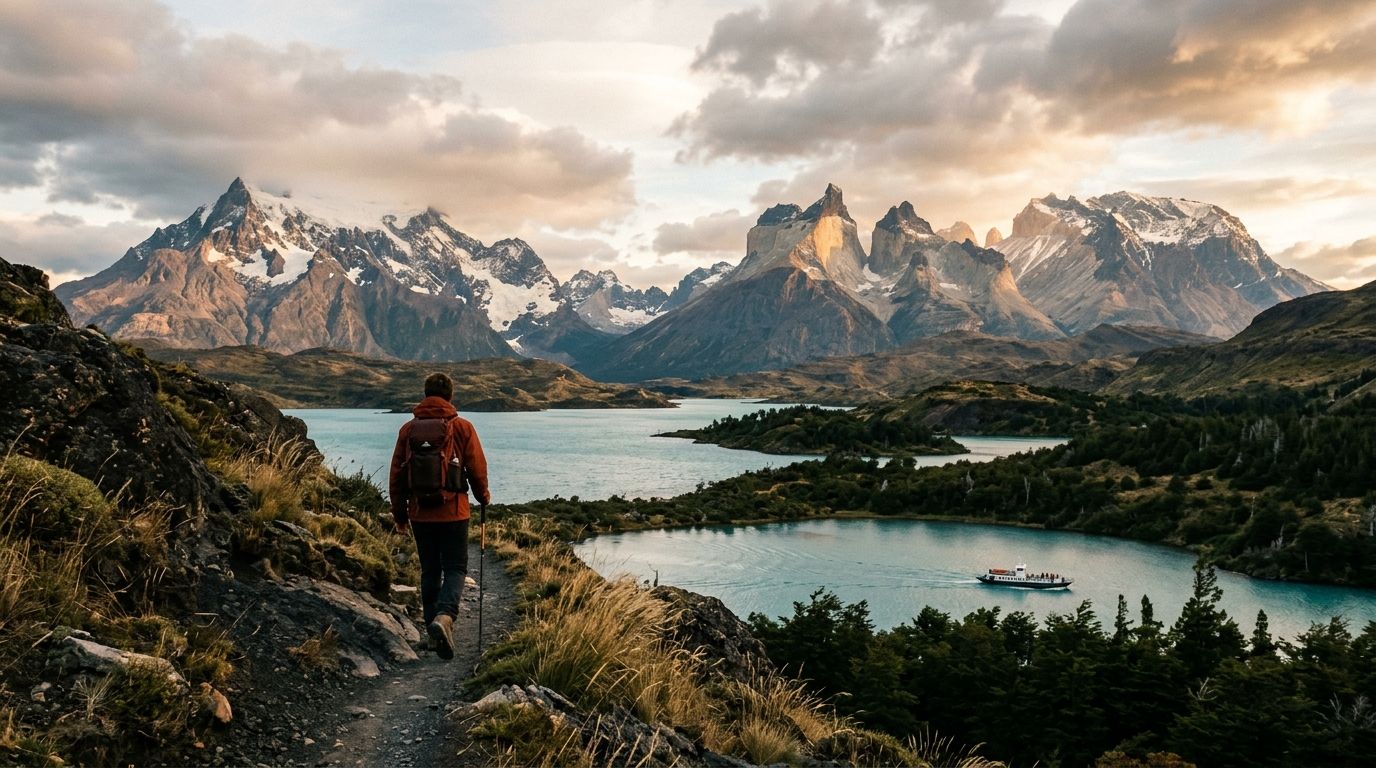
And then there's Patagonia proper—the south beyond Puerto Varas. Most people make the pilgrimage to Torres del Paine, the national park with granite peaks that rise 2,500 meters straight from the steppe. It's not about being "hidden" (it's visited by 250,000 people annually). It's about being geologically dramatic in a way that requires standing in front of it to comprehend. The W Trek—a 5-day hiking loop—is famous for a reason: those granite towers, Lago Grey with its icebergs, the sheer scale of it.
Finally, there's Easter Island (Rapa Nui)—technically Chilean but culturally and geographically its own universe, floating in the Pacific 3,500 kilometers offshore. Most people spend 2-3 days looking at moai (those famous stone heads), but the real story is the island's Polynesian culture, the walks across volcanic slopes, and the strange, quiet weight of standing in what's essentially the most isolated inhabited place on Earth.
What to Expect When You Actually Arrive
Flying into Santiago, your instinct will be to skip it. Don't. Spend 2-3 days walking the Lastarria neighborhood, eating at restaurants that don't have English menus, visiting the Museo Chileno de Arte Precolombino (genuinely one of the world's better museums). Use it as a pivot point to figure out where your energy actually lies.
The norte routes require heat tolerance and comfort with altitude. San Pedro sits high enough that soroche (altitude sickness) is real—days spent at 2,400 meters getting headaches are part of the experience, not a flaw in it. Tour operators in San Pedro are abundant and mostly reliable, but they're expensive because they're consolidating small groups. Expect $120-150 per day for guided tours. Private guides run $150-200.
The lakes region (Pucón, Villarrica, Puerto Varas) is where activity tourism clusters. Everything is bookable: kayaking, hiking, rafting. The landscape doesn't require extreme athleticism, which means it works for most fitness levels. Spring (September-November) is lush and wild. Summer (December-February) is crowded but cloudless. Autumn (March-May) has the best colors and fewer people.
Patagonia is where you need to respect the weather. The W Trek at Torres del Paine requires reasonable fitness and weather acceptance—yes, you might hike 6 hours and see nothing but cloud. Yes, the wind sometimes pushes at you like something physical. It's worth it, but the experience is defined as much by weather challenges as by the moment when you round a corner and the granite towers suddenly materialize through the mist.
Travel times between regions are significant. Santiago to San Pedro takes 2 hours by flight or 24 hours by bus. That's useful information for deciding how to structure a month.
The Practical Math of Planning
Best time overall: April-May and September-October. You'll miss summer crowds but catch good weather and intermediate light. Autumn has the advantage of vegetation color; spring has the psychological advantage of anticipation.
Minimum duration: 10 days will get you to one region and back, with 2-3 days actually exploring. Chile rewards 2-3 weeks. With a month, you can see Norte Grande, the lakes, and Patagonia without sprinting.
Getting around: Domestic flights are frequent and relatively affordable ($80-180 per sector). Buses are reliable, extensive, and cheap ($30-80 depending on distance), but they're slow. Rental cars work well for wine country and the lakes region. In the norte, most people rely on organized tours.
Costs: Chile is expensive by South American standards, similar to Argentina. Expect $60-100 per night for acceptable mid-range hotels, $15-25 for decent meals, $120-200 for guided activities. Budget tourism is possible but requires deliberate choices.
Crowds: Manageable outside of December-January and the W Trek peak (December-February). Easter Island books up 3-4 months in advance if you want specific lodging.
Nearby Worth Your Time
Bolivia's Salar de Uyuni: If you're already in the norte, a 2-3 day excursion from San Pedro climbs into the Atacama's interior and crosses into Bolivia to see salt flats that rival the Atacama's but with entirely different geology. The Flamingo Lagoons and Volcano Miniques make this a legitimate extension, not just tourist-checking-boxes.
Argentina's Mendoza: The wine country directly across the Andes (6 hours overland, or 1 hour by flight) produces Malbec rather than Chile's Carmenere, and the landscape offers vineyard density that Central Chile's more spread-out wineries don't. Worth a 3-4 day detour if wine is part of your structure.
The Atacama's Argentine Extensions: Salta and the Quebrada de Humahuaca on the Argentine side offers colonial architecture and mountain culture that complements Chile's geological focus. Feasible as a 4-5 day loop from the Chilean norte.
The Honest Assessment
Is Chile worth visiting? Yes, but with caveats.
It's not a country that works well on autopilot or as a quick add-on to Peru. The distances mean you're either doing one region properly or moving constantly. The costs (as a developing country with developed-world prices) mean it requires actual budget planning.
But if you have 2+ weeks and can accept long transit days and occasional weather frustration, Chile offers something genuinely scarce: a country where the landscape actually changes fundamentally every few hundred kilometers. You're not seeing variations on a theme. You're seeing entirely different geological and biological systems. That alone—the fact that you can see an extreme desert, temperate wine country, active volcanoes, and Patagonian wilderness in a single trip—makes it distinct from almost everywhere else you could travel.
The quality of tourism infrastructure (hotels, guides, restaurants) is consistently good. The people move at a human pace that feels respectful rather than performance-based. And the landscape is the kind that sits in your memory in a way that has nothing to do with marketing language or Instagram angles—it's just genuinely strange and beautiful in ways you didn't predict.
Use Touratu's interactive map to explore the routes connecting Chile's diverse regions, watch travel videos from these destinations, and book activities that fit your timeline and interests. Plan your journey with visual clarity before you commit to dates.
Loading activities…
