
Best Places to Visit in Tianjin: Top Attractions Guide
Tianjin: Where Colonial History Collides With Modern China
The Hai River winds through Tianjin like a thread connecting two completely different versions of the same city. On one bank, you'll find Art Deco facades that could have belonged to 1920s Shanghai. On the other, gleaming towers reflect a skyline that didn't exist twenty years ago. Standing at the Astico Italian Style Street at dusk—when the low sun catches the old European buildings and casts long shadows across cobblestones—you get the strange, compelling sensation of being suspended between eras.
This is what keeps people in Tianjin longer than they planned.
Most travellers skip it entirely, treating it as a Beijing suburb or a gateway to somewhere else. That's a miscalculation. Tianjin isn't trying to compete with Beijing's historical weight or Shanghai's cosmopolitan glamour. It's doing something weirder and more interesting: it's a city genuinely grappling with what it means to be both foreign and Chinese, historical and contemporary, all at the same time.
What Actually Makes Tianjin Worth Your Time
The honest answer is that Tianjin rewards wanderers more than it rewards box-tickers. You won't find one transcendent monument that justifies a pilgrimage. Instead, you'll find pockets of discovery that only make sense if you give yourself permission to get lost.
The colonial heritage is genuine—not recreated for tourism. During the 19th and early 20th centuries, foreign powers carved Tianjin into concessions: British, French, Italian, American, German, Japanese, Belgian, and Austro-Hungarian sections, each with their own architecture, governance, and character. After 1949, the Chinese government absorbed these areas, but the buildings remain. Today, you can walk through architectural evidence of imperialism without it feeling preserved in aspic. Cafés operate inside converted colonial mansions. Boutiques occupy old banks. Life continues in these spaces rather than being cordoned off behind velvet ropes.
The other draw is less obvious: Tianjin is authentically Chinese in ways that heavily touristed cities can't be anymore. You'll eat better than you expected. You'll find yourself in neighborhoods where foreigners are still novelties rather than expected tourists. There's a creative, slightly scrappy energy here—the city is always rebuilding, always reinventing itself—that feels more alive than polished.
What to Expect: Walking Through Layers of Time
The Italian Concession and Astico Italian Style Street
Start here because it's where the dissonance hits hardest. This wasn't a theme park creation—it was an actual Italian settlement between 1901 and 1947. About 900 Italians lived here at its peak. The street itself is narrow, lined with salmon-pink and cream-colored buildings with arched windows and Italian names still visible above doorways.
The experience is oddly intimate. You'll pass a café where locals drink coffee, then turn a corner to find a vintage bookstore, then a restaurant serving hand-pulled noodles. A Chinese family might be practicing tai chi in front of a building that once housed Italian merchants. This collision isn't jarring—it feels natural, like it's been happening for a century.
Budget 2-3 hours to properly walk it. Bring a camera, but also bring silence. The best moments happen when you stop photographing and just observe.
The Ancient Culture Street (Gu Wenhua Jie)
This is where you go if you want to understand how Tianjin fits into China's larger identity. Ancient Culture Street is designed to mimic the appearance of a traditional Chinese market street, but unlike many such recreations, it actually serves the community. You'll find people buying lanterns, calligraphy supplies, traditional instruments, and inkstones. Yes, there are tourist shops, but locals come here too.
The architecture does the work of cinema here—red lanterns, wooden shop fronts with traditional signage, narrow lanes that open into small courtyards. It's slightly theatrical, but not dishonestly so. Grab lunch at a small stall. Try the fried dough sticks. Stand for a moment and listen to the sounds—they're mostly Chinese, mostly not performed for outsiders.
The Tianhou Temple at the end of the street is still actively used for worship. You'll see real incense, real prayers, real offerings. It's one of China's oldest Mazu temples, dating to 1326, and it carries the worn authenticity of a place that's been visited for centuries rather than decades.
The Concession Areas Beyond Italian Street
This requires a guide or serious curiosity, but walking through the old British, French, and German concessions reveals how different colonial powers imposed their own aesthetic hierarchies. French concessions favored grand, sweeping avenues with plane trees. British areas had more restrained Georgian influence. German buildings were sturdy and efficient-looking.
The Tianjin Concert Hall, built during the Austro-Hungarian concession period, sits near Zhou Enlai's former residence. The Qing Imperial Mausoleum museum is housed in a repurposed royal compound. These aren't theme park recreations—they're functional buildings that happened to survive.
The Haihe River Front
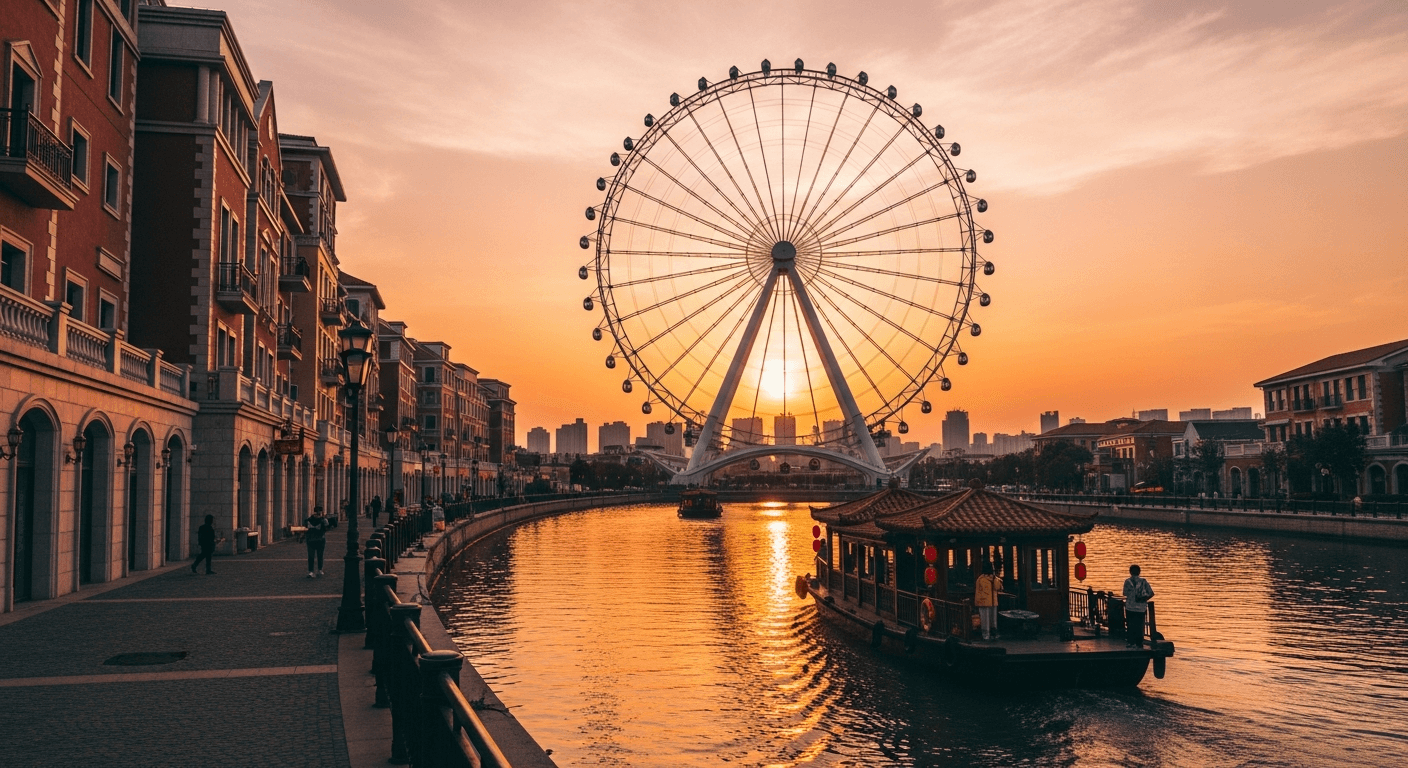
The Haihe is being aggressively redeveloped, and this is where modern Tianjin asserts itself. Gleaming office parks, luxury residences, and contemporary museums line the banks. The Tianjin Eye observation wheel (128 meters high) sits oddly among historic buildings. The Tianjin Museum is genuinely good, with comprehensive exhibits on the city's history, though it's one of the few places where you'll encounter obvious tourism infrastructure.
Walk the riverside at sunset. The contrast between the glittering new development and the historic buildings is exactly what Tianjin is—not fighting between old and new, but trying to be both simultaneously.
Planning Your Visit: The Practical Details
When to Go
Autumn (September to November) and spring (April to May) are genuinely pleasant. Winters are cold and occasionally hazy with air quality issues. Summers are hot and humid, though not unmanageable. Don't go during Chinese New Year unless crowds specifically appeal to you.
How Long to Spend
Two full days is the minimum to actually explore without rushing. Three days is better—it lets you wander without an itinerary and discover your own directions. Many people visit as a day trip from Beijing (it's 30 minutes by high-speed rail), which is possible but means you'll see maybe half of what makes the city worthwhile.
Getting Around
The metro system is straightforward and uses standard token cards. Buy a transit card (called a "Yang Card") at metro stations—it works on all public transport. Taxis are affordable and easy to flag down, though language can be an issue. Download the Baidu Maps app, which works better than Google Maps here.
Walking is actually the best way to experience the city. The concessions are compact and pedestrian-friendly. Wear comfortable shoes.
Staying Somewhere
The hotels in the old concession areas offer character—the Sleep City Hotel or Tianjin Dagu Grand Hotel are both in converted colonial buildings. They won't offer five-star amenities, but they offer something more valuable: proximity to the best parts of the city.
Budget accommodation is easy to find. Airbnb exists here, though WeChat payment is often required.
Getting There
From Beijing: High-speed rail (G-series trains) takes 30 minutes from Beijing South Station. Tickets cost about 55-75 RMB ($8-11 USD). Trains run every 20-30 minutes.
From Shanghai: About 5 hours by high-speed rail, roughly 300 RMB ($43 USD).
The airport exists but is rarely the best option for budget travellers—rail is cheaper and faster for regional connections.
Crowds and Pacing
Tianjin won't feel crowded compared to Beijing or Shanghai. The main attractions get busier on weekends, but you'll never feel herded. This is actually one of its strengths—you can explore without managing crowds.
Midweek visits are ideal. Early morning visits to Ancient Culture Street mean you're walking with locals rather than tour groups.
What's Nearby
The Great Wall at Juyongguan (90 minutes)
If you're in Tianjin and want to do something quintessentially Chinese, this section of wall is closer than the popular Beijing sections and feels less commercialized. The hiking is moderate and the views of Beijing's mountains are solid.
Dule Temple in Jixian County (90 minutes)
This 10th-century temple is one of China's oldest wooden structures still standing. It's not as famous as other temples, which means it's quieter. The architecture is genuinely remarkable—the proportions and engineering feel impossibly delicate for something a thousand years old.
The Bohai Bay Coast at Tanggu (45 minutes)
If Tianjin itself feels too urban, Tanggu offers beach access and coastal town atmosphere. It's not scenic—the Bohai Sea isn't particularly dramatic—but it's a genuine alternative pace. Local seafood restaurants are excellent and cheap.
Is It Worth the Detour?
Yes, but not for everyone. If you want temples and mountains and iconic monuments, you'll find better versions elsewhere in China. If you want to understand how China processes colonialism, how a city reinvents itself, and how modernity doesn't erase history but layers on top of it—then Tianjin is exactly the kind of place that stays with you.
The Italian Concession alone justifies a visit. Not because it's picturesque (it is), but because it asks uncomfortable questions about power, presence, and what remains when empires collapse.
You also won't be disappointed by the food, the price point, the ease of navigation, or the surprisingly genuine welcome you'll find.
The only real regret you'll have is not staying longer.
Quick Facts
- Best time to visit: September-November, April-May
- Duration: 2-3 days minimum
- Getting around: Metro, bus, or on foot
- Language barrier: Moderate. English speakers exist in tourist areas, but carry translation app
- Cost: Tianjin is cheaper than Beijing. Meals cost 15-40 RMB ($2-6 USD). Museums 20-50 RMB
- Visa: Standard Chinese visa required
- Altitude: Sea level—no acclimatization needed
Final Word
Tianjin won't give you one story to tell. It'll give you several—fragments of colonial architecture, a river at sunset, the taste of jianbing (Chinese pancake) from a street vendor, the unexpected courtesy of strangers. These pieces don't fit together into a neat narrative, which is exactly why they matter.
When you're ready to explore Tianjin properly, start with Touratu's interactive map to plan your routes between the colonial areas and concessions. We've also documented the best walking paths and local restaurants—check out our travel videos to see the rhythms of the city before you arrive.
Loading activities…
