
Best Places to Visit in Jiangsu: Authentic Experiences
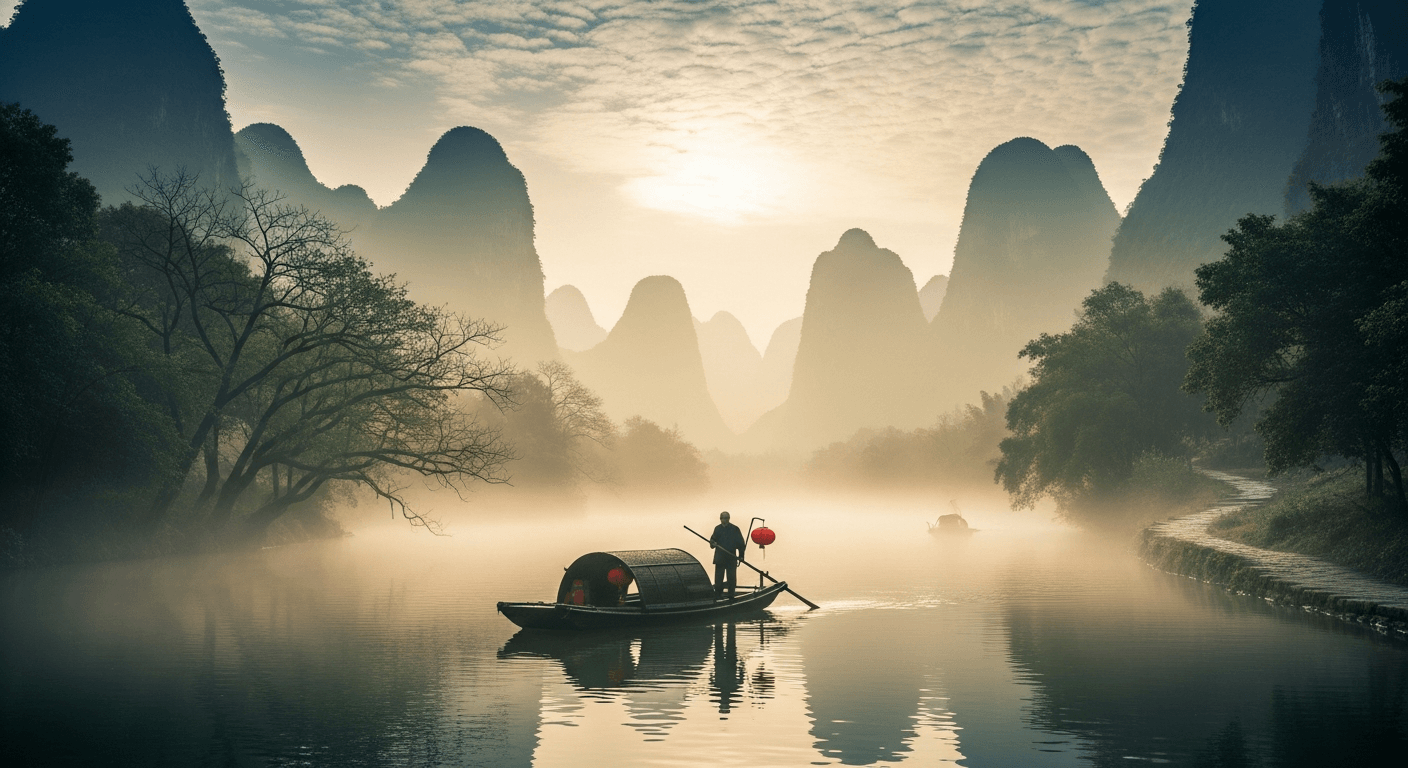
Jiangsu: Where Ancient China Meets Modern Ambition
The silk merchant's house in Suzhou has been empty for three hours, and you're still standing in the same courtyard. Not because you're lost, but because time moves differently inside these walls—a space where a scholar's garden from 600 years ago continues its quiet conversation with the present. Outside, scooters rush past. Inside, the only sound is water moving through stone channels, the deliberate architecture of contemplation.
This is what Jiangsu offers: not one destination, but a province where you can watch China's contradictions resolve themselves into something coherent. It's where the country's commercial future—Shanghai's younger, more purposeful sibling Nanjing; the manufacturing spine of Wuxi and Changzhou—coexists with landscapes that inspired ink painters and philosophers for centuries.
The Real Geography of Jiangsu
Jiangsu isn't a place you "do" in a weekend. The province sprawls across 106,000 square kilometers, from the Yangtze River's thick middle down to the flat, water-threaded south. What makes it complicated for visitors is that the best experiences don't market themselves. They wait.
Suzhou remains the most famous entry point, and there's good reason beyond the tourism board's narrative. The old city genuinely functions as a living museum of Ming and Qing aesthetics—not because it's been frozen, but because locals have quietly resisted the urge to replace substance with spectacle. When you walk the 7-kilometer circuit around the old town on foot, you're not seeing a restored theme park. You're seeing how water, commerce, and domestic architecture actually worked together.
The classical gardens—Humble Administrator's Garden, Master of the Nets Garden, Lion Grove—are the obvious anchors. They require real attention, not the hurried 20-minute circuit most tour groups perform. Spend ninety minutes alone in Master of the Nets Garden at dusk, and you'll understand why scholars considered these spaces sufficient substitutes for entire world travels. The compression of landscape (a mountain made of rocks, a lake you can walk around in eight minutes, distant mountains painted on walls) wasn't artistic poverty. It was deliberate philosophy: that vastness could be contemplated more honestly in miniature.
Nanjing, two hours southwest by high-speed rail, is where you sense Jiangsu's other pulse. The city spent 1,400 years as a capital, then spent the 20th century being history's anvil. What you encounter now is something more interesting than restoration: it's a city actively deciding what to remember and what to rebuild.
The Ming Xiaoling Mausoleum still stops you cold. Emperor Yongle's mother rests there, and the approach—a stone avenue lined with animals and officials that predates the Forbidden City's analogous avenue—moves with an authority that photographs fail to capture. There's no interpretive center, no dramatic lighting. Just stone, intention, and the ordinary sky.
The city walls remain walkable in sections. Unlike Xi'an's complete circuit, Nanjing's fragmentary remains are more honest—you're seeing actual medieval engineering interrupted by actual history. From the Zhonghua Gate, the largest remaining gateway, you're looking at 600-year-old architecture designed by people solving real problems: how to defend against cannon fire, how to house grain supplies, how to move troops efficiently.
The Nanjing Museum, if you have four hours, contains one of China's best collections of early Imperial ceramics and Song dynasty brushwork. It's the kind of museum where three objects can dismantle your understanding of what you thought you knew about Chinese aesthetics.
Yangzhou, an hour north of Nanjing, is what Suzhou was before Suzhou became famous. The city thrived on salt monopolies and the Grand Canal trade, and its gardens—particularly Slim West Lake and Ge Garden—have a different character than Suzhou's: less formally composed, more atmospheric. Walking through Yangzhou's old quarter, you're experiencing genuine lived space, not curated tourism.
What You're Actually Doing Here
The honest version: you're moving through a landscape of accumulated refinement. Not in a precious way, but as simple fact. This region developed particular ways of thinking about space, beauty, and how human beings should inhabit the world. You can see it in how gardens frame views, how houses organize around water, how cities accommodate both commerce and contemplation.
This is not automatically pleasurable. If you approach these experiences as entertainment, you'll find them slow. If you approach them as text—as documents that reveal how people thought—they become absorbing.
A proper morning in Suzhou's old quarter: breakfast at a local noodle shop (the thick, chewy kind), then three hours in a single garden without rushing. Lunch at a restaurant that's been operating in the same space for 150 years. Afternoon on a water channel, either by boat or walking. Evening at one of the remaining traditional performance spaces where musicians play pipa and guzheng for audiences of twelve people.
In Nanjing, the pace is brisker, the history more violent. You're walking through layers—the Qing government quarter, the Japanese occupation, Mao's early administration, now the contemporary capital of Jiangsu Province. The contradictions don't resolve cleanly, which is precisely the point.
The provincial museums—in Yangzhou, Wuxi, Changzhou—contain genuine scholarship. They're not designed as crowd-pleasers. This is where you discover what regional identity actually means in China.
The Practical Reality
When to go: April-May or September-October. The rainy season (May-June) is real; the summers are genuinely hot and humid; winter is gray but clear. Early autumn, after the summer crowds thin and before heating season arrives, is when the gardens show themselves most honestly.
How long: Two weeks minimum to explore properly. Ten days if you're focused. Three days is an admission that you came for the Instagram file.
Transport: The high-speed rail network is exceptional. From Shanghai (three hours), trains run every 20 minutes to Suzhou, less frequently to Nanjing. From Nanjing, you can reach Yangzhou (one hour), Wuxi (1.5 hours), or Changzhou (1 hour). Local transportation within cities is reliable—buses and Metro systems that work, bike rentals that are practical.
Accommodation: Jiangsu's middle tier is genuinely well-designed. You don't need luxury hotels; you need places built for actual inhabitants, not tourists. Suzhou and Nanjing have excellent options in this range.
Crowds: Suzhou during weekends is tourism by consensus—everyone's there for the same reason. Weekdays are substantially better. The lesser-known gardens have 5% of the visitors and 95% of the atmosphere. Yangzhou gets perhaps one-tenth the tourists of Suzhou while offering comparable experiences.
Budget: This region is not cheap by Chinese standards, but it's reasonable by international standards. Expect to spend $60-100 per day for mid-range comfort, more in Suzhou, less in Yangzhou.
Near Jiangsu: The Surrounding Context
Shanghai, three hours from Suzhou, is useful mostly as a transport hub and to understand the contrast. Shanghai's future-orientation makes Jiangsu's backward-looking aesthetic more comprehensible.
Anhui Province, west of Nanjing, contains the Yellow Mountains (Huangshan) and villages like Hongcun that are closer to what tourists expect from "classical China." They're worth the detour if you have time, but they're also precisely what Jiangsu isn't.
Zhenjiang, an hour east of Yangzhou, is a smaller river city with significant but undervisited history. The views from Jiao Hill overlooking the Yangtze are genuine, not performed.
Is It Worth Your Time?
Only if you're interested in how aesthetic philosophy actually functioned at the level of daily living. Only if you can sit in a garden and let its structure reveal itself rather than demanding it perform entertainment. Only if understanding regional identity across centuries matters to you more than collecting destination check-marks.
If you want landscapes that astonish on first viewing, go elsewhere. If you want architecture that teaches you how to see, how to move, how to consider space—if you're curious about a civilization's values embedded in stone and water—then Jiangsu is patient and worth the attention.
The province won't seduce you. It will simply, over time, make you think differently about what beauty requires.
Quick Facts
- Population: 80+ million (densest in China)
- Best entry: Shanghai or Nanjing
- Cost per day: $50-100 (mid-range)
- Getting around: High-speed rail, excellent local transit
- Duration: 10-14 days to experience meaningfully
Use Touratu's interactive map to explore routes between Suzhou, Nanjing, and Yangzhou, and watch travel videos that show these places at their quiet best—where the real experience lives, not just the famous framing.
Loading activities…
