
Best Places to Visit in Guangxi: Top Attractions
Guangxi: Where Limestone Dreams Meet River Life
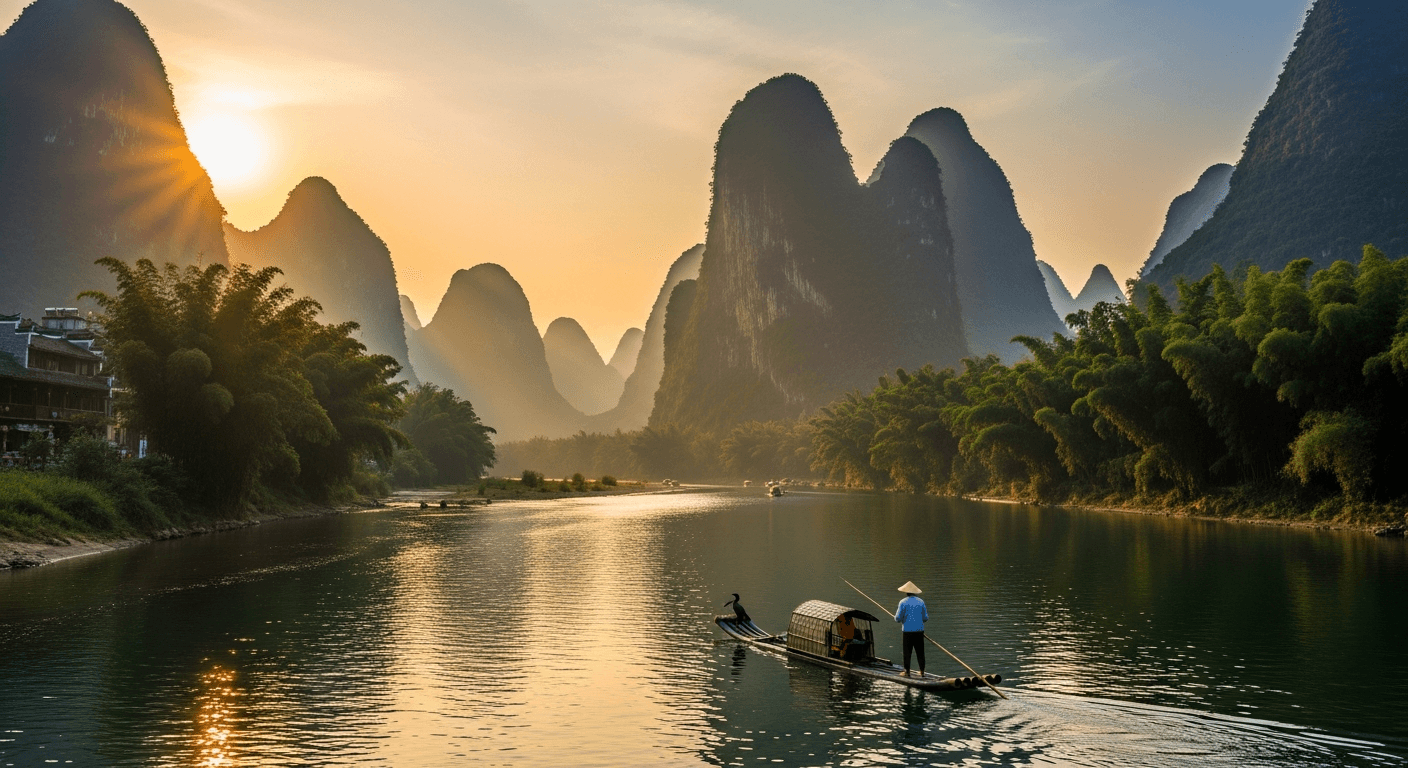
The moment your bamboo raft drifts past the tenth karst peak, you stop trying to photograph it. The light is already fading across the Li River, turning the water into brushed silver, and somewhere upstream, a cormorant fisherman is lighting his night lamps. You've heard this described as one of the most beautiful places on Earth. What strikes you instead is how quiet it feels—how a landscape this dramatic somehow still manages to whisper.
Guangxi isn't a single destination. It's a region in southwest China that operates on a different scale from the country's polished coastal cities. Here, the geography dictates everything: limestone karsts rise like broken teeth from river valleys, rice paddies hug narrow flatlands, and small towns wake to the sound of water buffalo rather than traffic. It's the kind of place that rewards curiosity over checklist tourism.
What Actually Makes Guangxi Memorable
Most accounts of Guangxi focus on its visual drama—the karst formations, the mist-wrapped mountains. That's accurate but incomplete. What lingers after you leave is something more textured: the feeling of moving through a landscape that hasn't been entirely redesigned for visitors.
The region remains fundamentally agricultural. You'll see farmers genuinely working their fields, not performing labor for photographs. You'll pass restaurants where the menu exists only in photographs on the wall, and the cook responds to your pointing with either a nod or a kind shake of the head. There's a specificity to Guangxi that mass tourism hasn't yet smoothed into universality.
The karst geology is real—the limestone peaks are genuinely among the world's most distinctive—but the human layer is what makes this place functional as a destination. The Zhuang people, an ethnic minority who make up nearly a third of Guangxi's population, have their own culture, language, and architectural traditions. You can see this in the design of wooden houses in Yangshuo, in the songs that drift from family homes in the evening, in the festivals that still follow lunar calendars rather than tourist seasons.
What to Expect: The Geography and How to Move Through It
Guilin and the Li River
Most visitors begin in Guilin, a city of 700,000 that serves as the region's practical hub. Guilin itself is worth a day—the Lijiang Waterfall Park has genuine charm beyond its postcards, and the city's numerous bridges and parks create a livable sense of place. But Guilin's real purpose is as a launching point.
The Li River journey is iconic for a reason. A bamboo raft float from Guilin to Yangshuo (about 80 kilometers) takes roughly five hours, depending on water levels. The experience varies enormously depending on when you go. In peak season (spring and autumn), you'll share the river with hundreds of other rafts—a genuine mob scene where guides bark commentary and everyone aims their phones at the same karst formations simultaneously. In low season, water levels drop and commercial rafts can't operate reliably. Mid-season offers a middle ground: enough water to flow smoothly, enough quiet to hear yourself think.
The raft itself matters. Tourist operators offer standard bamboo rafts (crowded, noisy) or sunrise/private options (quieter, pricier). I'd recommend booking through local operators rather than online agencies—you'll pay roughly the same price but support people who actually live there, and the small operators tend toward fewer passengers.
Yangshuo: The Counterculture Pocket
Yangshuo is a valley town of 10,000 people that has become an unlikely international community. Walk its main street and you'll hear English, French, German, Spanish—a legacy from decades of backpackers who arrived and decided to stay. This sounds like it might be irritating, and it can be if you expect undiscovered authenticity. Instead, accept that Yangshuo is a genuinely cosmopolitan small town with excellent coffee, climbing routes, and bike-rental infrastructure.
The genuine value in Yangshuo comes from its position as a base for exploring the valley. Rock climbing here has become sophisticated—the limestone formations attract climbers from across Asia. Cycling through the surrounding countryside puts you in rice paddies, village squares, and small temples without requiring specialized effort. A basic bike and good light will get you to places where tour buses cannot reach.
The town has a night market that functions as actual community gathering space, not tourist theater. Arrive hungry around 7 p.m., grab a small stool, and point at what interests you. Grilled fish, sticky rice cakes, fresh lime juice over ice—the food is straightforward and real.
Longji Rice Terraces: Agriculture as Landscape
Two hours north of Guilin, the Longji (Dragon's Backbone) terraces represent something different. These aren't natural formations—they're centuries of human labor carved into mountainsides by the Zhuang and Yao minorities. Walking between them, you're moving through an active agricultural system, not a historical museum.
The main viewing area is accessible by cable car, which feels like cheating but saves time and knees. From there, hiking trails wind through the terraces themselves, dropping you into the working landscape. Early morning light across the terraces is genuinely extraordinary, though you won't be alone—this is Guangxi's most popular photography location after the Li River.
What makes Longji work is the minor village of Dazhai at the top of the ridge. It's genuinely small—a dozen guesthouses, one main path, mostly Yao people who actually live and work there. Spending a night in Dazhai, waking to mist between the terraces, gives the landscape time to settle into something less frantic than day-trip photography.
Lesser-Visited: Cormorant Fishing and Xingping
The cormorant fishing demonstrations have become touristic—men and birds performing traditional practice for cameras. Xingping, a small town downstream from Yangshuo, is where this actually happens as residual tradition rather than tourist act. The town itself is architectural charm without being precious about it. Old wooden storefronts, a working ferry, restaurants that exist for locals first and visitors second.
If you're in the region beyond the standard Li River route, Xingping offers a quieter float and the possibility of seeing actual fishing rather than performance.
Planning Your Visit
Best time: October through early December, March through mid-April
Guangxi's seasons matter. Summer brings heat, humidity, and sudden rainfall. Winter (December-February) is cool and occasionally gray. Spring and autumn offer the sweet spot—warm days, clear skies, reasonable crowds compared to Chinese national holidays. Avoid the lunar new year period (usually February) and Golden Week (early October)—these bring crowds that fundamentally change the region's character.
Duration: Realistically 5-7 days
Three days minimum to see the core (Guilin, Li River, Yangshuo). Add days based on interest: rock climbing needs 2-3 days, Longji needs an overnight, exploring smaller towns requires flexibility and time. A week gives you actual breathing room to move slowly rather than hitting marks.
Transport
Guangxi has improving infrastructure. High-speed trains connect Guilin to major Chinese cities. Guilin's airport has international flights. Buses link towns but are slower—useful for experiencing the countryside at normal speed rather than the vague blur of highway travel. Within the region, local buses are cheap and frequent, if occasionally chaotic.
Managing crowds and expectations
This is where honest assessment matters. Guangxi's most famous sites are genuinely popular. The Li River on peak day sees thousands of raft visitors. Longji terraces draw steady crowds. This isn't a secret anymore, and hasn't been for a decade. Accept that fact, plan your timing around it, and move toward quieter elements of the region rather than pretending the popular areas are undiscovered.
Nearby Worth Considering
Sanjiang: About 90 minutes north by bus, this small town is the center of Dong minority culture. Wooden architecture, traditional villages, and a pace of life that makes Yangshuo feel urban. Requires more effort to visit but rewards careful travelers.
Pingan Village: Incorporated into the Longji trip often, but worth visiting separately for its genuine Zhuang community and terraces that feel less photographed than Dazhai.
Chongzuo: Near the Vietnamese border, this is where Guangxi's landscape becomes truly mountainous. Less visited, more adventurous, better if you're spending two weeks in the region rather than one.
Is It Worth Visiting?
Yes, but not for the reasons tourism copy suggests. Guangxi isn't a spiritual awakening or a transformative experience. It's a region with remarkable geology, living culture, and genuinely hospitable people. The food is good, the air is fresh, the movement through landscape has a coherent rhythm.
What you're getting is the experience of navigating a place that's still primarily itself—populated by people living normal lives in an exceptional setting. That's become rare enough to be valuable. The fact that it also looks extraordinary in photographs is almost secondary.
The main caveat: Guangxi requires more patience than theme-park tourism. Restaurant menus might confuse you. Direct communication can be difficult. Plans change based on weather or local circumstance. If you need predictability and English-language clarity, this isn't your destination. If you enjoy being slightly uncertain and figuring things out with local help, it's exceptional.
Quick Facts
- Population: ~49 million (province-level)
- Primary language: Mandarin Chinese and Zhuang
- Currency: Chinese Yuan (CNY)
- Visa: Standard Chinese requirements apply
- Best base: Yangshuo for flexibility, Guilin for infrastructure
- Transportation: Buses and local trains; flights to Guilin from major Asian cities
- Language barrier: Significant in small towns; translation apps help but local guides are worth it
The Final Movement
The real Guangxi experience isn't in the famous views, though those are genuine. It's in the flexibility to divert toward a small village because the light is interesting, to spend an extra hour in a local restaurant because the fish is excellent, to rent a bike and get mildly lost in rice paddies without checking your phone for location data.
Explore Guangxi's routes, timing, and local insights on Touratu's interactive map, where you can chart your movement through the region and watch travel videos that show you the actual pace and reality of moving through this landscape. It's the best way to plan the journey that suits your traveling style.
Loading activities…
