
Places to Visit in Delhi: Top Attractions & Neighborhoods
Delhi's Real Character: Beyond the Tourist Trail
The auto-rickshaw lurches through Old Delhi at dawn, and the city hasn't woken to its chaos yet. Street vendors are setting up their carts, mosque loudspeakers test their volume, and a man on a bicycle carries a tower of birdcages toward Jama Masjid's courtyard. This is the Delhi that doesn't appear in most guidebooks—not because it's hidden, but because tourists rarely arrive early enough to see it.
Delhi sprawls across 1,484 square kilometers with a population that's impossible to pin down. Official counts say 16 million; it probably feels like more. The city isn't designed for ease. It collides. Old Delhi feels medieval while New Delhi's tree-lined avenues carry the geometry of colonial planning. Monuments from multiple centuries occupy the same skyline. And somewhere in the noise and dust, Delhi contains something most travelers don't expect: nuance.
What Actually Happens Here
Delhi works on two timescales. There's the Delhi of monuments—the Red Fort, India Gate, Humayun's Tomb—which operates like any other historic city. You can photograph them, check them off, move forward. Then there's the Delhi that exists between and around these places: the neighborhood bazaars that have operated from the same location for three centuries, the dhabas where construction workers eat the same dal and roti they've eaten for decades, the bookstalls under bridges where you can find first editions no one else wants anymore.
The Red Fort is worth understanding, even if you don't love it. Built by Mughal emperor Shah Jahan (the same man who commissioned the Taj Mahal), it served as the seat of Mughal power for nearly 200 years. The symmetry is calculated—sandstone walls, octagonal towers, the Diwan-i-Aam and Diwan-i-Khas (halls for public and private audiences). It's enormous and feels mostly empty now, which is its own kind of poignancy. You walk through spaces where political decisions shaped subcontinents, and now it's a place where school groups photograph themselves.
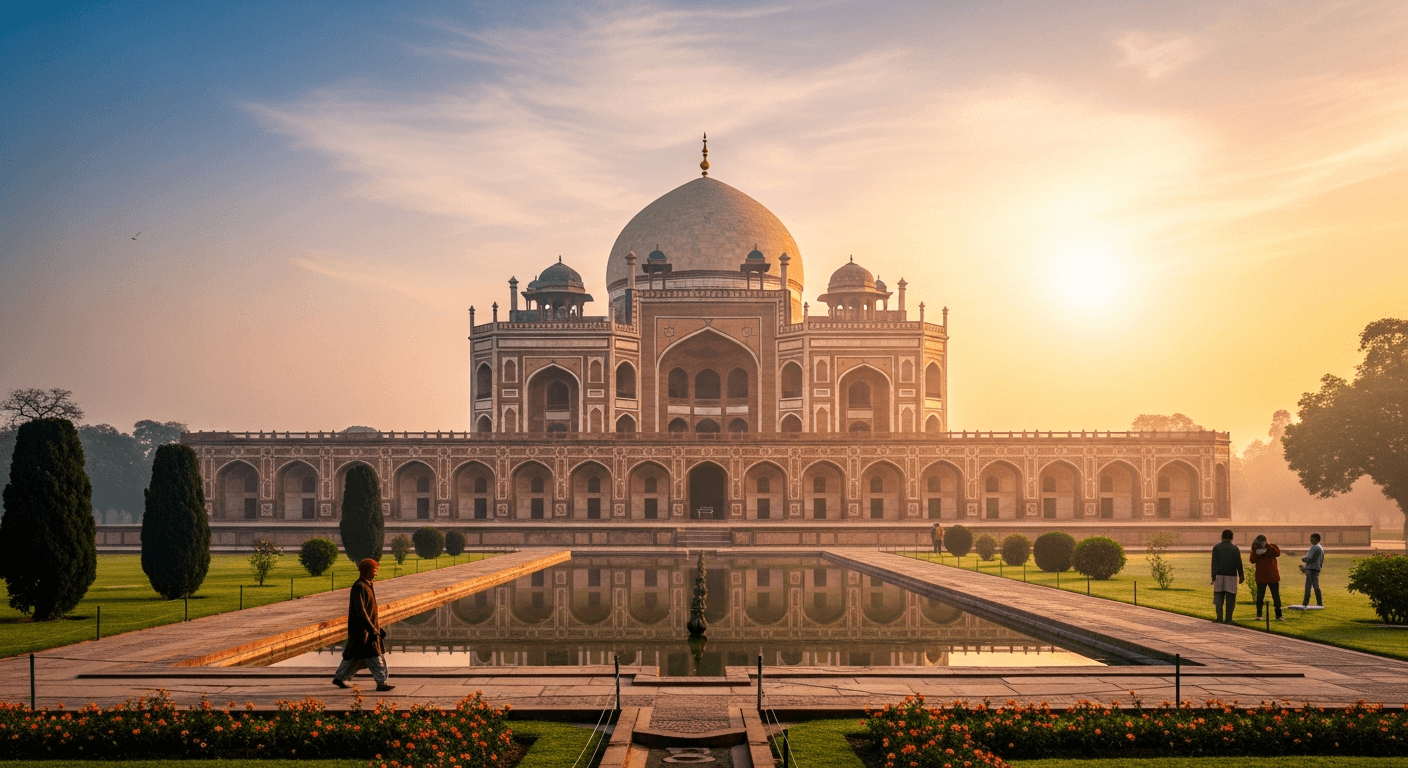
Humayun's Tomb is different. It's smaller, more intimate, and genuinely beautiful in a way that photographs don't convey. The proportions feel right—not overwhelming, not diminished. The red sandstone catches light differently depending on the hour. Visiting in late afternoon, when tour buses have cleared out, reveals the garden's actual design: the char bagh (four-part garden) that Mughal architects returned to again and again. There's a specific kind of quiet that happens when you're alone in a beautiful historical space. It's not spiritual exactly. It's more like entering someone's unfinished thought.
Jama Masjid is India's largest mosque, and it's functional. People actually pray here, not visit it. That distinction matters. The courtyard holds 25,000 people during major prayers, and there's something direct about a space that serves its original purpose rather than existing as a historical artifact. If you visit (and you should), you'll need to remove your shoes, and you'll be surrounded by genuine activity rather than tourism infrastructure.
What the Experience Actually Feels Like
Delhi doesn't ease you in. The sensory information arrives all at once: diesel exhaust, food smoke from street carts, human density, noise that seems to come from everywhere. The heat, if you visit in summer, is the kind that changes how your body works—sweat doesn't cool you, it just happens.
Old Delhi's Chandni Chowk is the literal and psychological center. It's a market that sprawls through narrow lanes where you can buy anything: spices, wedding jewelry, electronic components, silver leaf to decorate sweets, books, clothes, tools, religious objects. It's chaotic in a way that seems to have no organizing principle, except it clearly works. Millions of people navigate it daily. If you want to experience Delhi without romanticizing it, spend two hours here on a weekday morning.
The Jallianwala Bagh is a museum of a massacre—literally. It's the courtyard where, in 1919, British troops fired on unarmed Indian protesters. The well where people jumped to escape bullets is still there. It's not easy history, and the space doesn't soften the facts. This is important precisely because it doesn't feel like a "heritage site."
New Delhi's India Gate is exactly what you expect: a war memorial, tree-lined lawns, photographers, families on weekends. It's not the city's emotional center, but it's where Delhi's urban design becomes visible. The broad avenues, the British-colonial town planning, the way specific monuments were positioned to create sightlines—it all makes sense from here.
For something most tourists miss: Safdarjung's Tomb. It's less than Humayun's (different emperor, different era), but it's maintained less aggressively, with fewer crowds. The gardens are actually used by people exercising, walking, sitting. It exists as both monument and neighborhood space, which is a different kind of authenticity than the major sites.
Planning Your Visit (The Practical Reality)
Best time: October through March. The heat is gone, the air is occasionally clear, and Delhi doesn't feel like it's trying to kill you. April through September is genuinely difficult unless you're heat-adapted. Humidity, air quality, and temperature all peak.
Duration: Three to four days is sufficient for major sites and neighborhoods. Two days means Red Fort, Humayun's Tomb, and Jama Masjid, then you're moving on. Five days lets you explore neighborhoods without feeling rushed.
Getting around: The Metro is efficient, clean, and cheap (₹10-40 per journey). Use it for long distances. For shorter moves and exploration, autos work, but negotiate fares beforehand or use apps (Uber, Ola). Taxis are reliable if you don't mind the cost.
Crowds: Arriving early (7-8 AM) genuinely changes the experience. Sites are quieter, light is better, and the city feels different. By 11 AM, tour groups consolidate at major monuments.
Preparation: Get used to chaos. Your expectations should be recalibrated. Crowds won't stay in lines. Vendors will approach you. The pollution some days is visible in the air itself. These are Delhi's characteristics, not failures of management.
Nearby Places Worth Time
Agra (206 km / 4 hours by train): The Taj Mahal exists. It's beautiful and tragic and massive. The train journey (there are good options) is pleasant enough. Most people do this as an overnight trip, though I'd recommend staying 1-2 days to see it at different times and visit Agra Fort, which is less visited and architecturally significant.
Mathura and Vrindavan (180 km / 4 hours): Sacred sites for Krishna devotion, these cities are chaotic in ways that even Delhi finds extreme. The temples are extraordinary if you're interested in how faith operates at scale. Not recommended as a casual detour.
Gurgaon and Noida: Planned satellite cities where you might need to stay (cheaper hotels, malls, modern infrastructure). They're adjacent to Delhi but entirely different in character—glass buildings, business parks, the India you see in corporate advertising.
Is Delhi Actually Worth Your Time?
Yes, but with clarification. If you're seeking beauty, comfort, or clarity, Delhi will frustrate you. If you're interested in how cities actually function—how millions of people maintain systems that make no logical sense but work anyway—then Delhi is essential.
The monuments matter, but they're not what makes Delhi valuable. The value is in noticing. A conversation with someone selling tea. The engineering of an ancient water system. How a market 400 years old survives modernization. The particular way evening light hits the Red Fort's walls. These observations require patience and time.
Delhi isn't beautiful in a postcard sense. It's interesting, which is rarer and more valuable.
Quick Facts
- Population: ~16 million (Guinness Book estimates higher)
- When founded: Established as Indraprastha in ancient texts; Mughal Delhi dates from 1638
- Language: Hindi, English, Punjabi, Urdu
- Currency: Indian Rupee (₹)
- Visa: India electronic visa available for most nationalities
- Best sites to book: India Gate (free), Red Fort (₹250 foreigner entry), Humayun's Tomb (₹250), Jama Masjid (free, modest dress required)
Delhi rewards the curious and punishes the impatient. Spend time here, move slowly through its contradictions, and you'll understand something about India that no book captures. Visit the major sites, yes—they're worth understanding. But spend equal time in neighborhoods, markets, and spaces without plaques. That's where Delhi actually lives.
For route planning and to see travel videos of Delhi's neighborhoods, streets, and monuments in context, check out Touratu's interactive map. You can explore different paths through the city, see what works for your travel style, and watch real-time experiences from other travelers who've navigated Delhi thoughtfully.
Loading activities…
