
Argentina Travel Guide: Regions, Routes & Real Experiences
Argentina Travel Guide: Beyond the Buenos Aires Tourist Loop
You step off a night bus somewhere outside Mendoza, and the first thing that hits you is the quiet. Not silence—quiet. The kind where you can hear the wind moving through grapevines planted decades before you were born. An older man in a worn cap watches you from his vineyard fence with the expression of someone who's seen ten thousand tourists come and go, and he's not particularly bothered by this one either.
Argentina doesn't announce itself. It doesn't need to.
Most travel writing about Argentina treats it as a single destination where you spend three days in Buenos Aires, take a tango show selfie, eat a steak, and declare the job done. That's like visiting France and only seeing the gift shops around the Eiffel Tower. Argentina sprawls across roughly 1.3 million square miles. It's a country of profound contradictions—where ultramodern architecture sits beside crumbling colonial buildings, where the driest landscape in South America meets some of the wettest regions, where you can find yourself completely alone in a landscape that seems to stretch forever.
This guide doesn't try to compress Argentina into something digestible. Instead, it's built on a simple premise: Argentina rewards curiosity, patience, and the willingness to move slowly through regions that don't exist in guidebooks.
What Actually Makes Argentina Memorable
People rarely come back from Argentina talking about the tango. They come back talking about specific moments: the rancher who made coffee on a wood stove while explaining the difference between his cows. The afternoon light hitting the Andes. A conversation with a stranger in a Buenos Aires bookstore that lasted three hours. The taste of a 2009 Malbec that cost $8 and tasted like someone had understood wine and then explained it to the earth itself.
Argentina's genuine appeal lies in its unguarded moments. The country has a long tradition of European immigration—Italian, Spanish, German, Swiss—which created a cultural hodgepodge that never quite settled. That restlessness became part of the Argentine character. Porteños (people from Buenos Aires) are famously introspective, argumentative, passionate about ideas. The wine culture isn't performance—it's rooted in actual knowledge and genuine debate about terroir. The food culture isn't about luxury; it's about doing simple things perfectly.
The landscape matters too. Argentina contains the Atacama-adjacent Northwest, the wine valleys, the Pampas, Patagonia, the Atlantic coast, and subtropical zones near Brazil. You can wake up in a place where mountains pierce clouds and go to sleep in a forest where 40% of species exist nowhere else on Earth.
But here's what matters most: Argentina doesn't require you to be dazzled. It asks you to pay attention.
What to Expect When You Actually Travel Here
Buenos Aires (Not Optional)
You should spend time here, but not in the way tourist itineraries suggest. Don't do the "tango tour" unless you're genuinely interested in dance history. Instead: get coffee at a neighborhood café in San Telmo or Palermo Soho. Walk through MALBA (the Latin American art museum), which is legitimately excellent. Spend an afternoon in the Biblioteca Nacional, a brutalist masterpiece designed by Clorindo Testa. Read in the Parque Centenario. Eat at restaurants where locals actually eat (ask your host, not your phone).
The neighborhoods have distinct personalities. San Telmo is where you feel the city's history. La Boca is where tourists go (and yes, it's touristy, but the colors are real). Palermo splits between the design-conscious and the bohemian. Recoleta is wealthy and formal. San Isidro is where you understand the Spanish colonial bones.
Budget 4-5 days minimum. The city requires time to reveal itself.
Mendoza and the Wine Region
The drive from Buenos Aires takes a night bus (12 hours), or a short flight if you'd rather arrive awake. Mendoza sits in a high desert valley where mountains loom at the edge of every perspective. The vineyards exist in rows that go on until perspective swallows them.
Unlike Napa Valley's boutique-fication, Mendoza's wine culture remains rooted in agriculture. You visit a bodega and meet the winemaker, not a hospitality coordinator. The tasting notes come from genuine knowledge, not marketing copy. The wines are primarily Malbec and Cabernet Sauvignon, and they're often exceptional value.
The city itself is functional, rebuilt after a devastating 1861 earthquake. It won't enchant you architecturally, but the central park is pleasant, and the surrounding towns (Maipú, Luján de Cuyo) offer quieter versions of wine culture.
Northwestern Argentina (Salta, Jujuy, Catamarca)
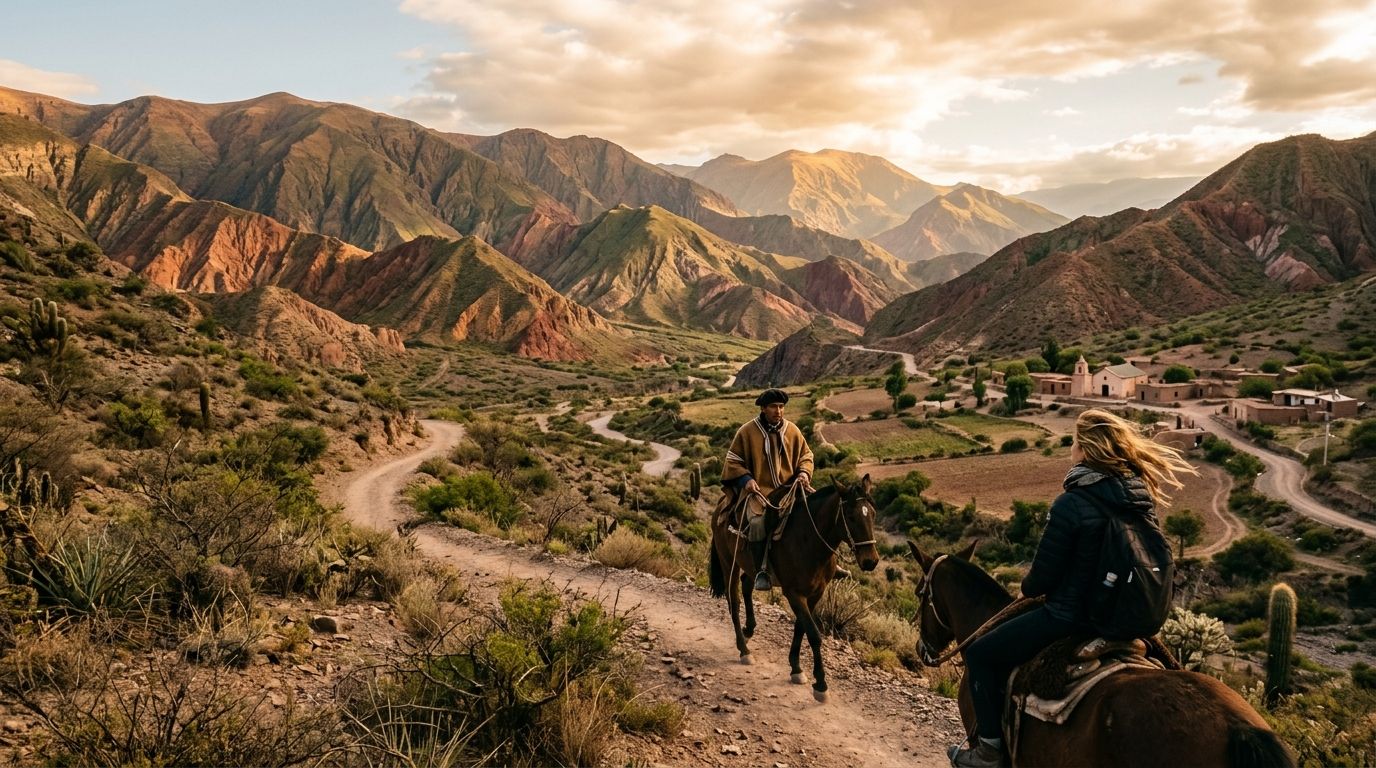
Here's where most tourists don't venture, and that's precisely why it matters. This region feels different from the rest of Argentina—landscape, architecture, and culture lean toward the Andean. The mountains are impossibly colorful (Serranías del Hornocal, the "14-Colors Mountain," actually delivers on its name). Colonial towns have genuine Spanish architecture, not theme park versions.
Salta city sits in a valley surrounded by mountains. The colonial center remains intact. The local food culture centers on empanadas, locro (a slow-cooked stew), and provoleta (grilled cheese). The people are warmer than porteños—less intellectual sparring, more genuine hospitality.
Spend time in Purmamarca to see the Serranías. Drive through the Puna—the high desert—to understand what emptiness actually means. Visit Tilcara, a smaller colonial town that doesn't perform for tourists.
Patagonia (Bariloche, El Chaltén, El Calafate)
Southern Argentina is where landscapes start making you quiet. Bariloche sits beside Nahuel Huapi Lake with the Andes rising dramatically. It's developed, touristy, but the mountains are serious. This is hiking country, lake country, chocolate-and-beer country.
El Chaltén is smaller, younger, more bohemian. It's become popular with climbers and trekkers—the Fitz Roy trail is famous enough to appear on travel blogs, which means it's crowded. But it's crowded for legitimate reasons. The landscape is genuinely dramatic.
El Calafate exists primarily because of Perito Moreno Glacier, a 50-meter wall of ice calving into a glacial lake. Yes, it's touristy. Yes, it's worth seeing. It's one of the few places where you comprehend scale viscerally.
The Atlantic Coast (Mar del Plata, Necochea)
Most travelers skip this, which means you'll have the beach nearly to yourself. Mar del Plata is a functional beach town—not glamorous, not pretentious, just real. The seafood is excellent because it comes from boats you can see from restaurants. Necochea, further south, is even quieter.
Planning Your Visit: The Practical Framework
Best Time to Visit
Argentina exists in the Southern Hemisphere, so seasons are flipped. Summer (December-February) is warm everywhere. Buenos Aires gets hot and humid. Patagonia is pleasant and crowded. Winter (June-August) brings cold and occasional snow in Patagonia, but Buenos Aires is just cool—perfect for walking.
April-May (autumn) and September-October (spring) offer ideal conditions: pleasant weather, fewer tourists, still accessible everywhere.
Duration
You need minimum 10-12 days to experience Argentina genuinely. A week works only if you choose one region (like Mendoza + Buenos Aires, or Patagonia + Buenos Aires). Three weeks lets you move slowly and actually absorb the country's regional variations.
Getting Around
Domestic flights are affordable. Buenos Aires to Mendoza ($40-80), Buenos Aires to Salta ($50-100), between Patagonian destinations ($50-150). Long-distance buses are genuinely good—sleeper buses between Buenos Aires and the Northwest aren't luxury, but they're comfortable and cost less than flights.
Rental cars work well in wine regions and Patagonia. In Buenos Aires, use taxis or the subway—driving is chaotic.
Crowds and Peak Season
The worst time is January and December (summer holidays when Argentines travel). March-May is ideal: warm enough, not crowded, not rainy. October-November is very good: spring weather, wildflowers in some areas, still not packed.
Nearby Regions Worth Your Time
Chile (the Atacama, the Lake District)
Four hours west of Mendoza, the high Andes separate Argentina from Chile. The Atacama Desert is technically in Chile, but you often visit from Argentina. The Lake District (around Puerto Varas) mirrors Patagonia but with different energy.
Uruguay (Montevideo, Colonia)
A ferry or flight from Buenos Aires. Colonia is a beautifully preserved Spanish colonial town. Montevideo is smaller, less intense than Buenos Aires, but with genuine cultural life.
Brazil (Misiones Province)
Northwestern Argentina borders Brazil. Iguazu Falls is technically split between Argentina and Brazil—seeing it from both sides takes two days but fundamentally changes how you understand the landscape.
Is It Worth Visiting? The Honest Answer
Yes, but not for the reasons marketing copy suggests. Argentina isn't about Instagram moments. It's about understanding a country that takes culture—wine, food, literature, philosophy—seriously without being pretentious. It's about landscapes that don't perform; they just exist at massive scale.
You should visit Argentina if you want to slow down, have conversations that go somewhere, drink wine while understanding something about where it comes from. You should visit if you're interested in Spanish colonial architecture, high-altitude hiking, or urban energy that feels genuinely Latin American.
You shouldn't visit if you're collecting countries or need constant novelty. Argentina rewards attention and patience.
Quick Facts
- Language: Spanish (Argentine Spanish sounds different—distinctive accent, Italian influences, local slang)
- Currency: Argentine Peso (exchange rates fluctuate; check current rates)
- Visa: Most nationalities get 90 days visa-free
- Vaccinations: Yellow fever recommended for northwestern regions and Misiones Province; check current requirements
- Food: Exceptional beef, wine, dulce de leche, empanadas, medialunas (croissants), alfajores (dulce de leche cookies)
- Cost: Moderate—cheaper than most of Western Europe, more expensive than Central America
- Safety: Generally safe in major cities and tourist regions; use standard urban caution
Planning Your Argentina Journey
The approach here matters. Argentina doesn't benefit from aggressive sightseeing. It rewards wandering, sitting in parks, talking with locals, staying longer in fewer places.
The interactive map on Touratu shows regional routes, lets you explore distances between destinations, and reveals how regions connect. The travel videos show what specific regions actually look like—not through a tourism filter, but through the perspective of someone moving through the landscape. You can explore the Mendoza wine route, trace the Ruta 9 through the Northwest, or understand how to approach Patagonia without feeling like you're following a checklist.
Argentina will surprise you, but only if you give it permission to move at its own pace.
Loading activities…
